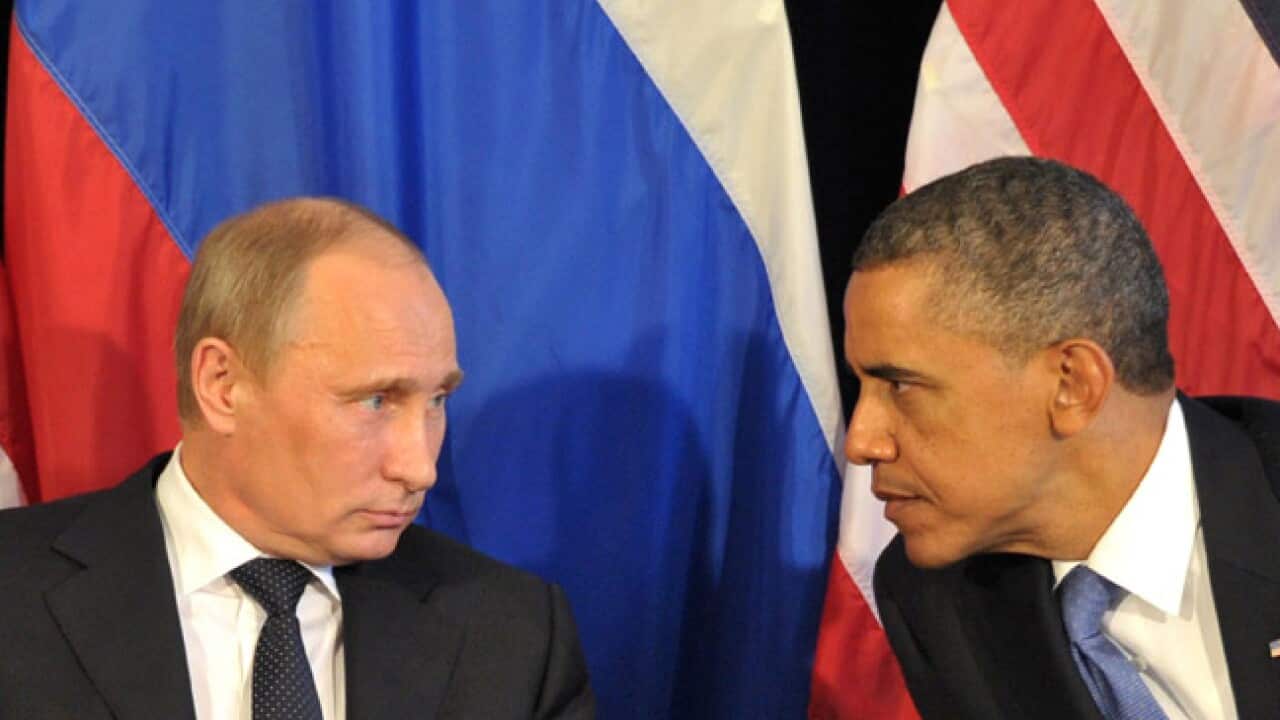
Russia is "disappointed" by the decision of US President Barack Obama to cancel a planned visit to Moscow in early September for a bilateral summit with Russian President Vladimir Putin, the Kremlin says.
US President Barack Obama has scrapped a Moscow summit with Russia's Vladimir Putin, with the White House citing a lack of progress in relations and 'disappointment' over the Edward Snowden affair.
The rare decision to cancel the talks set for next month came after Obama accused the Russians of slipping back "into a Cold War mentality," in an interview aired late on Tuesday.
Washington however did not slam the door on cooperation with Russia, noting that a meeting of foreign and defence ministers scheduled for later this week would go ahead as planned in the US capital.
In Moscow, the Kremlin said it was "disappointed" with the decision, saying Washington was not ready to build ties with Russia on an "equal basis," and insisted the invitation to Obama still stands.
News that makes sense
Your trusted source for staying up-to-date with the world around you. Get free daily news updates and analysis, straight to your inbox.
WATCH: Relations sour between US and Russia
White House spokesman Jay Carney said that while the United States valued what had been accomplished with Russia in Obama's first term, especially on Afghanistan and North Korea, there had not been enough progress to warrant a summit in early September.
"Given our lack of progress on issues such as missile defence and arms control, trade and commercial relations, global security issues, and human rights and civil society in the last twelve months, we have informed the Russian government that we believe it would be more constructive to postpone the summit until we have more results from our shared agenda," Carney said.
"Russia's disappointing decision to grant Edward Snowden temporary asylum was also a factor that we considered in assessing the current state of our bilateral relationship,' he said.
The White House had for weeks hinted that the summit on the sidelines of a Group of 20 summit in Saint Petersburg was in doubt, as ties with Russia deteriorated.
Moscow last week granted a year's temporary asylum to Snowden, a former US intelligence contractor who revealed the existence of US electronic surveillance programs that scoop phone and internet data on a global scale.
Snowden - who is facing espionage charges in the United States and whose passport has been revoked - was last week allowed to relocate to a secret safe house after being marooned in Moscow's airport for five weeks.
Other troublesome issues in the US-Russia relationship include Moscow's support for Syrian President Bashar al-Assad and a split over how to deal with Iran over its nuclear program.
The White House said Obama still planned to attend the G20 summit on September 5-6, and announced he would visit Stockholm before heading to Russia.
US Secretary of State John Kerry and Defense Secretary Chuck Hagel will still meet with their Russian counterparts in Washington on Friday "to discuss how we can best make progress moving forward on the full range of issues in our bilateral relationship," the White House said.
In Moscow, Putin's top foreign policy aide Yury Ushakov told reporters it was clear that the Snowden asylum decision had tipped the scales.
"This problem emphasises that the United States, as before, is not ready to build relations on an equal basis," Ushakov said, accusing the United States of thwarting the signing of a bilateral extradition agreement.
"We are ready to work further with the American partners on all key questions on the bilateral and multilateral agenda," he added.







