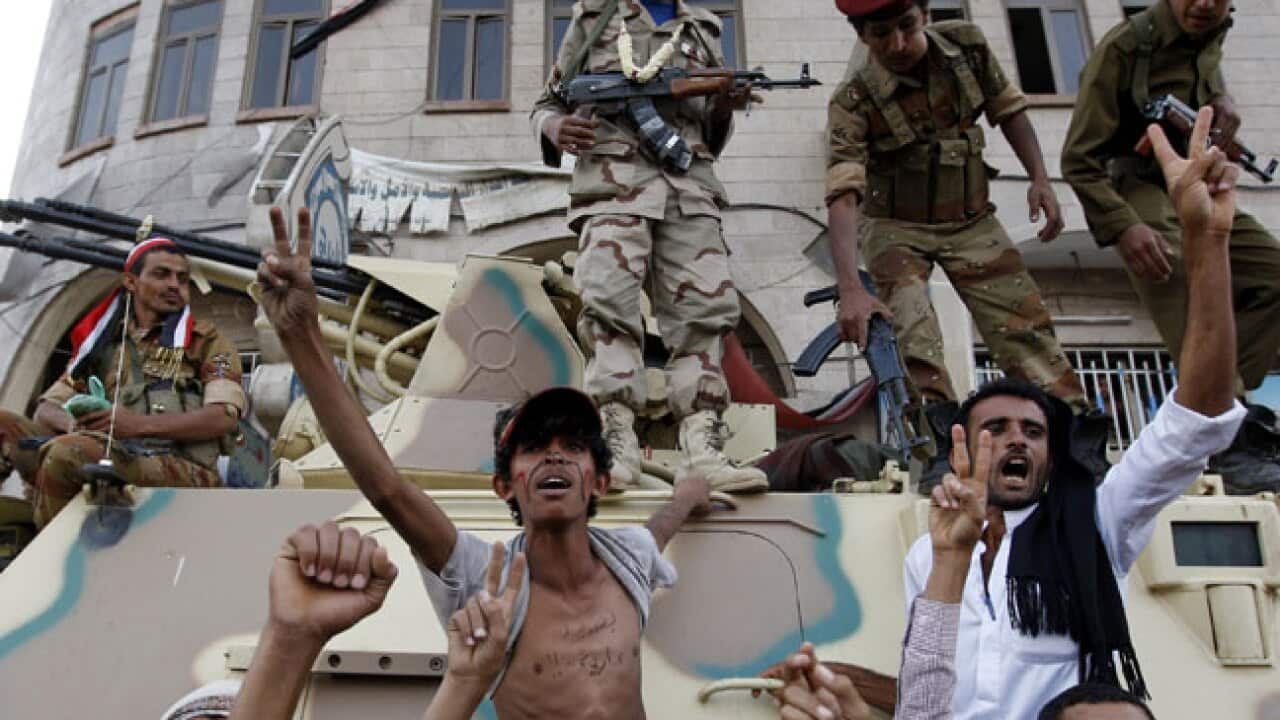
Yemeni protesters pushed for an interim presidential council to prevent president Saleh from returning to power as analysts suggest Saudi Arabia could be the key to solving the political turmoil in Yemen.
PROTESTERS DEMAND INTERIM COUNCIL
"The people want an interim council" chanted tens of thousands of protesters as they marched on the residence of Vice President Abdrabuh Mansur Hadi.
In a statement after the protest, the Revolution Youth group demanded "an immediate declaration of a one-year transitional period... and the formation of an interim presidential council made of civilians known for their integrity and competence."
News that makes sense
Your trusted source for staying up-to-date with the world around you. Get free daily news updates and analysis, straight to your inbox.
The group leading protests at the University Square in Sanaa, now dubbed "Change Square," also demanded banning figures of the "former regime" from joining the council, and not allowing members of the proposed council to run in later presidential elections.
SAUDIS 'KEY TO A YEMEN SOLUTION'
Powerful Saudi Arabia where wounded President Saleh is recuperating could be the key to solving the political turmoil in Yemen by pressing the veteran leader to transfer power or at least by impeding his return, analysts say.
A much weakened Saleh still clings to power from his sickbed, oblivious to four-months-old protests, growing international pressure and Friday's attack that could have killed him and other top figures in his embattled regime.
Saleh's presence in Riyadh "might provide an opportunity for the kingdom" to revive its efforts towards a political settlement in neighbouring Yemen, whose stability is "a strategic interest to Riyadh," said Ibrahim Sharqieh, deputy director of the Brookings Doha Centre.
"Saleh's position weakens with every day that passes, diminishing his chances of returning to Sanaa," said Sharqieh who sees stability in the Arabian Peninsula state as "a national security issue."
"I think Saudi Arabia is strongly discouraging his return to Yemen," said Da Lage, who believes that the oil-rich kingdom "is the main actor in Yemen."
He believes the Saudis "can use the weapon which they best know -- money."
But Saudi Arabia, a key player in the Middle East, also maintains strong ties with Yemen's powerful opposition Al-Ahmar tribe which has fought deadly battles with troops loyal to Saleh in which 140 people were killed since May 23.
On Monday, the GCC members said that their proposed exit deal for Saleh remained the "most suitable solution."
Abdulaziz Sager, chairman of the Gulf Research Centre, said he expects the Saudis to "ask Saleh to sign the GCC plan during his stay in Riyadh."
Such a signing, that would be seen as a way out for the embattled Saleh, "might take place during the next GCC meeting in Riyadh."
CHAOS PLANNED IN TAEZ
Meanwhile, gunmen backed by the opposition and local tribes have deployed in large parts of Yemen's second-largest city Taez to protect installations and neighbourhoods after security forces vanished two days ago, residents said.
Vigilante committees were formed following information that some 500 pro-regime thugs planned to cause chaos in Taez, which is leading the opposition movement against Saleh, they said.
"I consider Taez to have fallen under the control" of the dissidents, Sheikh Hammoud Saeed al-Mikhlafi, head of the tribal council in Taez, told AFP by telephone.
He said gunmen have been deployed to "protect the peaceful (anti-regime) demonstrators" after they faced "genocide" by pro-Saleh security forces.
More than 50 demonstrators were killed on May 30 after security forces cracked down on a sit-in in Freedom Square in central Taez, according to the UN human rights office.
At least 200 protesters have been killed nationwide in more than four months of deadly protests.
Loyal security forces had withdrawn to pockets within Taez, including the bases of Central Security and the Republican Guard, the local presidential palace and Al-Thawra hospital, an AFP journalist reported.
The interior ministry denied on state television the claim that dissident gunmen have taken control of Taez.
AL QAEDA 'CONTROLLING ZINJIBAR'
Residents reported sporadic fighting outside Zinjibar on Tuesday, saying the army had not yet managed to enter the city.
Suspected Al-Qaeda militants have controlled much of Zinjibar, capital of Abyan province, since taking it on May 29. Only the military base inside the city, home to the 25th mechanised brigade, remains in government hands.
The two sides blasted each other with machine guns, artillery rounds and mortar shells, military sources said, adding that the army would continue fighting the jihadists until the city is freed from their grip.
Security officials insist the militants holding the city are Al-Qaeda fighters, but the political opposition accuses Saleh's government of inventing a jihadist threat in a bid to head off Western pressure on his 33-year rule.
Washington has urged Saleh, its declared ally in the "war on terror," to step down immediately.
Washington supports a deal, brokered by the regional Gulf Cooperation Council, that would see Saleh cede power to an interim administration within 30 days, in exchange for immunity from prosecution.
Britain on Tuesday called for an immediate political transition in Yemen.
"We urge the vice president to work closely with all sides to implement the Gulf Cooperation Council agreement and to begin political transition now," Foreign Secretary William Hague told lawmakers in the British parliament.
Saleh, a wily operator who since 1978 has bought off tribal loyalties and stitched them together into a governable framework, has refused to sign the accord and warned that his ouster would only serve to boost Al-Qaeda.
Yemen is the home of Al-Qaeda in the Arabian Peninsula, an affiliate of the slain Osama bin Laden's militant network. The group is blamed for anti-US plots including trying to blow up a US-bound airplane on Christmas Day in 2009.







