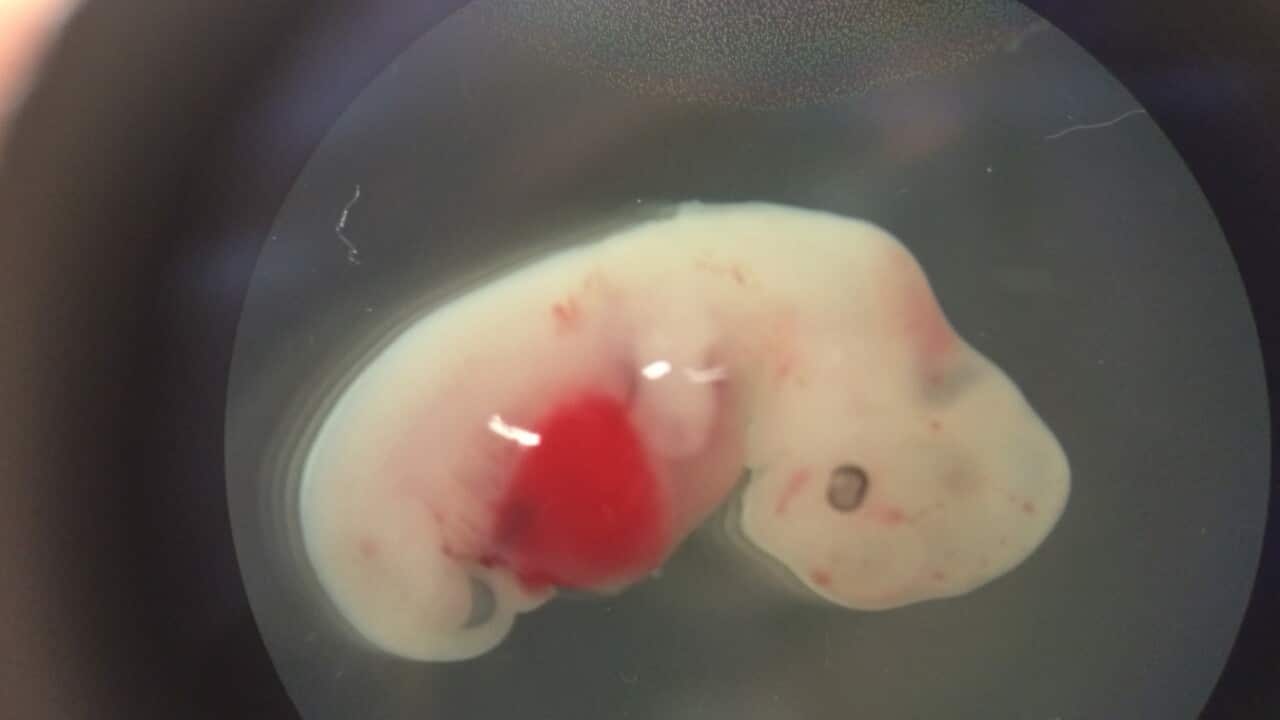
However, the research remains at a very early stage and proved more difficult than expected, the researchers reported in the peer-reviewed journal Cell.
"This is an important first step," said lead investigator Juan Carlos Izpisua Belmonte, a professor in the Salk Institute of Biological Studies' Gene Expression Laboratory.
"The ultimate goal is to grow functional and transplantable tissue or organs, but we are far away from that."
Scientists implanted adult human stem cells -- known as intermediate induced pluripotent stem cells -- into pig embryos and allowed them to grow for four weeks.
They terminated the embryos before any human-animal mixture, known as a chimera after the cross-species figures of Greek mythology, could be born.
News that makes sense
Your trusted source for staying up-to-date with the world around you. Get free daily news updates and analysis, straight to your inbox.
They found that the human cells began to form into muscle tissue in the pig embryos.
The effort involved some 1,500 pig embryos and took four years, far longer than intially estimated, due to the complicated nature of the experiments.
The notion of creating human-animal mixtures has stoked controversy and raised ethical questions, particularly since the experiments could theoretically lead to the creation of animals with human qualities, and possibly intelligence.
But Salk Institute staff scientist Jun Wu said the level of human contribution to the pig embryos was "low," and did not include precursors to brain cells.
Previous research has produced combinations of rats and mice, which are far more closely related.
Bruce Whitelaw, professor of animal biotechnology at the University of Edinburgh who was not involved in the study, described it as "exciting" because it "paves the way for significant advances."
According to Darren Griffin, professor of genetics at the University of Kent, the "work will also help us better understand evolution, development and disease" and may eventually lead to a remedy for organ shortages.
"In this study, the authors followed existing legal and ethical guidelines, allowing the embryos to develop to the maximum time allowed," he added.
"It is important that any further research is conducted with full transparency so as to allow public scrutiny and debate," Griffin said.







