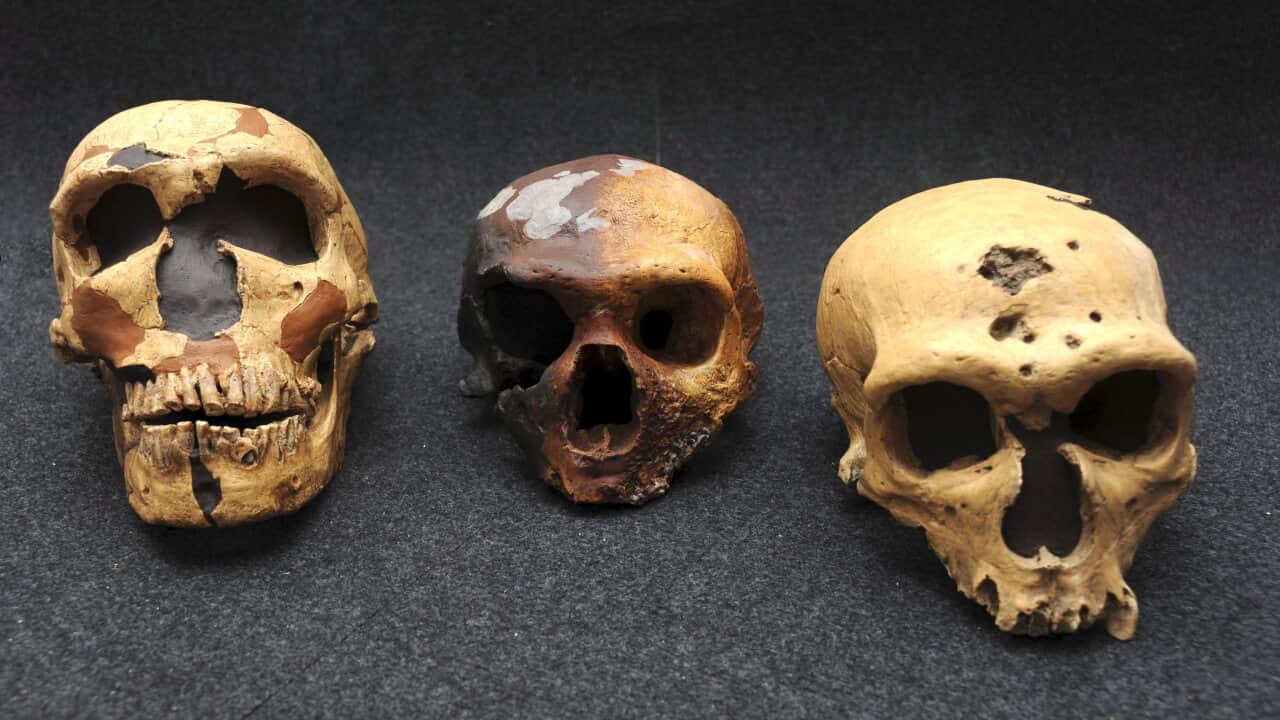
Anthropologists say they've decoded the oldest DNA ever found in the human family, extracted from a 400,000-year-old thigh bone found in a pit in Spain.
The feat expands knowledge of human genetics by some 300,000 years, they said, but also suggests the odyssey of Man's evolution may have been more convoluted than thought.
The bone was dug up at a presumed burial site dubbed the Sima de los Huesos ("Pit of Bones"), preserved by a deep subterranean chill in Spain's northern Sierra de Atapuerca highlands.
"Our results show that we can now study DNA from human ancestors that are hundreds of thousands of years old," said Svante Paabo, director at the Max Planck Institute for Evolutionary Anthropology in Leipzig, Germany, which took part in the study published in the journal Nature.
The previous oldest sequence of DNA from a hominin, a term meaning humans and their relatives, was that of a girl who lived about 80,000 years ago and belonged to an enigmatic Asian group called the Denisovans.
News that makes sense
Your trusted source for staying up-to-date with the world around you. Get free daily news updates and analysis, straight to your inbox.
The Sima de los Huesos is the world's largest concentration of hominin fossils from the Middle Pleistocene period some 700,000 to 100,000 years ago, so far yielding 28 skeletons.
The individuals found there had previously been described as members of the Homo heidelbergensis group thought to have been the forerunners of modern-day humans (Homo sapiens) and their cousins, the Neanderthals.
Paabo and the research team had expected their DNA analysis to reveal that the owners of the Spanish skeletons had shared an ancestor with Neanderthals.
But this was not the case.
The team sampled two grams of bone powder extracted from a femur, and sequenced the genome of mitochondrial DNA (mtDNA), which is passed down along the maternal line.
They then compared this code with that of modern humans, apes, Neanderthals and their sister group the Denisovans.
Study co-author Matthias Meyer said what they found was surprising - the Spanish hominins were more closely related to the geographically more distant Denisovans than to Neanderthals.
"The fact that the mtDNA of the Sima de los Huesos hominin shares a common ancestor with Denisovan rather than Neanderthal mtDNA is unexpected since its skeletal remains carry Neanderthal-derived features."
The findings throw up various possibilities.
One is that the Spanish individuals were related to a common ancestor of Neanderthals and their sister group, the Denisovans, said Meyer.
Alternatively, the group's unique features may have come from quite a different hominin group with Denisovan-like DNA.
Humans and Neanderthals are widely thought to have shared an ancestor more recently with each other than with Denisovans.







