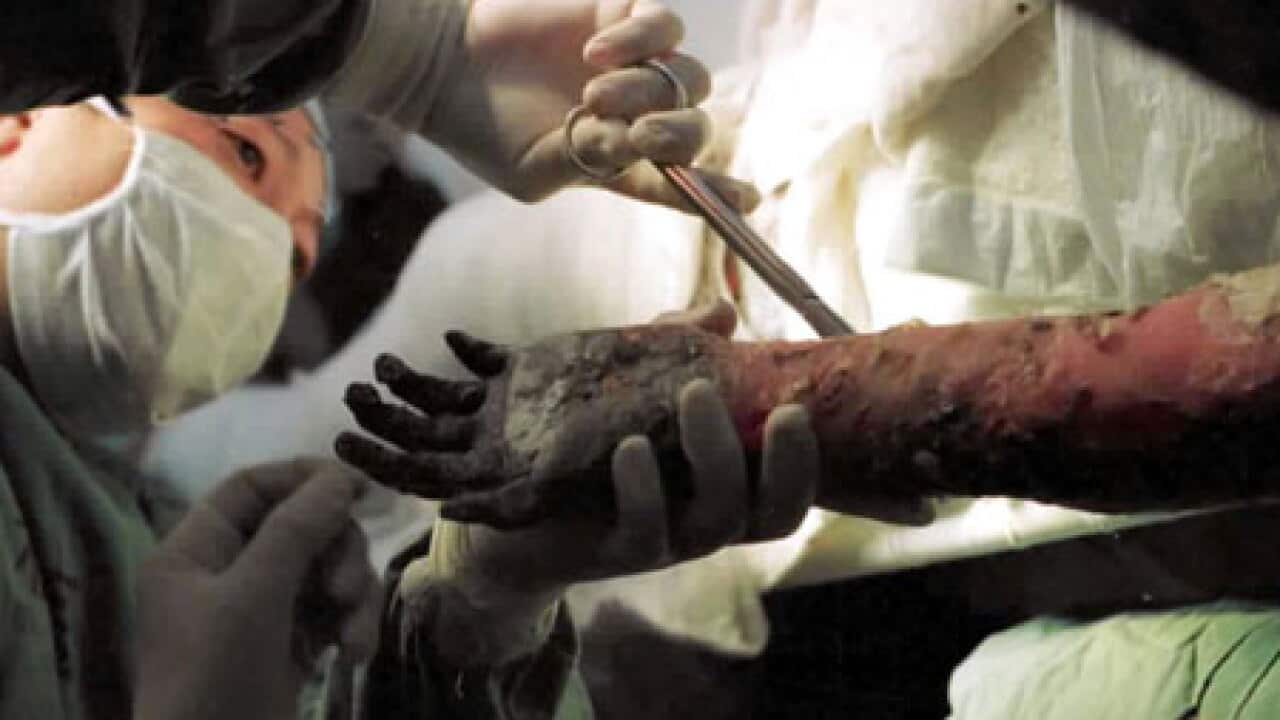
Australian scientists are developing a "living skin equivalent" that would revolutionise a burns victim's rehabilitation and dramatically improve their quality of life.
It would be up to 1.5 cm thick, says burns specialist Professor Peter Maitz, and a major advance on conventional methods, which can replace only the body's thinnest, outer layer of skin.
"Most skin grafting, including skin grown in the lab, is just the one mm surface," said Prof Maitz from the burns unit at Sydney's Concord Hospital.
News that makes sense
Your trusted source for staying up-to-date with the world around you. Get free daily news updates and analysis, straight to your inbox.
"That's where this new research comes in, it's a layer that's up to 1.5cm thick not one mm."
Prof Maitz and his research colleagues are working to create a synthetic "dermis", the skin's underpinning layer which carries nerves, blood vessels, sweat glands and hair follicles.
Researchers led by Dr Zhe Li have cultivated small amounts of the dermis-like synthetic skin, though not yet at the desired thickness, and trial grafts have been performed on animals.
The experimental skin is built from a synthetic material that mimics the structure of the dermis which is seeded with stem cells harvested from the patient's healthy skin.
If perfected, it would be a major advance on conventional synthetic grafts which, though usually life-saving, cannot restore many of the vital functions performed by the skin such as temperature control, perspiration and sensation of touch where the dermis is destroyed.
"In Australia, someone with a full-thickness burn to up to 80 per cent of their body surface area has every prospect of surviving the injury," Prof Maitz said.
"However, their quality of life remains questionable as we're unable, at present, to replace the burnt skin with normal skin.
"We're committed to ensuring the pain of survival is worth it, by developing a living skin equivalent."
Prof Maitz is deputy chair of the Sydney Burns Foundation, a new collaboration between the University of Sydney and Concord Hospital Burns Unit that will be officially launched today.
The foundation's aim is to support the ongoing research into the new synthetic skin, plus research and education in burns medicine and reconstructive surgery.







