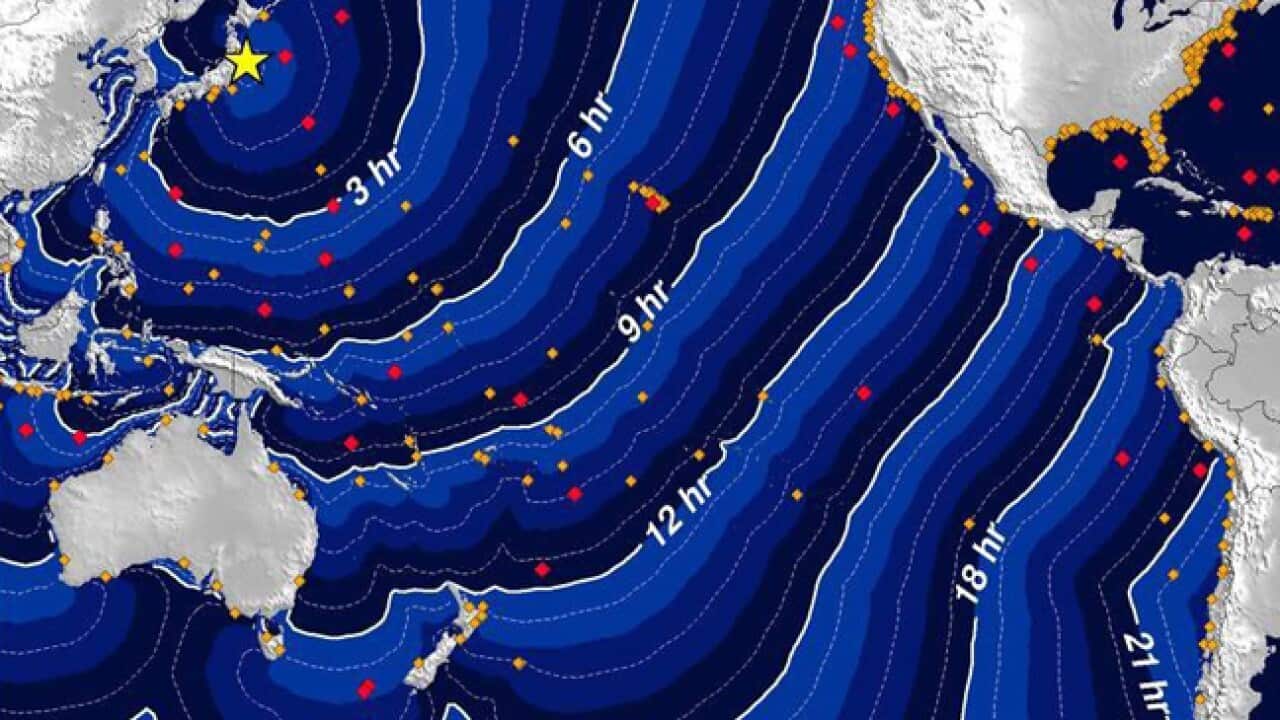
Friday's 8.9-magnitude temblor off the east coast of Japan ranks as one of the 10-largest earthquakes ever recorded.
Though scientists have just begun to pore over the data, they have already made some surprising discoveries about one of the most quake-prone regions on Earth.
Here's what experts have learned about the earthquake thus far.
Q: What caused it?
A: The earthquake occurred because a portion of the Pacific Plate is being pushed into and underneath the North American plate, forming a so-called subduction zone that built up so much pressure it ruptured, slipping as much as 20 metres.
News that makes sense
Your trusted source for staying up-to-date with the world around you. Get free daily news updates and analysis, straight to your inbox.
"This was a planetary monster," said Thomas Jordan, director of the Southern California Earthquake Center at USC.
The earthquake occurred along a patch of an undersea fault that's about 354km long and 95km wide.
Because the fault broke at a shallow depth, it shifted the sea floor, triggering tsunamis throughout the Pacific Ocean.
Q: Was it a surprise?
A: Yes and no. Seismologists said the quake was larger than they thought was possible in that part of the world.
"We thought about the Big One as an 8.5 or so," said Susan Hough, a seismologist at the US Geological Survey in Pasadena, California.
Such an earthquake would have been about one-third as strong as an 8.9 quake.
What tripped scientists up was a lack of recent activity in the area, Jordan said.
The last earthquake of this magnitude along this plate boundary occurred in the year 869.
Seismologists had been debating the fault's potential to break, but they had little data to go on.
"The question was whether that section had locked - accumulating strain - or was it slipping slowly," Jordan said.
"We now know that this is a plate boundary that was locked."
Q: You mean there were no hints at all?
A: Brian Atwater, a USGS seismologist based in Seattle, said that Japanese GPS data collected since the 1990s showed that the coast of Japan was being pulled inland at a rate of about 7 metres per century, another indication that the plates were stuck and energy was building between them.
"That's like money in the bank in terms of producing an earthquake," he said.
"The more time that passes, the more the bank account fills up. This fault had not been a big spender for a long time."
Q: There was a lot of seismic activity off Japan's coast last week, including a magnitude 7.2 quake on Wednesday. Should that have been a warning sign?
A: In hindsight, it's clear that there were foreshocks, experts said.
But if the smaller quakes had petered out, they would have looked like business as usual.
"It wasn't that big a deal for that part of the world," Hough said.
"There's always activity going on. But those are the kind of earthquakes that happen on a weekly basis. You can't go on high alert every time this happens."
"These were foreshocks," agreed USC's Jordan, "but we couldn't have known".
Q: Should we expect more earthquakes?
A: Aftershocks in the region have been ongoing, including 10 in the first hour alone.
Jordan and Hough said that these could be quite damaging and might even create another rupture along the complex system of plate boundaries that extend toward Tokyo.
It's not unusual to see far-flung increases in seismic activity after large earthquakes, Jordan said.
In part, that's because the Earth oscillates after a big quake much like when a musician hits a gong, and such vibrations can change the stresses on faults "in a small way".
But Hough said there's no reason to think that this earthquake will trigger a series of other catastrophic quakes around the world.
Sometimes it seems like big quakes come in clusters, but it's just a coincidence, she said: "It's not like there's some global supercluster getting out of hand."
Q: Will this change the way scientists look at earthquakes around the world?
A: It already has, by expanding the list of places where magnitude 9 "megaquakes" could happen, Hough said.
"We had a sense that these couldn't happen along any subduction zone - that it took a certain geometry, a bigger zone," she said.
"One lesson is that these are possible in more places than we thought."
Q: Does this change our understanding of earthquakes in Southern California and elsewhere on the US west coast?
A: Not really. The San Andreas fault is not a subduction fault. It's a strike-slip fault, where one plate moves sideways relative to the other, that is broken into two segments.
Hough said that a rupture over the length of the entire 1287km-long fault, which she believes would result in a magnitude 8.3 quake, is unlikely because there's a stretch in the middle where the fault is able to creep, releasing energy.
A full break of either section of the San Andreas would result in a quake of about a magnitude 8, she estimates.
The events in Japan don't alter those estimates.Comparisons to faults in the Pacific Northwest may be more apt.
There, as in Japan, the plate boundary is a subduction zone.
Q: This sounds a lot like the 9.3 earthquake that struck Sumatra in 2004, generating a tsunami that killed more than 230,000 people in 14 countries.
A: It's similar to that quake but significantly smaller.
The stretch of the plate boundary involved in the Sumatra quake was 1125km to 1450km long, Hough said.
Q: The 1995 Kobe quake in Japan killed more than 6000 people. Was it almost as big as this one?
A: Not even close. Its magnitude was 6.9 and its fault area was 100 times less than this quake's, Jordan said.
But it was deadly because it came so close to the city of Kobe.
"Earthquakes are like real estate," he said. What matters is "location, location, location".







