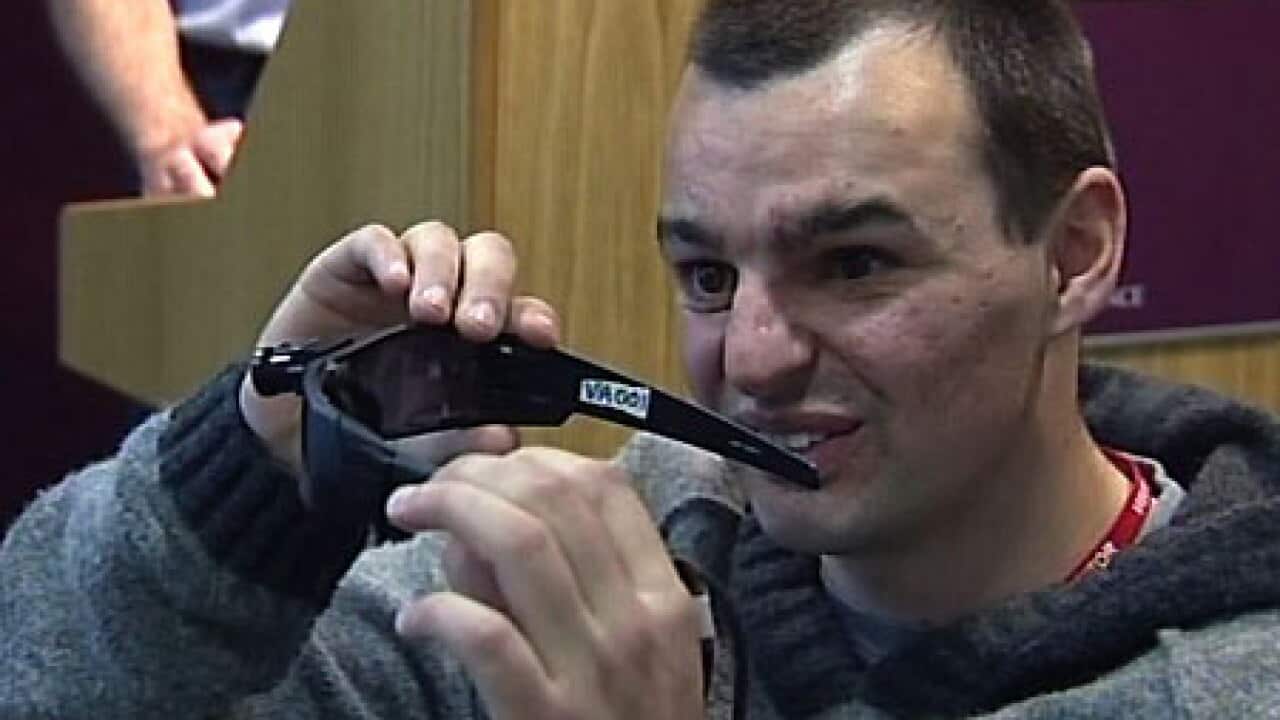
A British soldier blinded in a grenade attack has become the first person to try out a new pair of glasses that allow him to 'see' again - through his tongue.
Lance Corporal Craig Lundberg, 24, was serving in Iraq when he was hit by a rocket-propelled grenade, seriously wounding him. He recovered, but lost his sight.
Now he's been given a chance to see - using his tongue, rather than his eyes, thanks to a new technology, dubbed 'lingual vision'.
News that makes sense
Your trusted source for staying up-to-date with the world around you. Get free daily news updates and analysis, straight to your inbox.
The BrainPort glasses contain a camera which is connected by a wire to a device called the lollipop - a piece of plastic fitted with hundreds of electrodes.
'Like licking a battery'
The user puts the 'lollipop' into their mouth, and when the electrodes form shapes and images, he can 'read' these using his tongue.
"It's just like licking a battery," said Lance Corporal Lundberg. "It's that type of sensation - an electric-y, tingly type of current.
"This doesn't give me vision, as in sighted vision, it just gives me a sensation on my tongue, to help me identify objects."
BrainPort was developed by scientists in the US.
It works by substituting one sense for another - in this case replacing sight with touch.
When sighted people look at an object, their eyes send signals to the optic nerve, and on to the visual cortex in the brain, which interprets them.
'Huge hope' for future
This system does not work in blind and visually impaired people, and so the BrainPort retrains the way the mind processes information it cannot 'see'.
By stimulating the tongue with a series of tiny electrodes, the nerves send signals to the area of the brain dealing with touch, where they are interpreted instead.
The technology is expensive - the kit costs ₤10,000 (AU$16,400), but experts say it may revolutionise treatment for blind people.
"I think this provides huge hope," said Major General Gale Pollock.
"Because there's really been no advance for mobility of the vision impaired since we invented white canes and guide dogs.
"They've always been forced to be very dependent on others to get around."







