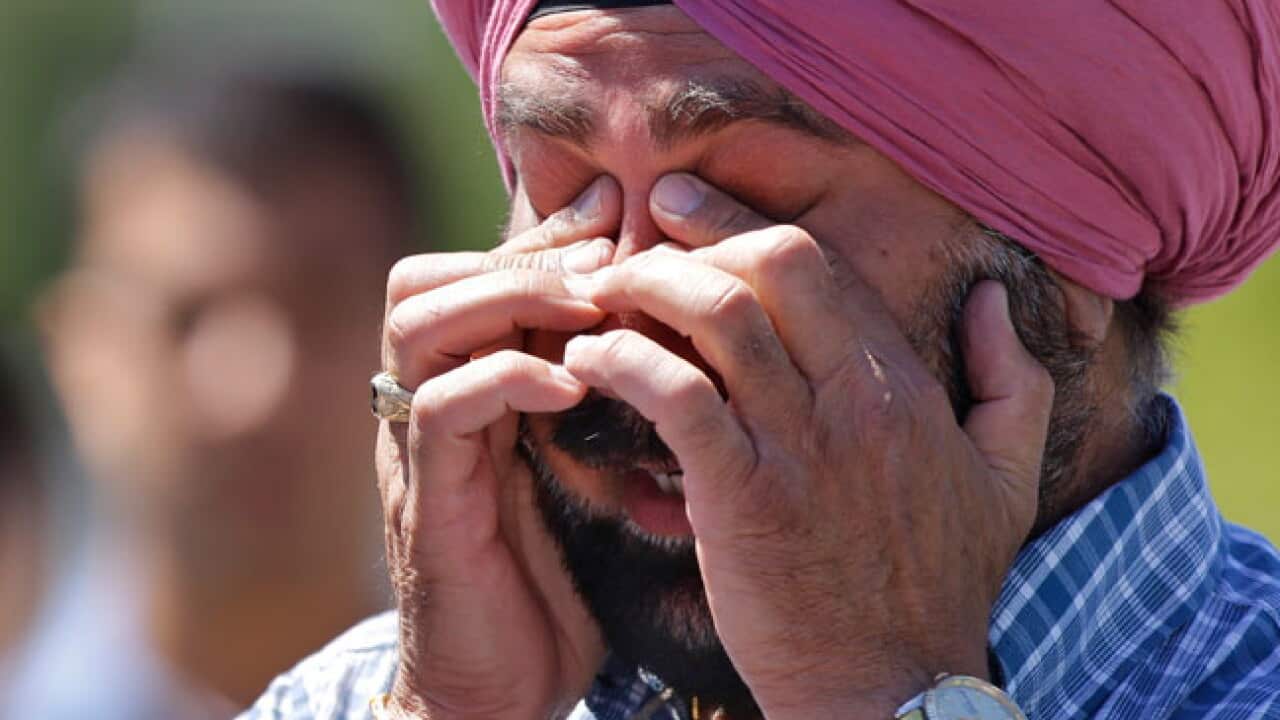
A massacre at a Sikh temple in Wisconsin, marks the grisliest attack yet against members of the faith in the United States, where they have faced persistent discrimination.
Police have not yet assigned a motive to the shooting spree in the Milwaukee suburb of Oak Creek, which left seven people dead, but many Sikhs have endured taunts or violence since the September 11, 2001 attacks.
The US Sikh community, estimated at around 500,000-700,000 strong, has encountered a confused form of hostility with assailants often incorrectly believing that Sikh men are radical Muslims because they wear turbans and keep beards.
News that makes sense
Your trusted source for staying up-to-date with the world around you. Get free daily news updates and analysis, straight to your inbox.
Kavneet Singh, managing director of the Sikh American Legal Defense and Education Fund, said the community could not recall an attack of similar proportions in recent memory.
"This is a true American tragedy for people to be targeted at their houses of worship in a country that was founded on religious freedom and the belief in civil and human rights," Singh told AFP.
Police said they were treating the shooting as "domestic terrorism" but did not give further details.
While Sikhs also have a history of internecine conflict, recent violence has almost entirely consisted of hate crimes.
In incidents this year, a Sikh family in the Virginia suburb of Washington received a letter threatening violence if they did not leave the United States, and in Michigan, the foundations of an under-construction Sikh temple, known as a gurudwara, were vandalized.
Last year, two elderly Sikhs were shot dead as they walked on a sidewalk in a suburb of California's capital Sacramento, where just months earlier a Sikh taxi driver was beaten up by assailants who were yelling slurs.
The Sikh faith, founded five centuries ago in India, requires men to wear turbans and beards and forbids them from cutting their hair.
While not all Sikh Americans have experienced violence, community members say they face regular stigmatisation, including bullying at schools and screenings of their turbans by airport security officers.
But Sikh Americans have also seen signs of growing acceptance. President Barack Obama has introduced celebrations at the White House of the birth anniversary of Guru Nanak, the religion's founder.
Obama voiced sorrow over the temple massacre, saying: "We are reminded how much our country has been enriched by Sikhs, who are a part of our broader American family."
Mitt Romney, who is challenging Obama in the November presidential election, also condemned the shooting, calling it "a tragedy that should never befall any house of worship."
The US military in recent years has begun to allow Sikhs to serve in uniform while keeping their articles of faith. Several other countries, including Britain, Canada and India, already allowed observant Sikhs in the armed forces.
In May, Washington became the first major US city to allow turbaned Sikhs to serve as police officers.
In 2010, voters in South Carolina elected as their governor Nikki Haley, who was raised Sikh. However, Haley identifies as Christian and a lawmaker derided her as a "raghead" during her election campaign.
Coincidentally, Sikh community members said they they faced little hostility in Wisconsin where the gurudwara has tried to reach out to neighbours.
A Sikh gas station magnate, Darshan Dhaliwal, has been prominent for years in the Milwaukee area and was a close friend and donor to long-serving former governor Tommy Thompson.
Singh, of the Sikh American Legal Defense and Education Fund, said that persistent violence was partly due to a lack of follow-up and media focus after previous incidents.
Balbir Singh Sodhi, who owned a gas station in Mesa, Arizona, was shot and killed on September 15, 2001 by an assailant who said he wanted to kill a Muslim out of patriotic sentiment.
The killing was widely condemned, but a decade later, an Arizona lawmaker attempted to remove Sodhi's name from a state September 11 memorial, saying that hate crimes after the attacks were a myth. Sodhi's brother was killed in a separate suspected hate crime.
"I think 9/11 proved to Sikhs that we need to be a little more proactive," Kavneet Singh said.







