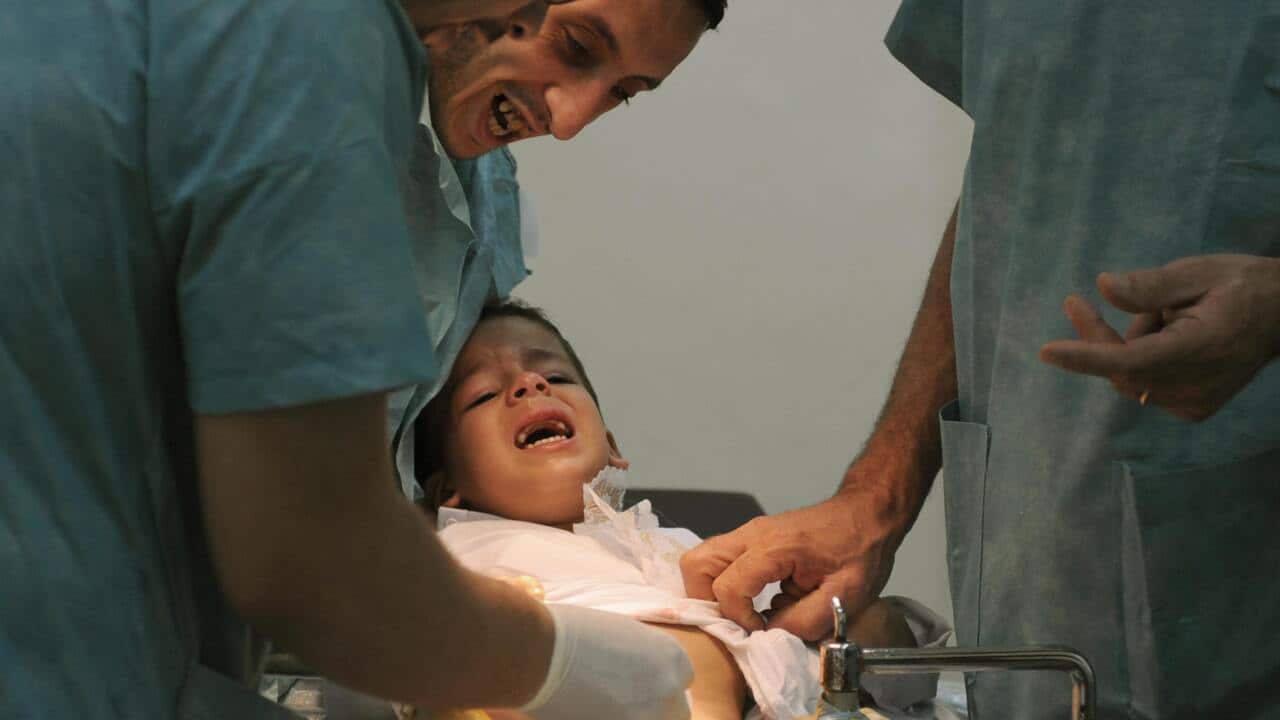
A report prepared in Tasmania recommending a ban on the circumcision of most baby boys continues to cause controversy more than 12 months after it was first published.
The Tasmanian Law Reform Institute issued a report questioning whether non-therapeutic male circumcision was lawful and called for a general ban on circumcision except for religious and ethnic reasons.
Now, a group of medical professionals in favour of circumcision has published a paper saying the Tasmanian report is seriously flawed.
The Tasmanian Law Reform Institute prepared its report at the request of the state's then Commissioner for Children, Paul Mason.
The Director of the Tasmanian Law Reform Institute is Kate Warner.
News that makes sense
Your trusted source for staying up-to-date with the world around you. Get free daily news updates and analysis, straight to your inbox.
"The Children's Commissioner asked us to look at this issue and I remember that it was because he'd been asked the question by some doctors at the Royal Hobart Hospital who were concerned that routine circumcision of male infants may have been illegal so he wanted clarification of the issue. So the Children's Commissioner referred it to us for that reason and also, I think, because he was opposed to the idea of routine male circumcision and he wanted us to do a project on it."
In fact, former Commissioner for Children Paul Mason is one of Australia's most outspoken opponents of male circumcision and once described it as tantamount to child sexual abuse.
Mr Mason has told Channel 9 it's a completely unnecessary procedure.
"There is zero evidence and there is not one single study in history that demonstrates that circumcising a baby has any affect on his future propensity for contracting or not contracting any disease, it just doesn't happen."
Kate Warner from the Tasmanian Law Reform Institute says the report found the law was unclear.
"We came to the conclusion that we should clarify the law and we thought that you should only be able to justify a circumcision on a male infant if there was some kind of medical reason for doing it, so some existing disease, so a therapeutic reason or perhaps if the parents wanted to do it for religious or ethnic reasons."
Professor Brian J Morris from the University of Sydney is a proponent of male circumcision and the co-author of paper that describes the Tasmanian report as unbalanced and not based on reasonable evidence.
Professor Morris says the report ignores a recommendation by the American Academy of Pediatrics which has found the medical benefits of male circumcision outweigh the risks.
Susan Blank chairs the Academy of Pediatrics in the US.
"The health benefits of male circumcision include a drop in the risk of urinary tract infection in the first year of life by up to 90 per cent, it drops the risk of heterosexual HIV acquisition by about 60 per cent , drops the risk of human papilloma virus and herpes virus, drops the risk of other infectious genital ulcers."
Professor Morris says he hopes the Tasmanian government looks at such recommendations if it decides to act on the report by the Tasmanian Law Reform Institute.
"Now we have the critique which will probably mean that if it is presented then the politicians will be able to appreciate the serious legal, ethical, public health, paediatric and other floors that make that report untenable and, in fact, it should be withdrawn by the Tasmanian Institute."
Professor Morris says getting boys circumcised has a whole range of benefits including providing some protection from sexually transmitted infections.
"Uncircumcised penis contains receptors on the very vulnerable inner mucosa, that's the inside of the foreskin and there is plenty of biological evidence as well as the epidemiology that supports that so it has the receptors on the inner lining of the foreskin, they've been shown through biological experiments to have receptors that take up HIV, lots of other mechanisms too, it's more prone to inflammation which weakens the lining and allows the virus in, it's more prone to tearing during sexual intercourse and then direct entry into the bloodstream."
At a national level, the Royal Australasian College of Physicians last reviewed the evidence in 2010 and came to the conclusion that routine circumcision wasn't necessary.
But it says it's reasonable for parents to be the ones to make the decision either way.
Professor Morris says more Australian boys would be having the procedure if it was made available in public hospitals.
He says between 10 and 20 per cent of male infants currently undergo the procedure each year.