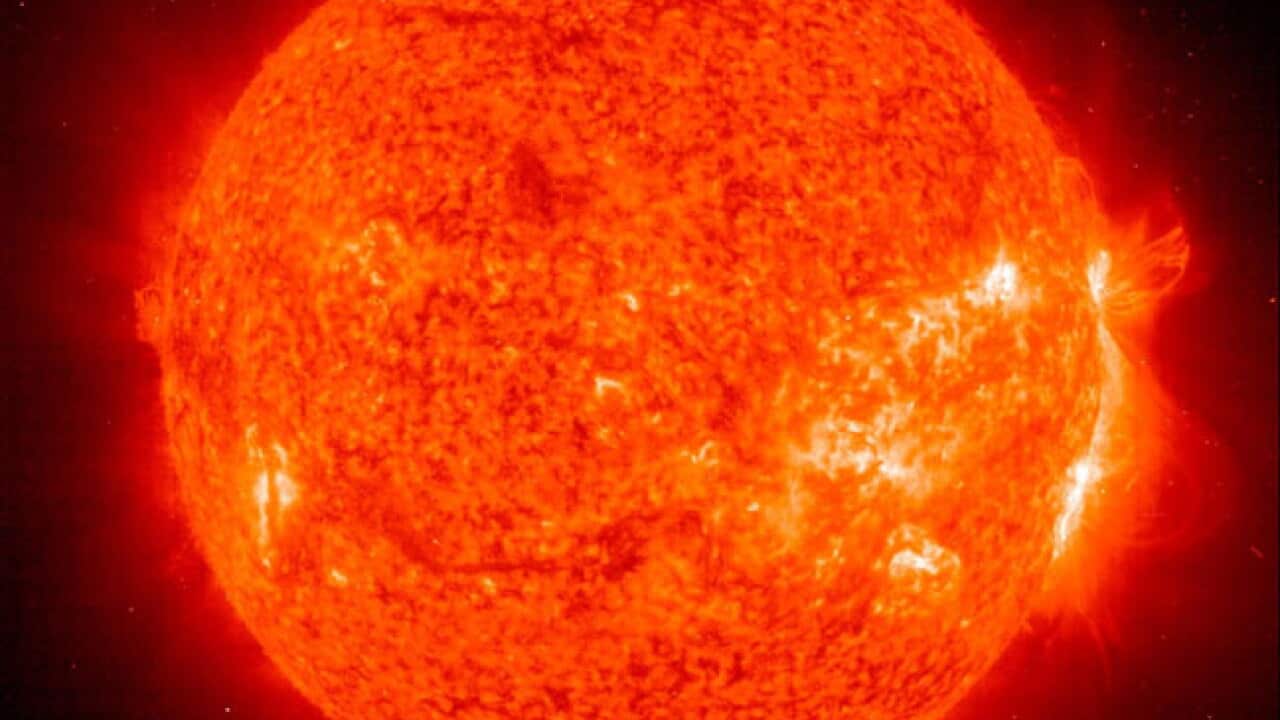
An unusual solar flare observed by a NASA space observatory on Tuesday could cause some disruptions to satellite communications and power on Earth over the next day or so, officials said.
The potent blast from the Sun unleashed a firestorm of radiation on a level not witnessed since 2006, and will likely lead to moderate geomagnetic storm activity by Wednesday, according to the National Weather Service.
"This one was rather dramatic," said Bill Murtagh, program coordinator at the National Weather Service's Space Weather Prediction Center, describing the M-2 (medium-sized) solar flare that peaked at 1:41 am Eastern time in the United States, or 0541 GMT.
News that makes sense
Your trusted source for staying up-to-date with the world around you. Get free daily news updates and analysis, straight to your inbox.
"We saw the initial flare occurring and it wasn't that big but then the eruption associated with it -- we got energy particle radiation flowing in and we got a big coronal mass injection," he said.
"You can see all the materials blasting up from the Sun so it is quite fantastic to look at."
NASA's solar dynamics observatory, which launched last year and provided the high-definition pictures and video of the event, described it as "visually spectacular," but noted that since the eruption was not pointed directly at Earth, the effects were expected to remain "fairly small."
"The large cloud of particles mushroomed up and fell back down looking as if it covered an area of almost half the solar surface," said a NASA statement.
Murtagh said space weather analysts were watching closely to see whether the event would cause any collision of magnetic fields between the Sun and Earth, some 93 million miles (150 million kilometers) apart.
"Part of our job here is to monitor and determine whether it is Earth-directed because essentially that material that is blasting out is gas with magnetic field combined," he told AFP.
"In a day or so from now we are expecting some of that material to impact us here on Earth and create a geomagnetic storm," he said.
"We don't expect it to be any kind of a real severe one but it could be kind of a moderate level storm."
The NWS's Space Weather Prediction Center said the event is "expected to cause G1 (minor) to G2 (moderate) levels of geomagnetic storm activity tomorrow, June 8, beginning around 1800 GMT."
Any geomagnetic storm activity will likely be over within 12-24 hours.
"The Solar Radiation Storm includes a significant contribution of high energy (>100 MeV) protons, the first such occurrence of an event of that type since December 2006," the NWS said.
NASA's lunar reconnaissance orbiter, CRaTER, also collected data on the event, detecting "a large number of high energy protons" and marking its "first 'bonafide solar proton event' today," the program said in a tweet.
"This is significant because it tells us that the event that created them was very energetic."
The resulting geomagnetic storm could cause some disruption in power grids, satellites that operate global positioning systems and other devices, and may lead to some rerouting of flights over the polar regions, Murtagh said.
"Generally it is not going to cause any big problems, it will just have to be managed," he said.
"If you fly from the United States to Asia, flying over the North Pole, there are well over a dozen flights every day," he added.
"During these big radiation storms some of these airlines will reroute the flights away from the polar regions for safety reasons to make sure they can maintain communications.
"People operating satellites would keep an eye on this, too, because geomagnetic storming can interfere with satellites in various ways whether it is the satellite itself or the signal coming down from the receiver."
The aurora borealis (Northern Lights) and aurora australis (Southern Lights) will also be visible in some parts of the world.







