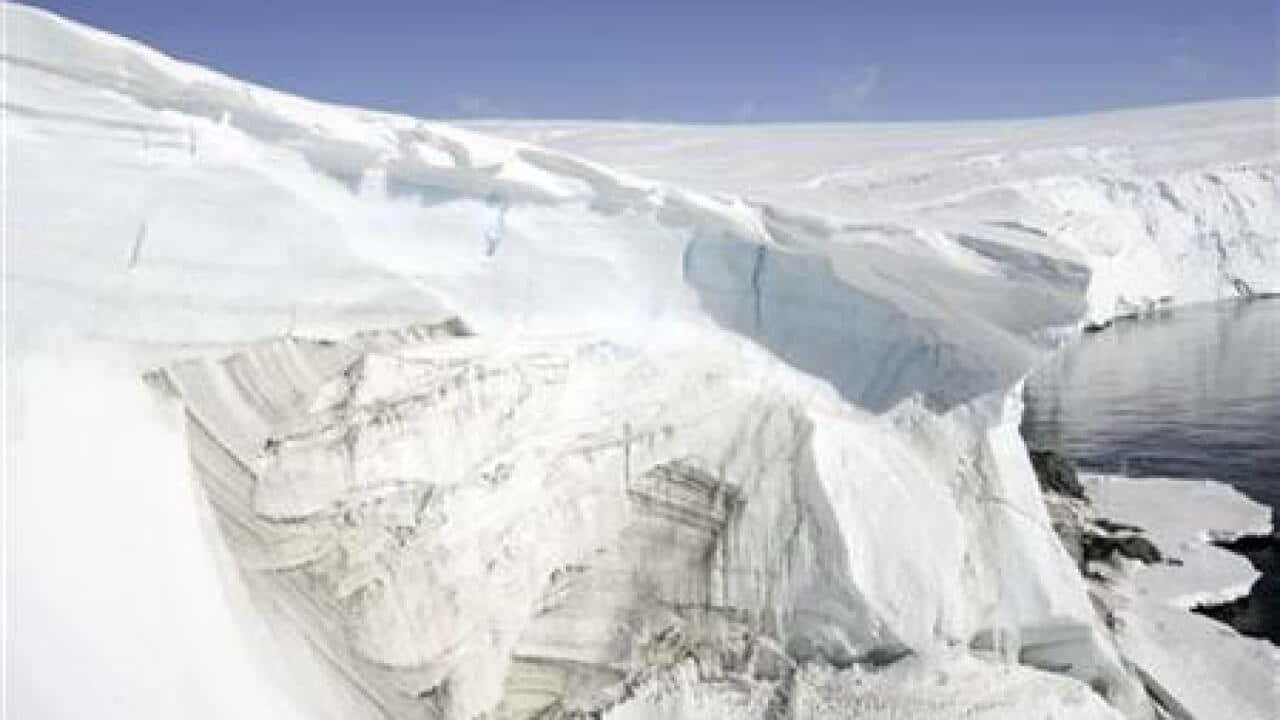
Some of Antarctica's ice sheet is formed by water re-freezing from below not just by snow falling on top as was traditionally thought. The new findings are believed to help scientists project effects of climate change.
Experts are seeking to understand the frozen continent since even a small thaw could swamp low-lying coastal areas and cities. Antarctica contains enough ice to raise world sea levels by about 57 meters (187 ft) if it ever all melted.
A six-nation study of the jagged mountain range as high as the Alps that is buried under ice in East Antarctica found that almost a quarter of the ice sheet in the area was formed by a thaw and re-freeze of water from underneath.
Deep below the surface, ice flowing into narrow, submerged valleys often melted because of high pressure and heat from the earth below and re-froze when it was forced up again.
The findings, published in the journal Science, confound a traditional view that ice sheets are almost solely formed by snow that lands on top, gets compressed into ice and flows slowly toward the oceans because of gravity.
News that makes sense
Your trusted source for staying up-to-date with the world around you. Get free daily news updates and analysis, straight to your inbox.
"We usually think of ice sheets like cakes -- one layer at a time added from the top. This is like someone injected a layer of frosting at the bottom -- a really thick layer," Robin Bell, lead author at Columbia University in New York, said in a statement.
DOME
The scientists said that about 24 percent of the ice in an area around Dome A, a 13,800 feet high plateau the size of California that forms the top of East Antarctica, was formed by re-frozen ice.
"In some places up to half the ice thickness has been added from below," they wrote of ice above the invisible Gamburtsev Mountain range.
The finding could help understand flows of Antarctic and Greenland ice sheets, and possible responses to global warming.
The British Antarctic Survey (BAS), which took part, said it gave "new understanding about ice sheet growth and movement that is essential for predicting how the ice sheet may change as the Earth's climate warms."
Radars spotted unexpected bulges deep in the ice -- one was 1 km (0.6 mile) high from the bottom of the ice sheet. "We almost thought the equipment was broken," co-author Tom Jordan of BAS told Reuters.
The U.N. panel of climate scientists projected in a 2007 report that world sea levels may rise by 18-59 cm (7-24 inches) in the 21st century, or by more if a thaw of Greenland or Antarctica picks up.
The thaw and re-freeze might also affect chances of finding unknown life in sub-glacial lakes in Antarctica such as Vostok where Russian scientists have been drilling. These lakes may have been isolated for a shorter time than previously believed.
Antarctica's ice sheet formed about 32 million years ago but Jordan said that experts now believed the oldest ice was only 1.4 million years old.







