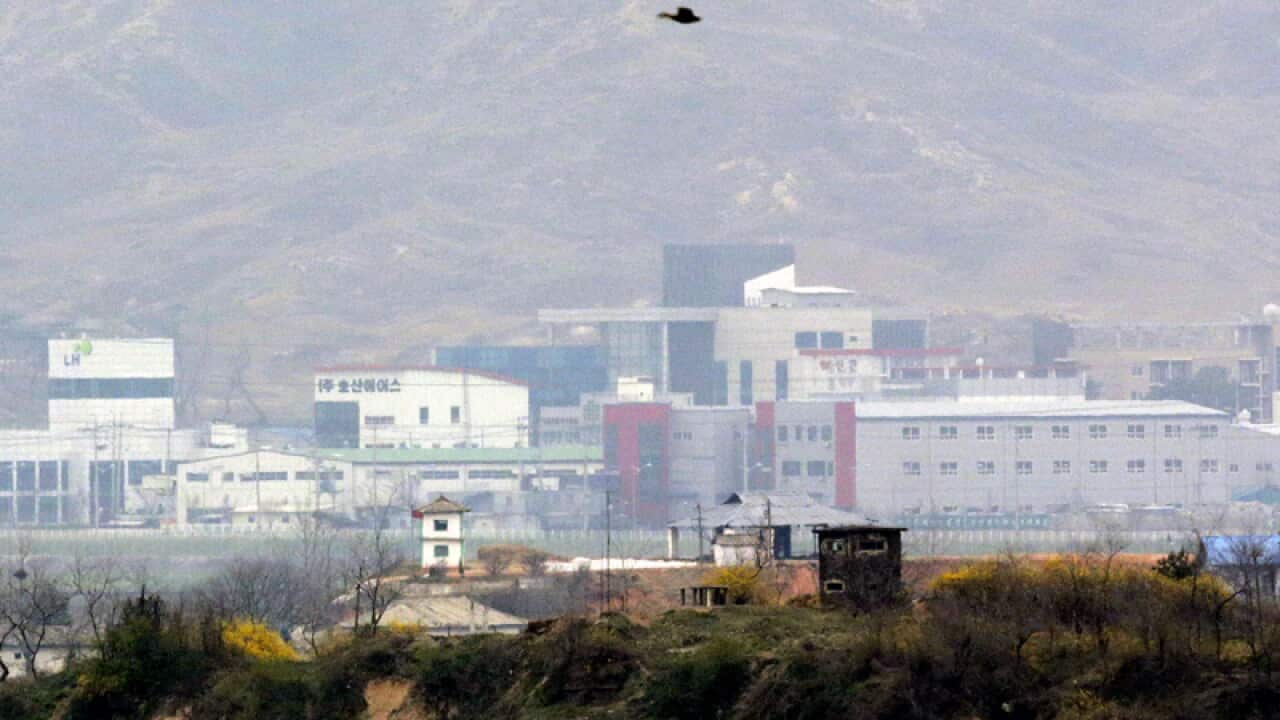
South Korean workers are due to start returning from a jointly run industrial park in North Korea after Seoul announced a complete withdrawal following months of military tensions.
The move plunges into doubt the future of the Kaesong complex -- once a rare symbol of cooperation across the world's most heavily militarised border, and a crucial source of hard currency for Kim Jong-Un's isolated regime.
A frustrated South Korea said Friday that it had decided to pull its remaining 175 workers from the site after Pyongyang rejected its ultimatum to join formal negotiations on restarting the stalled operations.
News that makes sense
Your trusted source for staying up-to-date with the world around you. Get free daily news updates and analysis, straight to your inbox.
"The government has made the inevitable decision to withdraw all the remaining people for their protection," the South's Unification Minister Ryoo Kihl-Jae said.
South Korean companies with factories at the site have expressed shock, with some threatening to ignore the evacuation in an effort to protect their investments.
A spokeswoman for the Unification Ministry said 127 workers were expected to cross back over the border in two convoys of vehicles on Saturday afternoon.
The remaining 48 people -- mostly government employees who manage the complex as well as telecom and electrical engineers -- would be pulled out on Monday, she said.
But a businessman with interests in Kaesong said many of the 123 South Korean companies who usually operate there were resisting the move.
"Some say we should comply with the government request to pull out but many others do not want to leave for fear of losing their investment," he told AFP, asking not to be named.
"Many of the employees remaining at Kaesong are also reluctant to come back to the South as they will find it hard to find new jobs," he said, adding that the workers still had enough food.
The complex has fallen victim to a cycle of escalating tensions triggered by the North's nuclear test in February, which came just over a year after a young Kim Jong-Un took power following the death of his father Kim Jong-Il.
Pyongyang, which has demanded the end of UN sanctions and a halt to all South Korea-US joint military exercises, decided on April 3 to block all South Korean access to Kaesong although it has allowed workers to leave.
Days later, the North pulled out its 53,000-strong workforce and suspended operations, angered by the South's mention of a "military" contingency plan to protect its staff at the site.
"The next South Korean step could be to cut off electricity to the complex before closing it permanently," said Yang Moo-Jin, a professor at the University of North Korean Studies in Seoul.
"South Korea's strong response may result in the disappearance of the last remaining point of contact -- and a prolonged confrontation -- between the two Koreas."
Established in 2004, the complex lies 10 kilometres (six miles) inside the North, which remains technically at war with the South after the 1950-53 Korean War was concluded with a ceasefire rather than a peace treaty.
Seoul has urged the North to guarantee the safe return of the workers and to protect the assets of the companies at Kaesong.
Dismissing the offer of negotiations, the North's National Defence Commission on Friday warned that Kaesong "is now on the verge of collapse".
"This is entirely attributable to the reckless war hysteria of the South Korean puppet regime," it said in a statement.
The project was born out of the "Sunshine Policy" of inter-Korean conciliation initiated in the late 1990s by then South Korean president Kim Dae-Jung.
It operates as a collaborative economic development zone that hosts South Korean companies attracted by its source of cheap, educated, skilled labour, with turnover in 2012 reported at $469.5 million.







