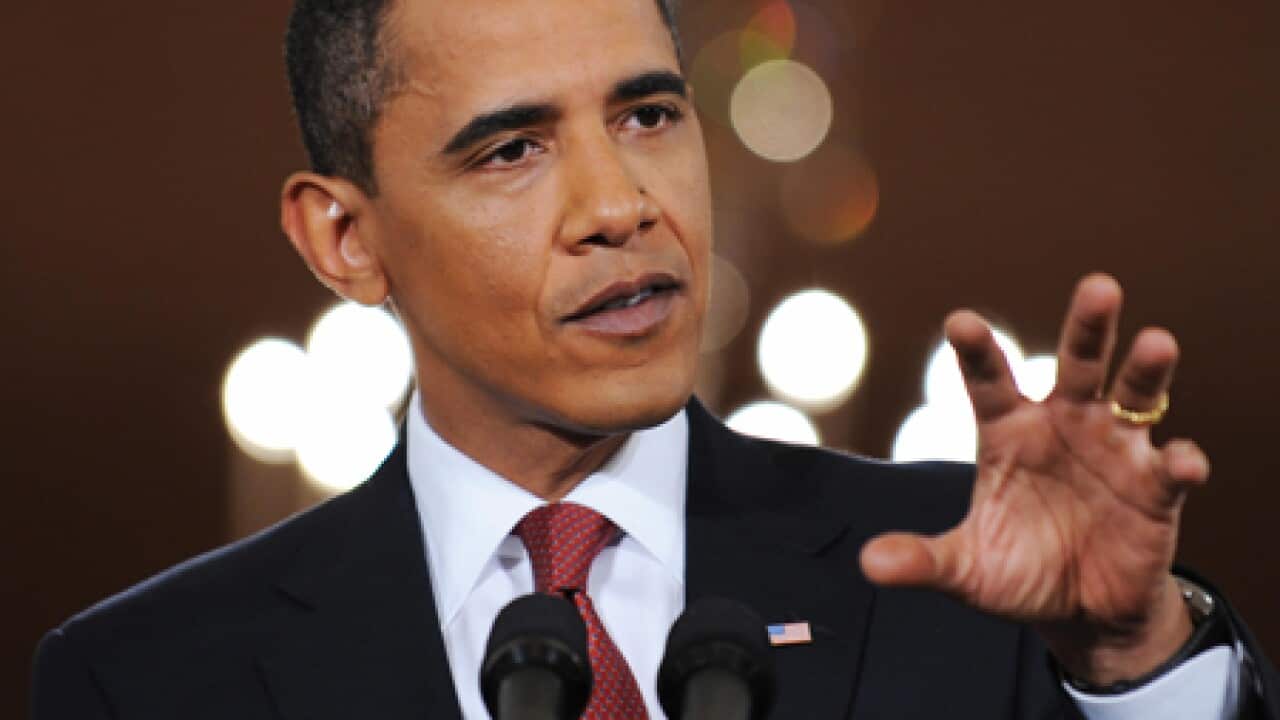
The White House has denied President Barack Obama's government spending freeze would suffocate the economic rebound or stifle efforts to ease crippling 10 percent unemployment.
The initiative will be a centrepiece of Obama's debut State of the Union address Wednesday, in which he will seek to revive ties with voters who gave him a mandate for change, but who now seem underwhelmed with his performance.
Spending freeze to last 3 years
News that makes sense
Your trusted source for staying up-to-date with the world around you. Get free daily news updates and analysis, straight to your inbox.
Preaching fiscal restraint, Obama has vowed to cut the deficit in half by the end of his term in 2013, but the scale of his task was underlined Wednesday by new data putting the shortfall at more than 1.3 trillion dollars in 2010.
The freeze on non-security discretionary spending, which exempts the Pentagon and international affairs budgets, would kick in with the 2011 accounts and last three years, to save 250 billion dollars over a decade.
Some critics have said that curbing spending with the economy in a deep hole is wrong, arguing the government needs to spend its way out of recession.
"We do not believe, the president does not believe, the economic team does not believe, that the overall macro-economic effect would impact the recovery efforts," White House spokesman Robert Gibbs said.
Gibbs also said that if the government could not cut down on discretionary expenditures, it would have little hope of making further cuts in the budget.
"If we can't make these steps, how are you going to go after stuff that is politically hard? How are you going to create a coalition to do that?"
Reforms may be scaled back under 'fiscal straightjacket'
The fiscal straitjacket will lead to painful decisions on some government programs beloved of Democratic leaders and lawmakers in Congress and will crimp the spending plans of some members of Obama's own cabinet.
It may also force Obama to scale back the size of his ambitious reform agenda, just one year into his four-year term of office.
"You can't afford to do everything you might have always wanted to do," said one senior Obama administration official.
"That's the decision-making process the president and the economic team went through. It's the very same process American families have gone through for the past several years."
But prominent members of Obama's core Democratic base offered a lukewarm or downbeat reaction to news of the spending freeze.
"We'll have to look at see what the president's talking about cutting," Senate Democratic Majority Leader Harry Reid said.
"We have all kinds of programs I'll look at very, very closely, but I mention two of those that are extremely important to me," Reid told reporters.
Critics speak out
Obama got a lashing on Monday night on MSNBC from liberal commentator Rachel Maddow who accused him on her show of adopting the 1930s style policies of former president Herbert Hoover that made "the Depression Great."
Steny Hoyer, the top Democrat in the House of Representatives admitted that Obama's move would force tough choices on Congress.
"In the short term, we need to build jobs; and in the long term, we need to balance our budgets.
"The freeze will certainly give the Congress the challenge to make a choice on priorities within those freeze numbers, and I think we will do that."
The Congressional Budget Office added fuel to the turbulent political debate on Tuesday, saying that the government budget deficit would come in at 1.349 trillion dollars in 2010.
The size of the deficit is one factor along with high unemployment and the sluggish economic recovery from the worst financial crisis in decades that is helping to drag down public perceptions of Obama's economic management.
Republicans have hammered Obama for big spending programs, including a 787-billion-dollar economic stimulus plan, and dismiss administration claims that the program saved or created two million jobs.
They downplayed Obama's freeze, saying it would not do enough to rein in wasted spending by lawmakers, and also pointed out in his 2008 campaign, the president had argued that such curbs never worked.
"Americans aren't happy with the administrations approach," said the top Senate Republican Mitch McConnell.
"They're tired of the spending, debt, and government takeovers. They want a step-by-step approach to our problems, not grand government experiments and schemes."







