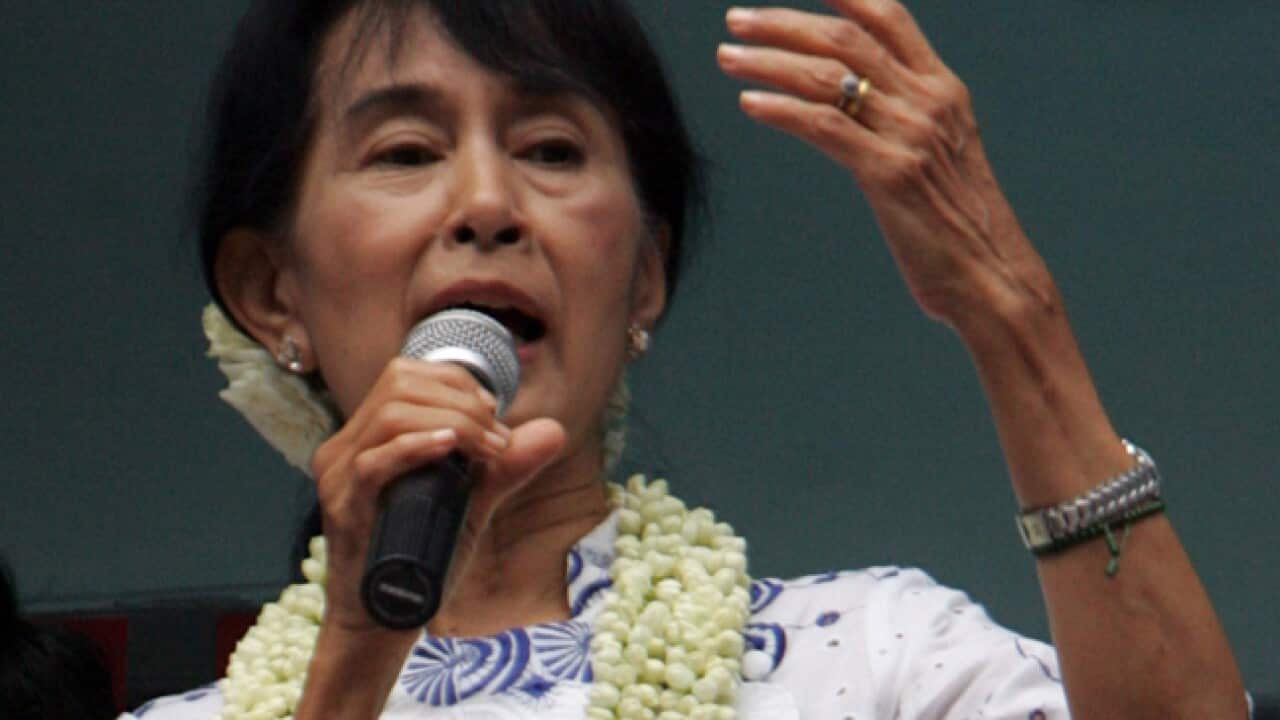
Democracy leader Aung San Suu Kyi has urged "healthy scepticism" over Burma's dramatic reforms, saying only the rule of law can cement recent political progress and foster clean investment.
Speaking at a gathering of world business leaders in Bangkok, she also warned China and the United States against turning Burma into a "battling ground" as they vie for influence over the strategically important nation.
On her first major international engagement after more than two decades of isolation, the Nobel laureate dampened what she called "reckless optimism" over democratic measures taken under reformist president Thein Sein.
News that makes sense
Your trusted source for staying up-to-date with the world around you. Get free daily news updates and analysis, straight to your inbox.
Appealing to delegates to "think deeply" about the wider good of Burma, she said hope in her country's future since the end of five decades of authoritarian rule last year should be tempered by caution.
"A little bit of healthy scepticism is in order," she told the packed auditorium.
In practical terms, Burma needed the "rule of law" more than anticipated investment legislation, Suu Kyi said, as the country tries to embed democratic reforms, lift millions out of poverty and diffuse the "timebomb" of high youth unemployment.
Companies are hungrily eyeing resource-rich Burma after political reforms were rewarded by the easing of some international sanctions.
But Suu Kyi expressed fears a flood of investment -- and international competition for a foothold in the nation -- could deepen graft and serve the country's elite.
"We do not want investment to mean more possibilities for corruption," the 1991 Nobel Peace Prize laureate said.
"We do not want investment to mean greater inequality. And we do not want investment to mean greater privileges for those already privileged."
Resource-rich but poor Burma has a history of engagement with Beijing, but Washington has recently sought closer ties with the quasi-civilian government, easing some sanctions to reward the end of military rule.
"I'm always very concerned when Burma is seen as a battling ground for the United States and China," she told reporters in a press conference following her forum address, using Burma's former name.
"It should not be so, it should be an area of harmony for those two big countries," she said, adding that Burma and China had been "good neighbours" for many years.
Suu Kyi has stolen the show at the Bangkok forum, posing for endless photographs as she shuttles between forum events and visits to meet Burma migrants.
Chris Herink, country director for World Vision, said her address was received with "rapt interest" by delegates, who represent governments, the private sector and civil society groups.
"I think what was gratifying to me in the address... was her ability to speak to all of these audiences," he said, praising her exhortations for investors and donors to empower rather than undermine Burma's people.
Having spent 15 of the past 22 years under house arrest, Suu Kyi has taken an increasingly global role as Burma sheds its pariah status, meeting top world dignitaries in Rangoon and encouraging easing of Western economic sanctions.
Reflecting on her debut trip after decades inside Burma, the pro-democracy leader recalled the moment she flew into Bangkok, saying she was struck by the city's illuminated nightscape.
"I had just left a Burma that was suffering electricity cuts... I thought thirty years ago the scene that met my eyes landing in Bangkok, would not have been very different from landing in Rangoon."
Rallies last week against power cuts in several cities including Rangoon and Mandalay, were the first major protests in years, testing the regime's tolerance of public discontent.
Suu Kyi, who addressed joyful crowds of Burma migrants on her first full day in Thailand, is scheduled to travel to the country's north to meet Burma refugees on Saturday before returning to her homeland on Sunday.
Europe is next on the horizon, where Suu Kyi will address an International Labour Organization conference in Geneva and give a speech in Oslo to finally accept the Nobel Prize she was awarded in 1991.
She also intends to travel to Britain, where she lived for years with her family, and will address parliament in London.







