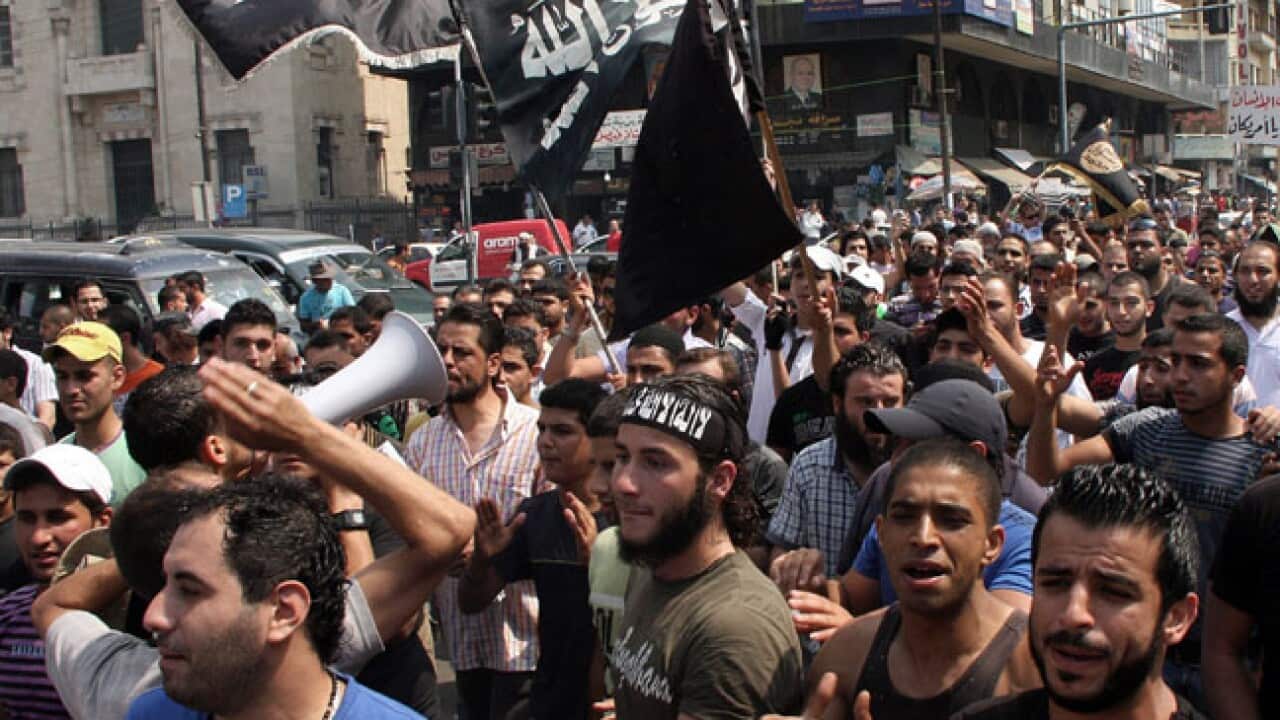
More than 100 dissidents heard calls for a 'peaceful transition to democracy' at a public meeting in Damascus on Monday that they said was unprecedented in five decades of iron-fisted Baath party rule.
"There are two ways forward -- the first a clear and non-negotiable move to a peaceful transition to democracy which would rescue our country and our people," activist Munzer Khaddam told the meeting in a hotel in the Syrian capital.
"The alternative is a road that leads into the unknown and which will destroy everyone," he said.
News that makes sense
Your trusted source for staying up-to-date with the world around you. Get free daily news updates and analysis, straight to your inbox.
"We are with the people and we, like them, have chosen the first path. Those who refuse to take it will go to hell."
The opposition figures, all of them independent of any party affiliation, gathered in a Damascus hotel to discuss "how to solve the crisis" which has gripped Syria since mid-March.
They sang the national anthem and held a minute's silence for the "martyrs, both civilian and military" in the protests which have rocked the country since mid-March.
"We will talk so that we can formulate a national strategy on how to end Syria's current crisis," Abdel Karim Rihawi, president of the Syrian League for Human Rights, told AFP, stressing that the meeting was not intended to take the place of the "protesters in the street."
Anwar Bunni, a prominent human rights lawyer who has spent five years in Syrian jails, said it would be the "first meeting of its kind at a public venue announced in advance."
There had been no confirmation from the Syrian authorities that the meeting would be allowed to go ahead.
Bunni told AFP that opponents of President Bashar al-Assad would take part in the "national dialogue" he proposed last week only if peaceful demonstrations were authorised, political prisoners released, the opposition recognised and the use of force ended.
In a televised address on June 20 -- only his third since the protests against his 11-year rule erupted -- Assad said the proposed dialogue could lead to a new constitution and even an end to his Baath party's monopoly of power.
"We can say that national dialogue is the slogan of the next stage," he said. "The national dialogue could lead to amendments of the constitution or to a new constitution."
But Assad said he refused to reform Syria under "chaos," drawing a pledge from the pro-democracy activists who have spearheaded the protests that their "revolution" would go on.
Demonstrators again took to the streets later the same day, meeting deadly violence from the security forces.
The Coordination Committee, an umbrella group of activists, said dialogue was pointless as long as Assad remained in power.
"We consider any dialogue useless that does not turn the page on the current regime," it said.
In the days since Assad's speech, the security forces have pressed their deadly sweep for dissidents towards Syria's borders sending around 11,000 refugees fleeing into Turkey and hundreds more in to Lebanon.
Some 300 students detained last week after a rare protest in Syria's second-largest city Aleppo have been charged with "sabotage" and "insulting the president," a human rights activist said Monday.
"The 304 students were brought before court yesterday (Sunday). They were arrested last week in Aleppo's University City," said Radif Mustafa, the chairman of the Kurdish Human Rights Committee.
"It is a new sign that the authorities are set on deepening the crisis rather than finding political solutions," he added.
French Foreign Minister Alain Juppe said on Sunday that Assad had passed the "point of no return".
"I would be happy to admit I'm wrong, but I don't think so," he told France's RTL radio.
"I regret that the repression continues to unfold in conditions which calls into question the region's security," he said.
Pro-government daily Al-Watan said on Sunday that the border areas near Turkey being targeted by the military had been used as a "key crossing for armed groups".
Syrian military spokesman Major General Riad Haddad, said 1,300 members of the security forces had been killed in the revolt.
But foreign governments have refused to accept the contention that the protests are the work of armed gangs supported from abroad.
"We're just not buying it," US State Department spokesperson Victoria Nuland said last week.
The London-based Syrian Observatory for Human Rights says 1,342 civilians have been killed in the government's crackdown and that 342 security force personnel have also died.







