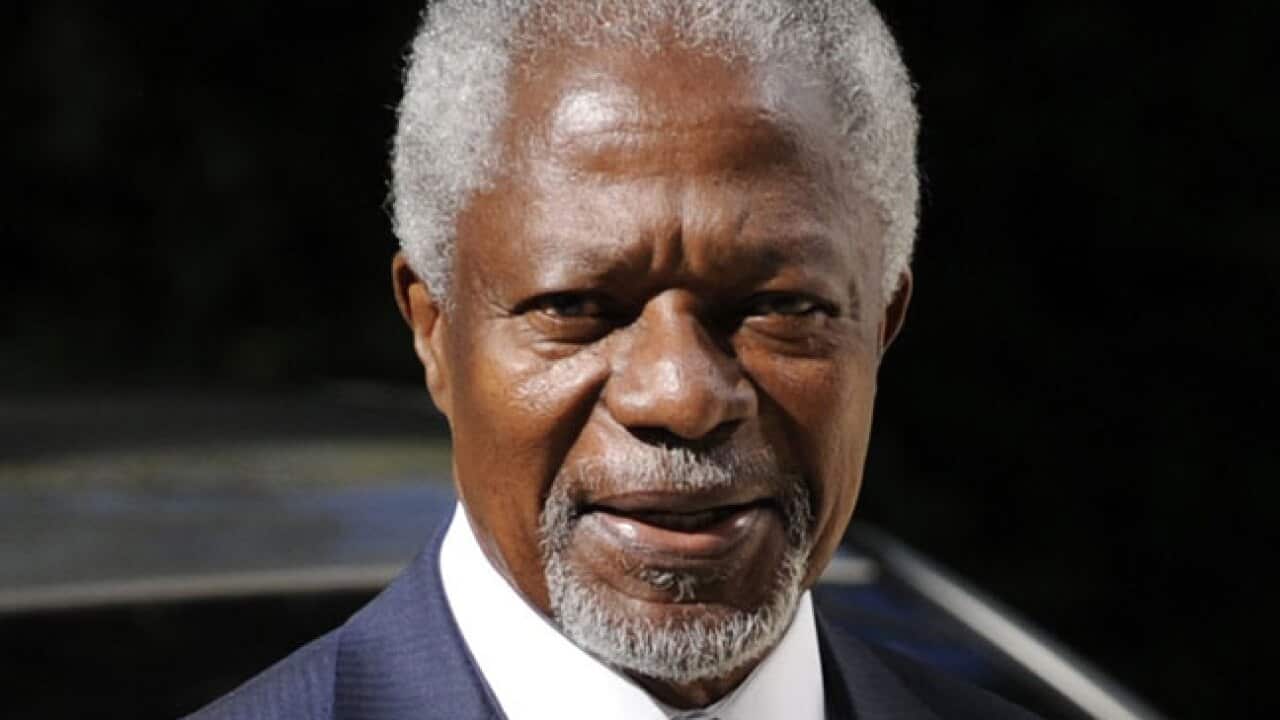
While the agreement makes no explicit call for President Bashar al-Assad to step aside, the UN's special envoy Kofi Annan said he doubts Syrians would choose anyone with blood on their hands.
Mr Annan called the level of violence in Syria gravely alarming and called for a commitment to a ceasefire on all sides, declaring that the government and opposition must work together.
"We have offered a perspective for the future that can be shared by all in Syria: a genuinely democratic and pluralistic state with free and fair elections, full respect for human rights and the rule of law," he said.
"There must be a commitment to accountability and national reconciliation."
The main points of the agreement are:
News that makes sense
Your trusted source for staying up-to-date with the world around you. Get free daily news updates and analysis, straight to your inbox.
- RECOMMITMENT TO CEASEFIRE: Parties must recommit to a sustained cessation of armed violence, and an immediate implementation of Annan's six-point peace plan.
- TRANSITION GOVERNMENT: Could include members of the present government and the opposition and other groups and shall be formed on the basis of mutual consent.
- A SYRIAN-DRIVEN PROCESS: Syrians will determine future of their country. All groups in the country must be allowed to join in a national dialogue process.
- CONSTITUTIONAL REVIEW: A review of the constitutional order and legal system to be carried out, and changes subject to popular approval.
- GENUINE ENGAGEMENT: Parties must engage genuinely with Annan to work towards the transition.
Western and Arab leaders met on Saturday, convened by international envoy Kofi Annan, in a desperate bid to salvage Annan's peace plan for Syria to end 16 months of bloodshed and agree on a transition for the strife-hit country.
Saturday's meeting included Western and Arab leaders, and the talks yet again highlighted the differences between Western leaders, who continue to call for Mr Assad to step aside, and Russia's position, which is that no party should be excluded from any future government.
US secretary of state Hillary Clinton says a true transition would require Mr Assad to go.
"He will never pass the mutual consent test," she said.
Annan had announced the meeting on Tuesday, inviting Clinton, Russian foreign minister Sergei Lavrov, and the foreign ministers of Britain, China, France, Iraq, Qatar, Turkey and Kuwait to the talks, and conspicuously leaving Iran and Saudi Arabia out.
Meanwhile, violence in Syria continued, with human rights monitors saying more than 230 people -- most of them civilians -- had been killed across the strategic Middle East country since Thursday.
SYRIA: DIPLOMATIC TIMELINE
The main diplomatic moves to try to end the conflict in Syria, which monitors say has left more than 15,800 people dead since a widespread revolt broke out in March 2011:
- August 18, 2011: US President Barack Obama and Western allies call for President Bashar al-Assad to step down.
- August 27: The Arab League, of which Syria is a member, holds an extraordinary summit on ending the violence.
Efforts by Western powers to obtain a United Nations Security Council resolution condemning Syria are stymied by Russia and China.
- November 2: The Arab League says it has the agreement of Assad on a plan that would involve an end to the violence and a pullback of belligerent forces, leading to a "conference of national dialogue".
Ten days later, however, the League votes to suspend Syria's membership of the pan-Arab organisation due to the continued repression. It later also calls on its members to enact sanctions against the regime.
- December 19: After tough negotiations, Syria agrees to receive a delegation of Arab League monitors.
- January 22, 2012: The Arab League agrees on a new plan under which Assad would hand over power to his deputy pending elections.
- January 28: The Arab League acknowledges its observer mission has failed to halt the violence.
- February 24: A group of mainly Western and Arab countries calling themselves the "Friends of Syria" hold a conference in Tunis. However Russia and China, who hold veto power on the UN Security Council, refuse to attend.
- March 21: The Security Council agrees on a plan drafted by its former secretary general, Kofi Annan. The plan calls for a ceasefire, return of troops to their barracks and the opening of talks between the government and opposition.
- April 1: Meeting in Istanbul, Friends of Syria countries extend formal recognition to the Syrian National Council, the main opposition umbrella group.
- April 12: The ceasefire called for under the Annan plan is supposed to come into force -- but violence continues unabated.
- April 14 and 21: The UN Security Council votes to send first 30 and then 300 observers to Syria.
- June 16: Amid continuing heavy violence, the UN suspends the work of its observer mission, although they remain in the country.
- June 18: Presidents Obama of the United States and Vladimir Putin of Russia meet at a G20 summit and call for "an immediate cessation of all violence."
- Saturday, June 30: The foreign ministers of the five permanent UN Security Council members -- Britain, China, France, Russia and the United States -- to meet in Geneva to discuss a transitional plan for Syria.







