
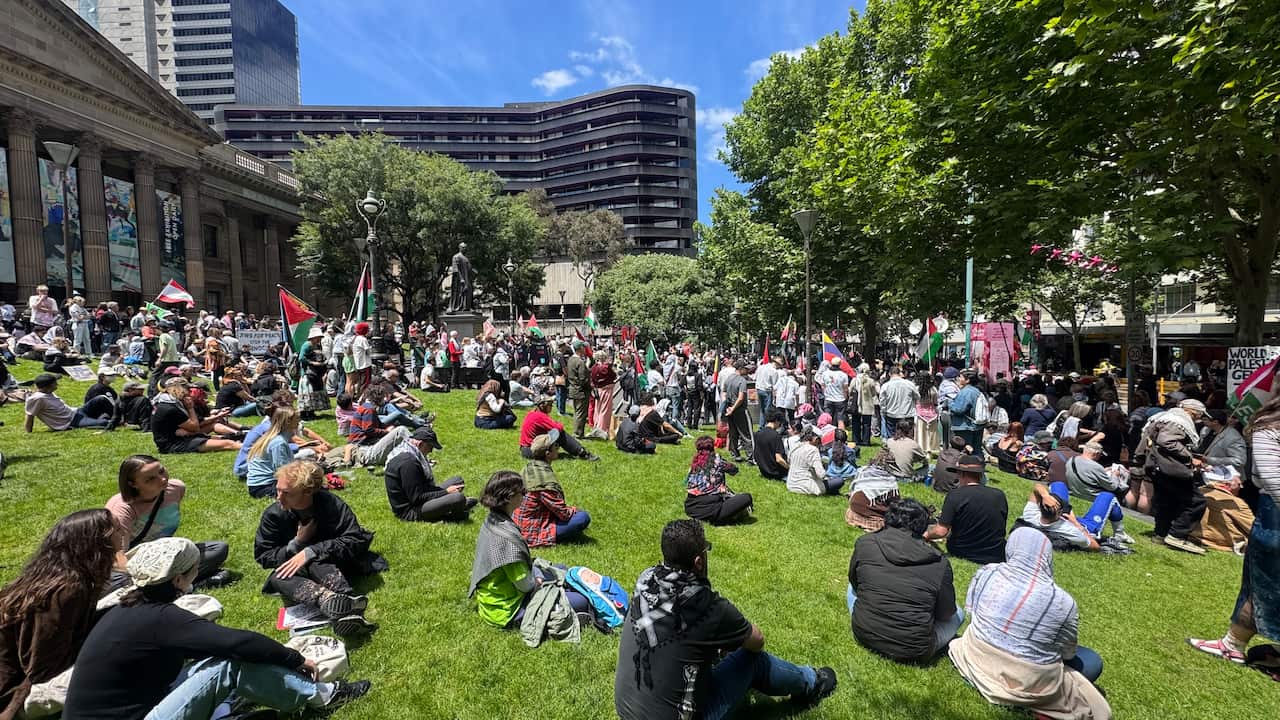
An estimated 600 people gathered outside SBS's Melbourne headquarters in Federation Square, calling for a Eurovision Song Contest boycott as part of broader pro-Palestinian rallies.
The European Broadcasting Union (EBU) has cleared Israel to enter the 2026 Eurovision Song Contest, plunging the competition into a political row.
The organisation decided not to hold a vote on Israel's participation, saying it had instead passed new rules aimed at discouraging governments from influencing the contest.
Pro-Palestinian protesters who gathered in Melbourne on Sunday were calling for sanctions on Israel and an end to weapons supplies and military actions in Gaza, while also demanding SBS boycott the song contest.
SBS is an associate member of the EBU and Australia's official broadcaster of Eurovision, having broadcast the competition every year since 1983.
News that makes sense
Your trusted source for staying up-to-date with the world around you. Get free daily news updates and analysis, straight to your inbox.
The protesters marched from the State Library to the broadcaster's office, with Palestinian community member and organiser Mai Saif speaking out against the broadcaster's decision to air the contest.
"SBS, our public broadcaster, has a responsibility not to platform a country that is committing war crimes, that is committing genocide," Saif told SBS News.
SBS says boycott would undermine impartiality
SBS said a decision to boycott Eurovision would compromise its editorial independence and impartiality.
“We respect the right for people to express their views peacefully and respectfully. SBS’s participation in and coverage of Eurovision will continue in 2026," an SBS spokesperson said.
"Eurovision was created to bring people and cultures together through music, a purpose that continues to guide the contest and has shaped SBS’s broadcast for more than 40 years.
"Our position remains that, as a public broadcaster, making a decision to be involved based on the inclusion or exclusion of any country would undermine SBS’s editorial independence and impartiality," they added.
"SBS recognises and respects the deeply held views and concerns about the war in the Middle East and its impact, both locally among our audiences and internationally as reflected by other broadcasters. Our responsibility is to provide comprehensive, trusted and impartial coverage for Australians across our network, and we will continue to do so."
Protesters reject SBS stance
Rallies organised by the Free Palestine Coalition were held across Australia on Sunday, calling out genocide in Gaza.
In September, a report by the United Nations Independent International Commission of Inquiry concluded that Israeli authorities and forces had, since October 2023, committed "four of the five genocidal acts" listed in the 1948 Genocide Convention.
Israel has said it "categorically rejects" the findings of the UN probe.
The protesters who gathered in Melbourne on Sunday rejected SBS's position on Eurovision.
"If you believe in inclusion, you also believe in ensuring that those who are not committing war crimes and atrocities are not being platformed," Saif said.
Another protester, Robert Martin, said airing Eurovision was supporting genocide.
"That's not neutrality. That's backing a genocide," he told SBS News. "It's totally unacceptable to have our governments not step up, but also for SBS to allow it."
The group would continue protesting monthly, "if not every week", he said.
Muayad Ali from the Free Palestine Movement said the protest called for a boycott of Israel in Eurovision, and that all artists and broadcasters, including SBS, should participate in the boycott.
"SBS is the main broadcaster of this event here in Australia. We need to tell them to boycott Israel and not actually do it," Ali said. "We cannot entertain genocide."
Noura Mansour from the Australian Palestinian Advocacy Network (APAN) criticised mainstream media coverage of the conflict.
"Gaza would not have been able to be sustained this long without the complicity of the mainstream media. Without the mainstream media normalising Palestinian deaths … and providing cover to the Israeli government to continue with its crimes against humanity, against Palestine," Mansour told the crowd.
"We are here to demand that the SBS not broadcast the Eurovision and not continue to normalise a genocidal state."
A total of 1,200 people were killed and 251 taken hostage in the October 7 attack by Hamas, according to Israeli tallies.
More than 70,000 people have been killed in Gaza in the ensuing conflict, according to health authorities in the enclave.
At least 367 Palestinians have been killed in Israeli attacks since the start of the ceasefire less than two months ago, according to Gaza's health ministry, which does not differentiate between civilians and combatants.
Four countries withdraw from Eurovision
The EBU, of which SBS is a member, seemed to echo the Australian broadcaster's statement on the importance of public service media remaining impartial.
Meeting in Geneva this week, the EBU said many of its members took the opportunity to stress the importance of protecting the independence of public service media and the freedom of the press to report, not least in conflict zones such as Gaza.
“The result of this vote demonstrates our members’ shared commitment to protecting transparency and trust in the Eurovision Song Contest, the world’s largest live music event," EBU President Delphine Ernotte Cunci said in a statement.
The EBU added it had introduced new rules to prevent governments, members and third parties from disproportionately promoting songs to sway voters, following allegations that Israel unfairly boosted its entrant this year.
Nevertheless, Israel's clearance to participate in the contest this week prompted four countries — the Netherlands, Spain, Ireland and Slovenia — to withdraw in protest over the Gaza war.
Some broadcasters also threatened to boycott the event, citing the death toll in Gaza and accusing Israel of violating rules intended to maintain the contest's neutrality.
Israel's President Isaac Herzog welcomed Israel's inclusion in the competition, saying: "I am pleased that Israel will once again participate in the Eurovision Song Contest, and I hope that the competition will remain one that champions culture, music, friendship between nations, and cross-border cultural understanding."
Israeli foreign minister Gideon Sa'ar criticised the boycotting countries.
"I welcome the decision of the European Broadcasting Union. I am ashamed of those countries that chose to boycott a music competition like Eurovision because of Israel's participation. The disgrace is upon them," Sa'ar said on X.
The Eurovision finals will be held in Austria in May 2026.
For the latest from SBS News, download our app and subscribe to our newsletter.







