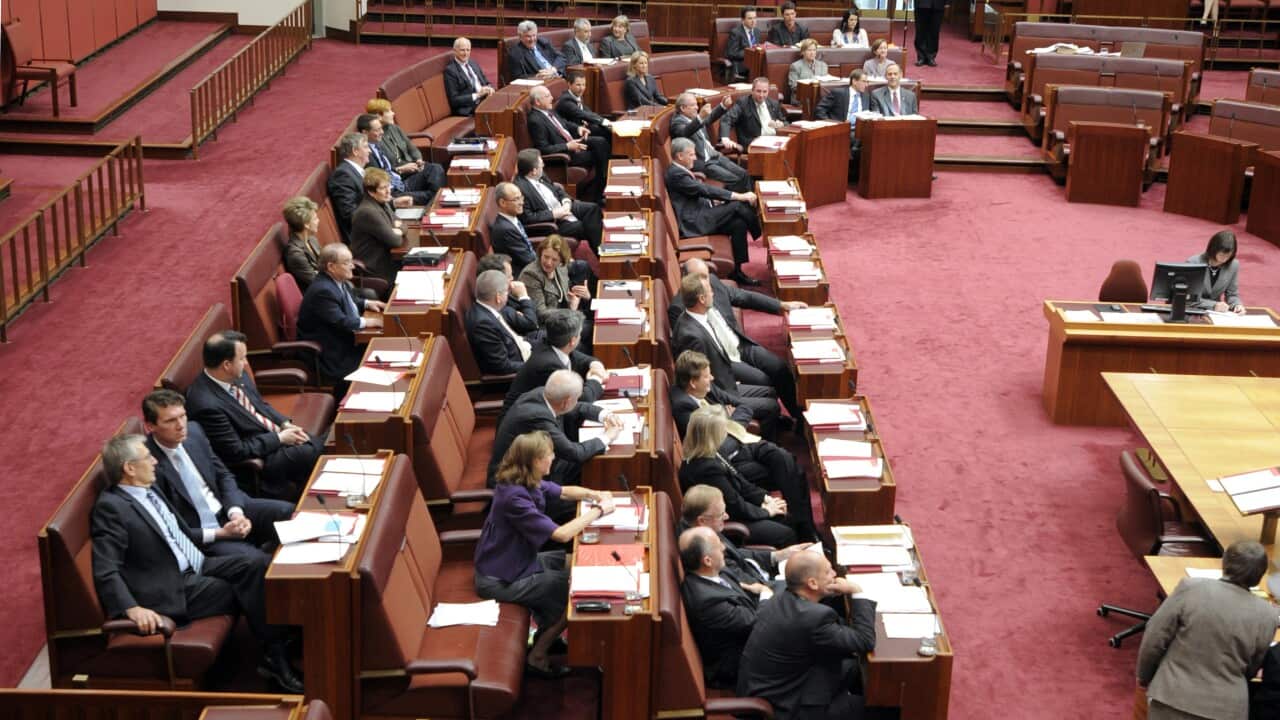
Senate vote counting will continue for several days, but already it's apparent that the crossbench will include micro parties such as the Palmer United Party, the Liberal Democrats, the Australian Motoring Enthusiast Party, Family First and the Australian Sports Party.
The likely result has prompted some parliamentarians to call for a review of the election process.
The Australian Sports Party has netted just 233 primary votes in Western Australia, where 130 thousand votes are needed to obtain the quota to win a Senate seat.
News that makes sense
Your trusted source for staying up-to-date with the world around you. Get free daily news updates and analysis, straight to your inbox.
But the Sports Party will win a seat because of a complicated preference deal with other minor and micro parties.
This system of preferencing looks set to deny the Coalition a 39-seat majority in the upper house, while granting a Senate ticket to newcomers like former rugby league player Glenn Lazarus in Queensland for the Palmer United Party.
On current projections, the Coalition is expected to get three Senators each in New South Wales, Victoria, Queensland and Western Australia.
It also expects to have two Senate seats in South Australia and Tasmania and one each in the Australian Capital Territory and the Northern Territory.
Combined with those Senators who did not face re-election, this would leave the Coalition with an unchanged national total of 34.
Labor is set to hold two Senate seats in New South Wales, Victoria, Queensland, Tasmania and Western Australia, with one each in the ACT, Northern Territory and South Australia, giving it a total of 26, down five from its current standing.
Northern Territory Labor Senator-elect Nova Peris will be the first Indigenous woman in parliament.
The Palmer United Party could pick up a second seat, with Jacqui Lambie in Tasmania.
The man responsible for the helping several of the micro-parties to electoral success is political consultant Glen Drury.
Mr Drury has told the ABC the current system is designed to keep the balance of power with the major parties but there is a way to manipulate the preferences to advantage smaller parties.
"Initially I explained to them how the system worked. The system that was imposed upon all of us by the major parties many years ago. The system that was imposed on us to keep minor parties out, by the way. And I showed these people that there is a way through. I don't think they ever really figured out that somebody would learn how to use the system".
Independent Nick Xenophon will be returned in South Australia where Greens Senator Sarah Hanson-Young's place remains in doubt.
Senator Xenophon says the process of micro-party preferencing is bizarre and needs to be greater transparency in the process.
"Inevitably as a result of this election the major parties will want to look at that. I don't want to be excluding independents such as myself or minor parties from having a fair go but there needs to be some transparency in the way that some of these preference flows are harvested."
Incoming Coalition government minister Christopher Pyne thinks it will be easier to deal with micro-parties on the Senate crossbench than Labor or the Greens.
He says they're all of centre-right persuasion, which will make it much easier for the Coalition to deal with them.
But he's raised concerns about the rise of micro parties and says a parliamentary committee may examine it.
"Every election there is a is a review of the election. The joint standing committee on electoral matters conducts a review and this was the first election in which there seems to be a very determined and organised campaign to run micro parties. which we have seen in New South Wales before. And there seems to be an industry growing of how to elect micro parties to the upper houses which I don't think is necessarily healthy."
Greens leader Christine Milne says negotiating legislation through such a fragmented Senate won't be easy for the Abbott government.
But she says there's a certain irony in the situation.
"There is a delicious irony that comes out of this election. Tony Abbott is going to have to do exactly what he condemned Julia Gillard for doing. And that is to negotiate on a daily basis with a group of people who have no policy platform in most cases. Some of them are extreme conservatives, right off the map in terms of extreme. And you have no idea on how they are going to vote on anything."
Until the Senate changeover in July next year, the Greens will continue to hold the balance of power.
This will make it all but impossible for the Abbott government to pass legislation such as the carbon tax repeal and toughening up asylum seeker policies unless Labor offers its support.







