
In Brief
- A German economist has successfully predicted three World Cup winners.
- He says the Socceroos may be knocked out in the second round.
In 2014, German economist Joachim Klement created a formula that predicted his home nation would win that year's FIFA World Cup.
To his surprise and delight, attacking midfielder Mario Götze scored the winning goal in the last minutes of extra time in the final, cementing Germany's 1-0 victory over Argentina in Brazil.
Klement's formula predicted France would win in 2018 in Russia and Argentina in 2022 in Qatar — confirming a 100 per cent success rate for his complex prediction model.
With the 2026 tournament only weeks away, Klement has called who he believes will claim the Cup.
News that makes sense
Your trusted source for staying up-to-date with the world around you. Get free daily news updates and analysis, straight to your inbox.
This time he's backing a relative underdog, forecasting the Netherlands will win the tournament.
The Netherlands have never won a World Cup but were runners-up in the 1974, 1978 and 2010 finals.
Currently, the nation sits seventh in FIFA's men's world ranking. Bookmakers broadly have the Netherlands as eighth favourite to win the World Cup, with Spain as the top pick, followed by France and England.
"I was a bit surprised when it came out of my model and the simulations that the Netherlands would win," Klemet told SBS Dutch.
"Particularly given that the simulation showed that the Netherlands has a very, very difficult path to the final."
- All the FIFA World Cup 2026 coverage on our World Cup page
- How to watch the FIFA World Cup 2026 on SBS
- Watch all 104 matches of the FIFA World Cup 2026 at our On Demand hub
For the first time in World Cup history, the number of competing teams has been expanded from 32 to 48.
Hosted by Canada, the US and Mexico and the US, the 104-match tournament will take place from 11 June to 19 July.
It'll start with 12 groups of four teams competing, with the top two and the top eight third-placed teams moving to the knockout round.
In the group stage, the Netherlands will compete against Japan, Sweden and Tunisia, facing Japan first on 15 June at Dallas Stadium.
Klement predicts the Netherlands will win against Morocco and Canada in the knockout stage, and France in the quarter-finals.
"France would be more likely to win against the Netherlands, because it's one of the best teams in the world right now," he said.
"But ... on any given day, in any given match, luck plays an important role and, in fact, about 50 per cent of the outcome is given by luck."
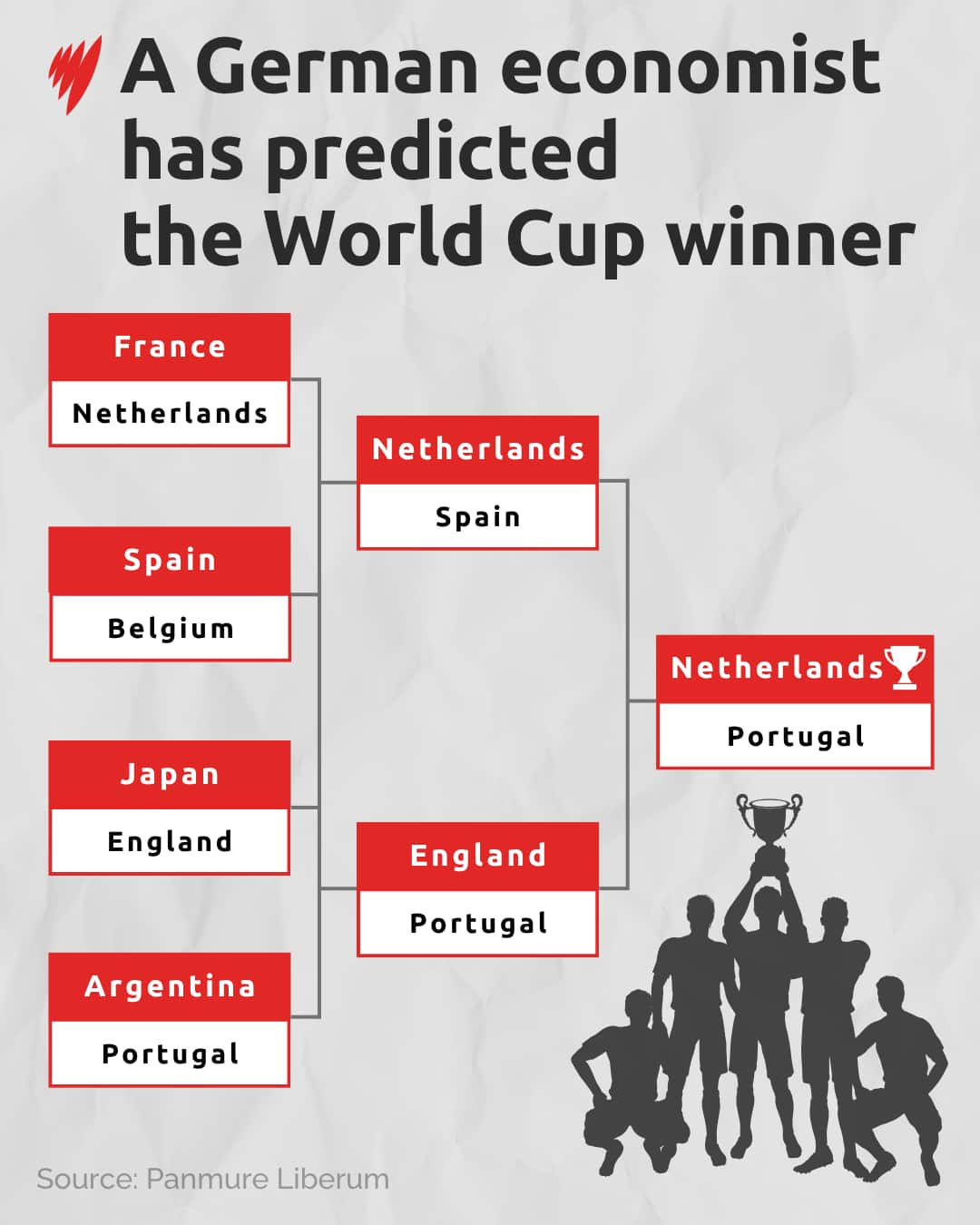
The Netherlands would then face Spain in the semi-finals.
"If Holland makes it to the semi-finals, it will be a situation where it already has a lot of confidence that it can beat anyone," he said.
"I think it will literally be 50/50 if you beat Spain or not, and if you beat Spain, then the path is clear to the World Cup."
Klement's formula calculates a final between the Netherlands and Portugal, who are considered sixth-favourite to win the tournament.
His proprietary econometric model measures five factors for a team's success: GDP per capita, population, temperature, FIFA ranking points, and the host-country advantage.
"If you look at my model, it uses economic fundamentals and climate fundamentals to assess how strong a team should be, and the closer two teams are in strength, the more luck plays a role in any individual match," Klement explained.
Predicting Australia's path through the FIFA World Cup
When it comes to the Socceroos' chances, Klement isn't as positive.
The Australians will make their seventh appearance at the men's World Cup finals, and have drawn Türkiye, the USA and Paraguay in the group stage.
"They will make it out of the group stage, but then very quickly run into Belgium," Klement said.
"That, in my model, will be the end of the Socceroos in that tournament because Belgium is, despite all, a strong team and stronger than Australia."
Klement created the formula to poke fun at his profession.
"Twelve years ago, when I started this, I thought this was a nice way to show how full of themselves economists are, thinking they can predict absolutely everything, even if they have no idea what is going on."
It went "horribly wrong".
"When I did it for the 2014 World Cup, I predicted Germany as the winner, and then Germany won. And then I did it again in order to show that it was just a fluke, and I got it right again, and a third time," he said.
The formula has brought Klement celebrity status in the nations he's predicted favourably.
"I suddenly became very, very popular in the Netherlands," he said with a laugh.
"This is great for me because I like to go to Holland at the end of each year on vacation. I just fear that if my prediction doesn't come true this time around, I might not be allowed back into the country in December!"

An economist at heart, Klement issued a warning to those taking his prediction as gospel.
"Now, I always stress that ... 50 per cent of each match is luck, which means that the prediction for the World Cup winner, more than 50 per cent of it is due to luck," he said.
"Just because I was right three times in a row doesn't mean I have a magic crystal ball."
The FIFA World Cup 26ᵀᴹ kicks off on 12 June (AEST) — with the tournament opener between Mexico and South Africa, kicking off at 5am (AEST).
This story was produced in collaboration with SBS Dutch.
You can watch all 104 games of the FIFA World Cup 2026™ live, free and exclusive on SBS, SBS VICELAND and SBS On Demand.
FIFA World Cup 2026™ at SBS On Demand: get match ready.
For the latest from SBS News, download our app and subscribe to our newsletter.







