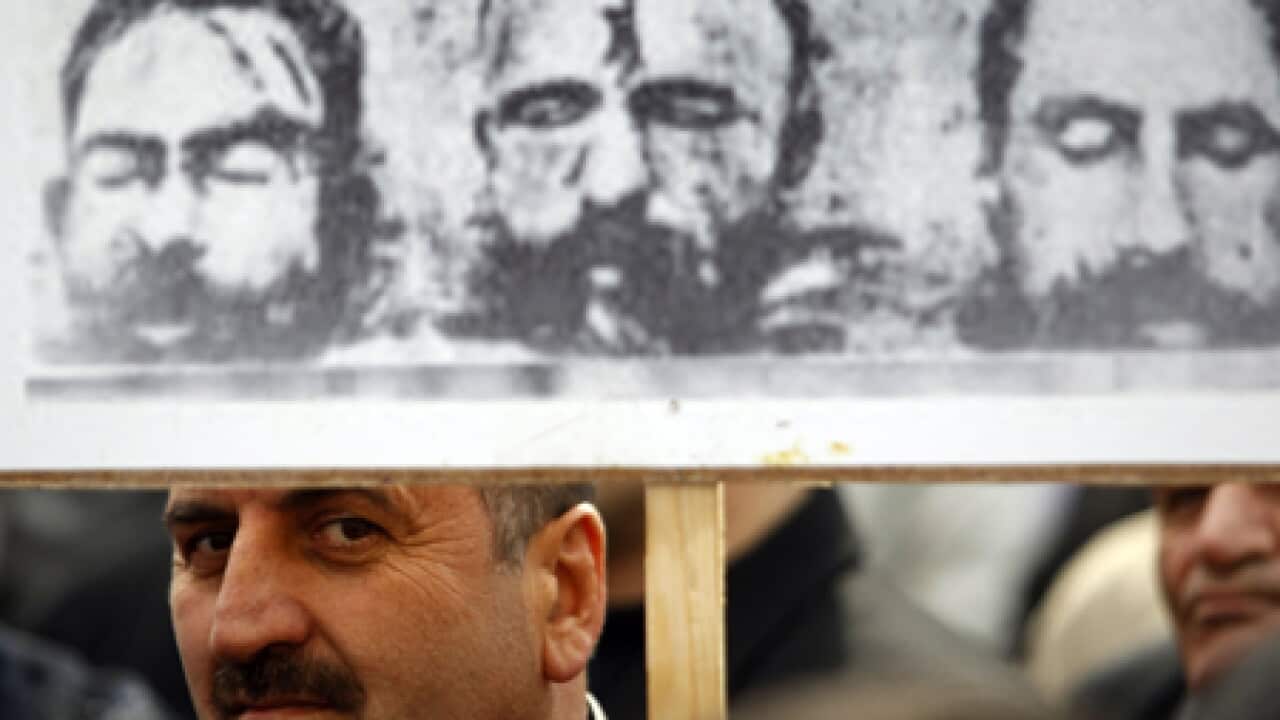
Tens of thousands of Armenians on Saturday marked the 95th anniversary of mass killings under the Ottoman Empire amid fresh tensions with Turkey over the collapse of reconciliation efforts.
Despite the political tensions, this year also saw the anniversary marked for the first time in Turkey, where rights activists and artists in Istanbul broke with taboo and commemorated the massacres.
Under grey skies in the Armenian capital Yerevan, a stream of people marched to lay flowers at a hilltop memorial to the massacres, which Armenians insist constituted genocide.
News that makes sense
Your trusted source for staying up-to-date with the world around you. Get free daily news updates and analysis, straight to your inbox.
Turkey fiercely rejects the genocide label and the dispute has poisoned relations between the two neighbours for decades.
Unprecedented reconciliation efforts begun last year fell apart just before the anniversary, when Armenia announced on Thursday that it was halting ratification of agreements normalising ties.
Calls for international recognition
President Serzh Sarkisian, who attended a solemn ceremony at the memorial, said international recognition that the killings constituted genocide was inevitable.
"We thank all of those who in many countries of the world, including in Turkey, understand the importance of preventing crimes against humanity and who stand with us in this struggle. This process has an inevitable momentum which has no alternative," he said.
In Istanbul, the IHD human rights group held a rally of about 100 people outside the Haydarpasa train station, from where the first convoy of Armenians were deported on April 24, 1915.
Hundreds later staged a sit-in at Taksin Square in the heart of the city as a strong police deployment kept a close watch.
Turkish intellectuals and artists signed a petition calling on "those who feel the great pain" to show their sorrow. Avoiding an open confrontation over the term genocide, the petition speaks of the "Great Catastrophe".
Lebanese Armenians and expats show support
Tens of thousands of Lebanese-Armenians also took to the streets in a peaceful demonstration in Beirut, while others blocked a main highway into the city.
In Paris several thousand people urged Turkey to recognise the genocide at a rally at the foot of the statue of Armenian priest and composer Komitas.
Renowned French singer of Armenian origin Charles Aznavour later kindled the flame of the unknown soldier at the Arc de Triomphe in memory of the dead.
"This is an important moment for us, to remember our parents and grand-parents," said 73-year-old Arsene Kalaidjian with tears in his eyes, telling AFP that his "father was nine when he was deported".
Hundreds of protesters also rallied outside the Turkish consulate in the southern city of Marseille.
In Brussels hundreds of Armenians and their supporters marched between the Turkish embassy and the EU headquarters shouting "justice for the Armenian people".
Dispute lives on
Armenians say up to 1.5 million of their kin were systematically killed between 1915 and 1917 as the Ottoman Empire, the predecessor of modern Turkey, was falling apart.
Turkey categorically rejects the genocide label and says between 300,000 and 500,000 Armenians and at least as many Turks died in civil strife when Armenians took up arms and sided with invading Russian troops.
The governments or parliaments of many countries, including France and Canada, have recognised the massacres as genocide.
But US President Barack Obama for a second year avoided using the politically charged term in a traditional anniversary statement.
He described the events 95 years ago as "one of the worst atrocities of the 20th century" but said he was encouraged by dialogue between Turkey and Armenia that would help recognise their "common humanity."
Turkish Prime Minister Recep Tayyip Erdogan, quoted by the Anatolia news agency, said Obama had "made a statement which takes into account the sensibilities of Turkey."
Ankara recalled its ambassador to Washington in March after a row over moves in Congress to brand the massacres as genocide, but returned the envoy this month.
Armenia and Turkey signed a landmark deal in October to establish diplomatic ties and reopen their border.
But ratification of the deal faltered amid mutual recriminations that the other side was not committed to reconciliation and Armenia on Thursday announced it was removing the agreement from its parliament's agenda.
Yerevan blamed Ankara for stalling ratification and linking the agreement with Armenia's conflict with Turkish ally Azerbaijan over the breakaway Nagorny Karabakh region.







