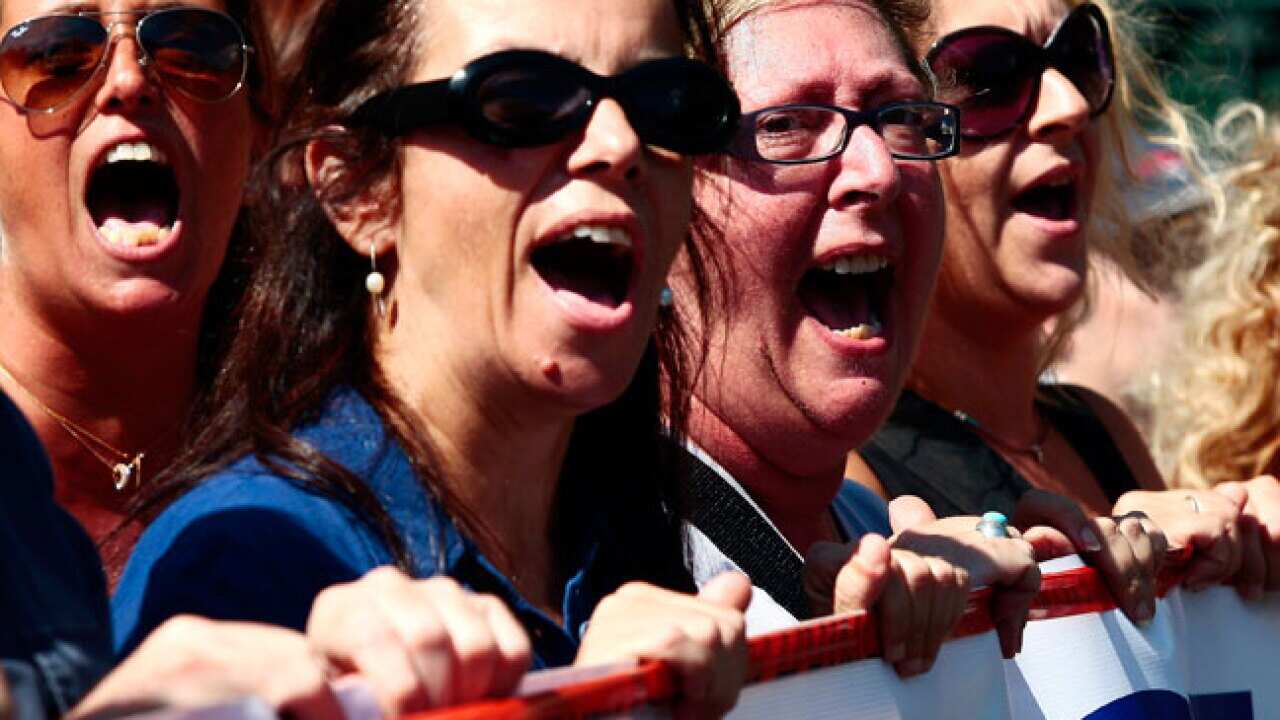
Greek police tear-gassed protestors in central Athens on Wednesday as public sector staff and students went on strike over austerity cuts, shutting down courts, schools and transport including flights.
On Athens' central Syntagma Square outside the parliament building, police used tear gas to clear some of the 20,000 protestors, who included some 300 anarchists, after firebombs were thrown at them, an AFP reporter said.
At least two protesters were injured, the ambulance service said, in addition to an AFP photographer struck in the face by a riot policeman's shield as she took pictures of his colleagues hitting a demonstrator lying on the ground.
News that makes sense
Your trusted source for staying up-to-date with the world around you. Get free daily news updates and analysis, straight to your inbox.
Another 10,000 people marched in the northern city of Thessaloniki.
The protests organised by the two main Greek unions, ADEDY and GSEE, came ahead of a general strike on October 19, which will also affect banks and shops.
It was called in response to new taxes, wage cuts and layoffs imposed by a government, fighting to avert a default on its debt payments, as the next installment of international aid hangs in the balance.
"Every time the public deficit gets bigger they impose new taxes, life is just getting too expensive," said Stavros and Helena, a married couple employed by the city of Athens.
"They should just put us on a boat and send us away," they told AFP.
"All workers must unite and coordinate their forces against this storm of measures that strike income and labour rights," ADEDY chairman Costas Tsikrikas told Flash Radio.
"If we don't resist we will lose everything," he said.
Interior Minister Haris Kastanidis said Greece must hold a referendum so the seemingly outraged public can vote on the government's response to the debt crisis.
There was a need, Kastanidis said, "for the Greek people, at this critical moment, to take a position on the fiscal problem."
He did not specify when such a call to the public would be made, or the exact phrasing of the question, but said, "it will not be an easy question, but a vital question."
Government spokesman Elias Mossialos later denied that a referendum was being planned.
Civil servants are protesting a plan to furlough some 30,000 employees, who will be on reduced pay for a year as they try to find other jobs.
The workers concerned already suffered sweeping wage cuts last year.
"Furlough equals layoffs," read a banner carried by municipal workers. Communist unions urged Greek to "organised resistance" as they marched on parliament.
The 24-hour walkout has shut down ministries, town halls, museums, schools and courtrooms, as well as flights in Greece. It also brought trains to a halt and hospitals were reduced to emergency staffing.
The labour plan, accompanied by downsizing at scores of state-owned companies, is designed to ease the state payroll as the government struggles to balance its bulging public deficit.
But there has been mounting criticism even within the ruling Socialist party.
"We have fallen behind in three crucial reform fields -- civil service wages, tax evasion and privatisations," former labour minister Louka Katseli told private television station Mega.
"We gave our (EU) peers an excuse to say that necessary reforms were not carried out in the summer," she said.
The additional austerity cuts are mandated by Greece's international creditors -- the EU, IMF and European Central Bank -- under an economic recovery programme launched last year in return for a 110-billion-euro ($149-billion) loan.
A high-level mission from the three organisations is currently conducting an audit of Greek finances and must sign off on the release of an eight-billion-euro loan installment next month.
Greece's state reserves to pay wages and pensions run out in November.
The country is trapped in a deepening recession and many Greeks point out that the cumulative cuts are only digging a deeper hole for the economy, which is expected to contract by 5.5 percent of output this year.
As the recession has repeatedly neutralised part of the sacrifices, there is concern that additional cutbacks to meet slipping fiscal targets are inevitable.







