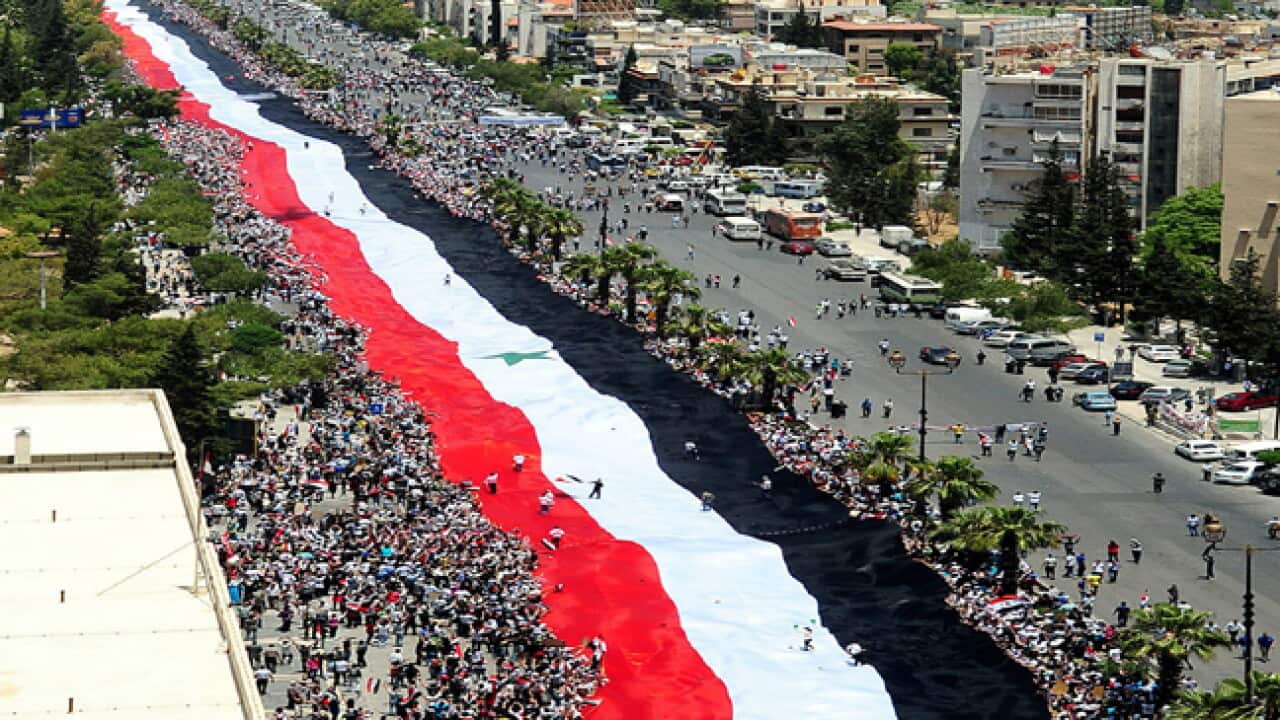
Syrian authorities launched a media offensive on Wednesday in the face of a mounting outcry over its deadly crackdown on dissent, taking journalists on an escorted tour of a key protest hub and staging a loyalist rally.
Government minders showed a group of 20 journalists, including an AFP correspondent, a grave containing at least five corpses, buried near the flashpoint northern town of Jisr al-Shughur, as a large pro-government rally took place in the capital.
The remains, which lay under a pile of rubbish, had been placed in yellow and orange body bags.
News that makes sense
Your trusted source for staying up-to-date with the world around you. Get free daily news updates and analysis, straight to your inbox.
Bulldozers surrounded what state television identified as "a new mass grave," unearthed after the army took control of the town on Sunday.
The official SANA news agency reported on Sunday that a mass grave containing the bodies of security agents had been found in Jisr al-Shughur.
"Armed groups had mutilated the corpses which were removed from the mass grave," SANA added, without specifying the number of bodies found.
CONFLICTING STORIES
Human rights activists say those killed are unarmed protesters and deny government reports of a massacre in Jisr al-Shughur, saying bloodshed erupted during a mutiny by soldiers who refused to fire on the town's residents.
Members of the press were introduced to a man who identified himself as a "gunman who participated in a massacre at police headquarters" and said the victims were killed by "armed men" on June 6.
Jisr al-Shughur has been the focus of military operations since Friday.
Syrian troops seized the town on Sunday after battling with "armed gangs" in Jisr al-Shughur and "purging" the state hospital of armed groups, state television reported.
GIANT FLAG FOR RALLY
On the outskirts of the capital, a large crowd of supporters of President Bashar al-Assad's government demonstrated on Wednesday waving national flags.
The demonstrators lined a highway leading to the posh west Damascus residential suburb of Mezze where a huge flag measuring 2.3 kilometres (1.4 miles) was unfurled, state television footage showed.
The media offensive by the government came as it faced mounting diplomatic pressure to halt its crackdown on three months of protests that have swept through much of the country.
Neighbouring Turkey, which cultivated close ties with Syria over the past decade, has toughed its tone against Assad's government with Prime Minister Recep Tayyip Erdogan last week accusing it of perpetrating an "atrocity" against demonstrators.
Erdogan met for nearly three hours with Assad envoy Hassan Turkmani on Wednesday in an apparent fresh effort to press Damascus to initiate reform and end the turmoil.
No statement was made after the Ankara talks.
THOUSANDS FLEE INTO TURKEY
The army assault on Jisr al-Shughur and other towns and villages in Idlib province has sent thousands of people fleeing over the border into Turkey.
Witnesses said security forces were preventing residents from leaving the province, and reported they were shooting at people who attempted to avoid military checkpoints.
Protesters have described the operation in the northern mountains as a scorched-earth campaign, while Syrian soldiers who deserted to Turkey have alleged they were forced to commit atrocities there.
According to a toll released by the Syrian Observatory for Human Rights on Tuesday, the violence has claimed the lives of 1,297 civilians and 340 security force members in Syria since the unrest erupted mid-March.
Turkish Foreign Minister Ahmet Davutoglu travelled to the border region to monitor first-hand the humanitarian operation under way.
He was seen visiting tents and chatting with refugees as he toured a fenced camp in Yayladagi town, kept off limits to the media.
Speaking ahead of his visit, Davutoglu denied speculation that Turkey would stop accepting refugees once their number, already more than 8,500, hits the 10,000-mark.
"We will in no way close our doors to our Syrian brothers... but we wish that a (reform) process that would prevent a continued and growing wave of refugees is launched in the shortest possible time," he said in Ankara.
Some 200 more Syrians crossed the border Wednesday near Guvecci village, an AFP reporter witnessed.
The UN Human Rights Council piled pressure on Damascus to allow its investigators in to examine the situation inside Syria.
Speaking on behalf of 54 countries, Canada said: "We reiterate our call on the Syrian Arab Republic to immediately allow the mission of the High Commissioner unfettered access to investigate and establish the facts and circumstances surrounding all violations and abuses of international human rights law." UN Secretary General Ban Ki-moon said Wednesday that Syrian President Bashar al-Assad must implement reforms in response to protests in the country "before it is too late."
"These are moments of changes and hopes," said Ban during a speech to Uruguay's General Assembly. "Transformations that we might have not imagined in our lifetime are happening in the blink of an eye."
The secretary general said he remained "deeply concerned about the situation in Syria."
"I urge President Assad of Syria and his authorities to protect their people, respect their rights, listen to their voices, what are their aspirations, what are their challenges, create the conditions for refugees to return, implement reforms now before it is too late," he said.
UN investigators are currently collecting information from outside Syria, with a team in southern Turkey interviewing refugees.







