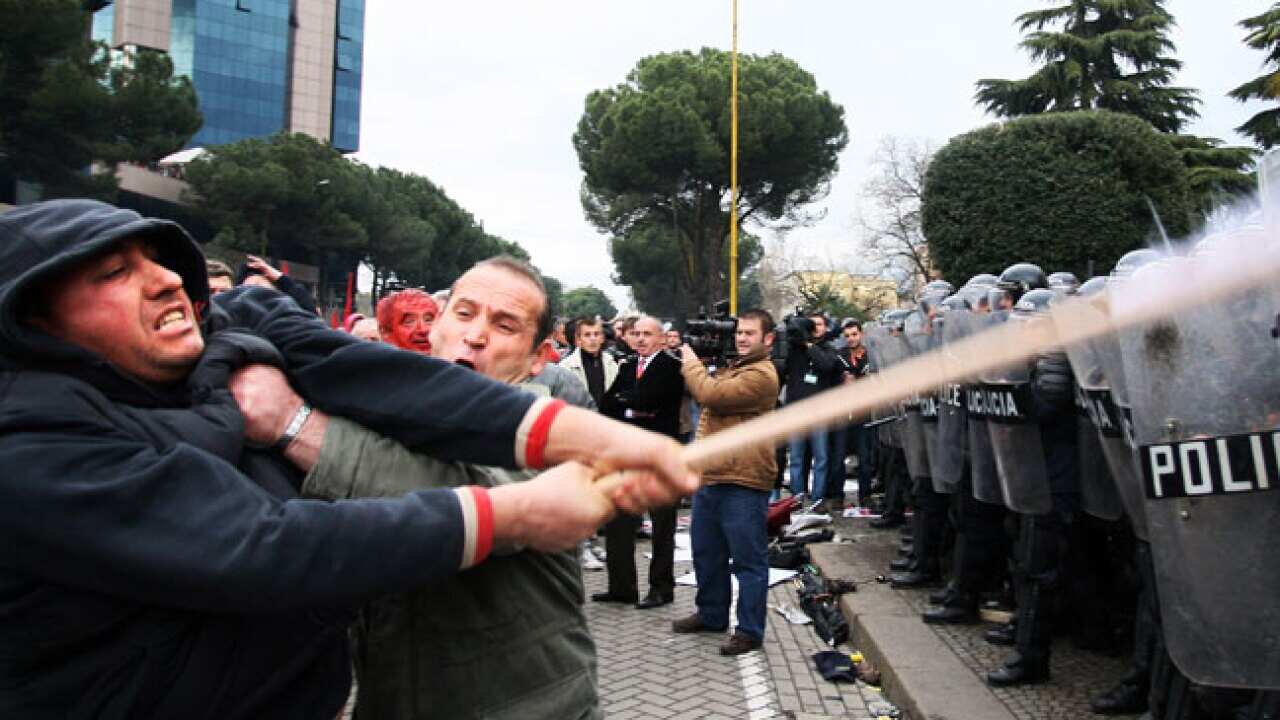
Three people were brought to the city's military hospital with fatal gunshot wounds, hospital emergency services chief Sami Koceku told AFP by phone.
It remained unclear who had shot the demonstrators, but Albanian Prime Minister Sali Berisha said they had been killed by weapons that police and the army "do not use" and blamed the protest's organisers for the violence.
News that makes sense
Your trusted source for staying up-to-date with the world around you. Get free daily news updates and analysis, straight to your inbox.
Police were yet to confirm the toll, but hospital sources reported 55 injured, of whom 25 were police officers and 30 civilians.
The clashes marked the first time opposition protests had ended in violence since the political crisis erupted after disputed 2009 general elections.
After hours of tension, police managed to disperse thousands of protestors gathered in the centre of the capital in response to a call from the socialist opposition to protest Berisha's government.
The socialists, led by Tirana Mayor Edi Rama, called the demonstration to pressure the government to step down, accusing it of corruption and electoral fraud.
Their call came after last week's resignation of deputy prime minister Ilir Meta, who is at the centre of a corruption affair.
Demonstrators threw stones and other projectiles at the security forces, who responded by firing tear gas into the crowd and used a water cannon in front of government buildings.
Several police cars and vans were set on fire by protesters while some of them tried to break through a riot police cordon.
Preserve political stability: President
Albanian President Bamir Topi called for calm, urging "all political figures to urgently return to dialogue and take a responsibility to preserve political stability."
"Albania needs to cure its wounds, not to open new ones," Topi said in a statement.
Rama also sought to ease tensions, but insisted the clashes had been provoked by the police.
EU foreign policy chief Catherine Ashton and the EU's Enlargement Commissioner Stefan Fuele said in a joint statement: "Demonstrations are instruments of freedom of expression and peaceful assembly for citizens.
"We deplore that today's event has spiralled into violence. We urgently appeal to all political forces to call for calm and refrain from provocation," they added.
OSCE condemns bloodshed
The Organization for Security and Co-operation in Europe also condemned the bloodshed.
"The right to demonstrate comes with a responsibility to do so peacefully," said Lithuanian Foreign Minister Audronius Azubalis, currently chairman of the OSCE.
"Dialogue and co-operation could contribute to resolving the problems Albania is facing. Violence and provocative statements only aggravate the situation."
Council of Europe general secretary Thorbjorn Jagland also called for an end to violence.
Political deadlock
Albania has been in political deadlock since its last elections. The opposition refused to recognise the results, blocking legislation and reforms in parliament.
The opposition also blamed the government over its failure to convince the European Union to agree on the country's candidate status.
Albania has the green light from Brussels for visa liberalisation, but its request for EU candidate status was rejected.
Instead, Brussels urged Tirana to step up its fight against corruption and expressed concern about the political crisis.
Rama, joined by leaders of other smaller opposition coalition partners, has led the protests, claiming that the vote count was rigged to ensure the Berisha's governing Democratic party was re-elected.
Berisha, who controls 75 of parliament's 140 seats, has rejected their calls for a recount.
Later, the opposition decided to take part in parliament sessions but not in the voting, making it hard for the country to pass much-needed reforms, especially those linked to integration steps toward EU membership.
International efforts to mediate between the two sides have so far failed.
Since the collapse of Albania's hardline communist regime in 1991, elections in the country have often been marred by violence and allegations of fraud. The current impasse is the longest political crisis the country has faced.







