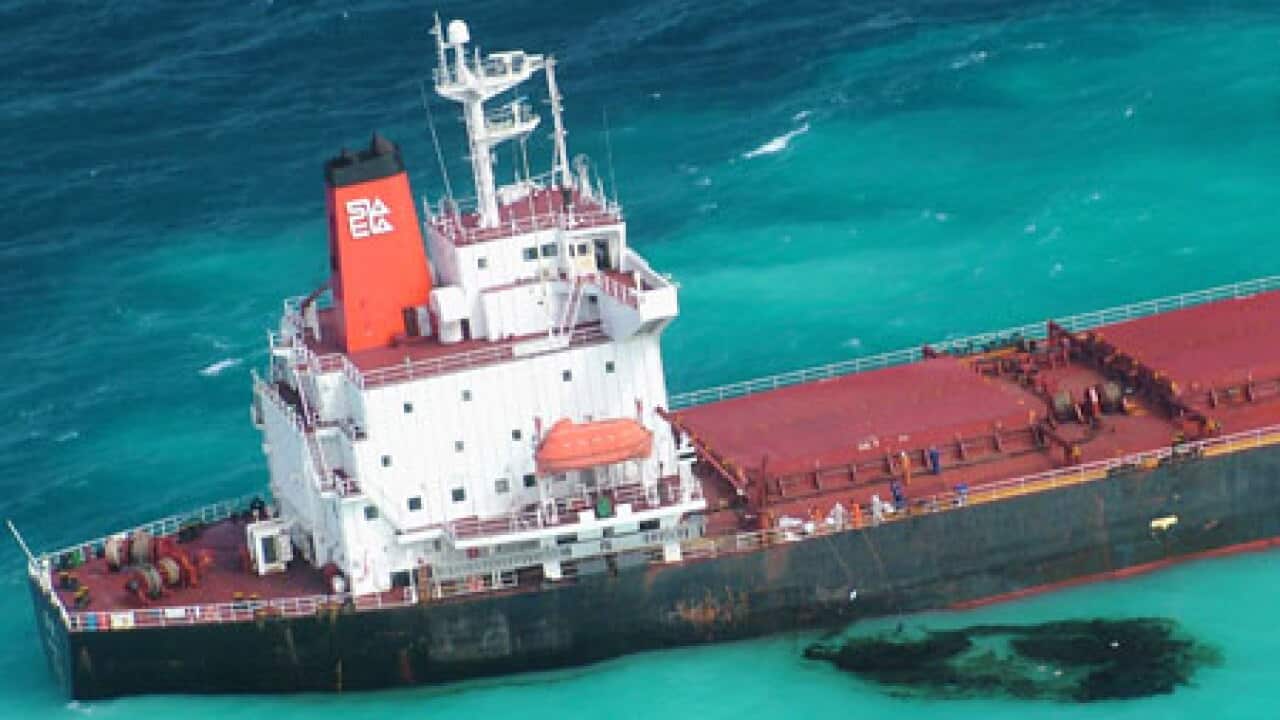
Queensland will increase its penalties for ships causing oil spills five-fold, threatening offenders with fines of up to $10 million, as authorities say will attempt to refloat the stranded bulk coal carrier on the Great Barrier later on Monday night.
Premier Anna Bligh said cabinet had approved new laws following the oil spill from the Chinese bulk coal carrier Shen Neng 1, which ran aground on the Great Barrier Reef last week.
Ms Bligh said the maximum penalty for corporations would increase by five times from $1.75 million, while individuals would face a $500,000 fine - up from $350,000.
News that makes sense
Your trusted source for staying up-to-date with the world around you. Get free daily news updates and analysis, straight to your inbox.
'On par with country's toughest'
The penalties would apply also when oil spills in commonwealth waters drifted into state waters and washed up on the state's coastline, and would be equal to the toughest penalties in the country, Ms Bligh said.
"This increase in penalties will send a message to the thousands of ship crews who pass through Queensland waters that nothing but the greatest attention to safety and care will be tolerated," she said.
"Ten million dollars is a lot of money for any company to have to hand over in the event of a marine mishap, and it would be in addition to any compensation a company would to pay for a clean up."
The new legislation will be introduced to Queensland parliament this week.
Refloating hopes
Salvagers say the 230-metre Shen Neng 1, which ran aground on Douglas Shoal off Rockhampton on April 3, has been moving slightly, raising hopes the vessel can be refloated.
Preparatory efforts on Monday have involved pumping compressed air into its tanks, to see what kind of lift that provides.
Most of the 970 tonnes of heavy fuel oil aboard the ship has already been pumped out ahead of the attempt to refloat the carrier.
Maritime Safety Queensland general manager Patrick Quirk said the plan, to be confirmed at 5pm (AEST), would attempt the refloat at 6pm, with high tide expected at 8pm.
He said the formation of an east coast low in the area had hastened the refloat operation.
"Doing nothing at the moment is not an option," he said.
Time running out
"We would need to try to move that vessel before the swell and the wind increases tomorrow afternoon (Tuesday)."
He said divers had not inspected the physical damage underneath the vessel but naval architects who inspected the inside believed it had enough stability and strength to survive a refloat.
Following the refloat, authorities would inspect the vessel to ensure there were no structural failures or further oil leaks before it was tugged to safe waters northwest of Keppel Island.
'Window of opportunity'
But he said there were "no guarantees".
"We have another window of opportunity eight o'clock tomorrow morning if we fail tonight," he said.
Mr Quirk said extra tugs would be sent to help if the carrier remained stranded when the weather turned late on Wednesday.
"We would just need to handle that," he said.
"... It's not ideal conditions but these salvors save vessels in the middle of the north Atlantic storms and I'm sure we can get the vessel off.
"Unfortunately the vessel will probably suffer more damage during that process and there's increased risk of oil leaking from the vessel in those circumstances."







