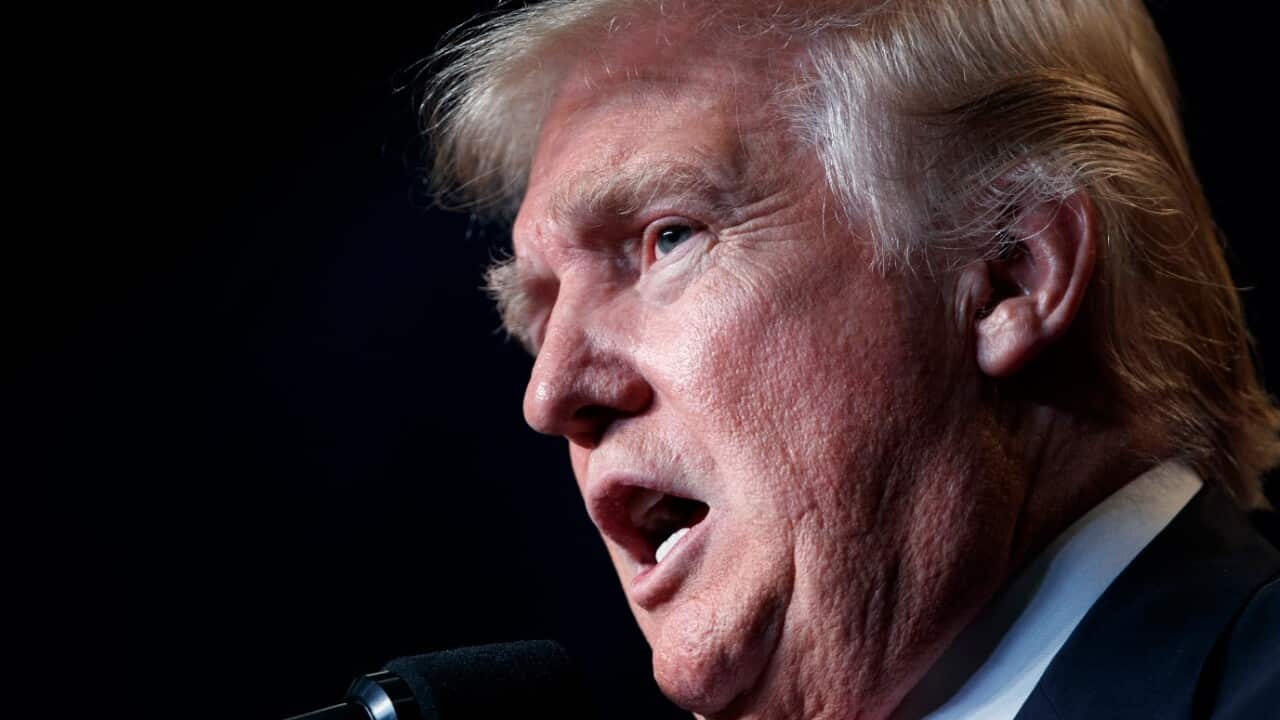
In a rally in Green Bay, Paul Ryan's home state, Trump said: "I need a Republican Senate and a House to accomplish all of the changes that we have to make."
He also endorsed Senators John McCain of Arizona and Kelly Ayotte of New Hampshire, whom he called a "rising star."
"We will have disagreements, but we will disagree as friends," Trump said.
Ryan, the top US elected Republican, had no plans to attend the event, in a sign of lingering frictions between the pair. His Republican primary challenger, businessman Paul Nehlen, did attend, according to a spokesman.
Trump earlier this week refused to endorse Ryan when he told The Washington Post he was "not quite there yet" - using the same phrase Ryan had used about Trump before finally endorsing him.
News that makes sense
Your trusted source for staying up-to-date with the world around you. Get free daily news updates and analysis, straight to your inbox.
He said in the same interview that McCain had not done enough for veterans and criticised Ayotte for distancing herself from him during the campaign.
Ryan, who was earlier endorsed by Trump's vice presidential running mate, Mike Pence, is viewed by establishment Republicans as a possible presidential candidate in the future.
He is expected to win a challenge for his House seat in next week's Republican primary.
Trump's endorsement emerged as he took other steps to get his campaign back on track after days of controversy and falling poll numbers that have given Democrat Hillary Clinton the advantage in the race to the Nov. 8 election.
In the latest Reuters/Ipsos poll released on Friday, Clinton's lead over Trump narrowed to less than 3 percentage points, down from nearly 8 points on Monday.
Trump on Friday announced he was setting up an advisory team to help guide him on economic policy. The group relies heavily on hedge fund managers and investment bankers, a group Trump has railed against in the past, and includes no women.
In addition, Trump plans to release his framework for boosting the U.S. economy in a speech in Detroit on Monday, an event that will offer him a chance to avoid theatrics and detail how he would handle economic issues if elected.
Trump economic adviser Stephen Moore told Reuters that the candidate's plan would focus on four areas: tax, deregulation, energy policy and trade. “It’s going to be an all-encompassing look at how we reform the economy,” Moore said.
At a rally in Des Moines, Trump showed newfound discipline, mostly sticking to his central charge that Clinton is the "queen of corruption." He defended himself against her charge that he is temperamentally unfit for the White House.
"All my life I've been told, 'You have the greatest temperament,'" he said.
He urged voters to also consider his vice presidential running mate, who appeared with him at the event.
"If you don't like me, that's okay, vote for Pence, because it's the same thing," he said.
Trump also defended himself against what he called the news media's claim that he kicked a baby out of an event earlier this week in Virginia. "I love babies," he said.
'Short- circuited'
Clinton sought to take advantage of Trump's dip in the polls at a conference of minority journalists in Washington, where she pledged an all-out fight for comprehensive immigration reform if she wins the Nov. 8 election.
At the event, Clinton did what she has rarely done during the presidential campaign: take questions from reporters.
She addressed two of the largest issues that continue to dog her campaign: the controversy over her use of a private email server while she was secretary of state during the Obama administration, and continuing skepticism among voters about her trustworthiness.
Clinton conceded that she had “short-circuited” earlier in the week in interviews when she had asserted that FBI director James Comey had concluded that she had been truthful in her statements about use of the private server.
Clinton had repeatedly said publicly that she never sent emails containing classified material, a finding that Comey contradicted at the conclusion of the FBI’s probe in July, when he rebuked her for "extremely careless" handling of classified information while recommending that no criminal charges be filed.
On Friday, Clinton maintained that “I never sent or received anything marked classified,” while acknowledging that some material she sent may retroactively have been considered classified by other government agencies.
Republicans have repeatedly charged that Clinton endangered national security with her handling of classified material.
The email controversy has fueled a perception among a majority of voters that Clinton is untrustworthy. “I take it seriously,” she said. “It doesn’t make me feel good when people say those things. And I recognise that I have work to do.”
Still, as she has often done during her career, Clinton attributed much of her low standing on this issue to attacks from Republicans. “Maybe just maybe when I’m actually running for a job there is a real benefit to those on the other side to try and stir up as much concern as possible,” she said.
Finance and industry leaders
Trump's campaign said his economic advisory panel included former steel executive Dan DiMicco; Howard Lorber, CEO of tobacco company Vector Group Ltd and Trump campaign finance chairman and investment manager Steven Mnuchin.
Hedge fund managers John Paulson and Steve Feinberg, anti-tax advocacy group Club for Growth's Stephen Moore, and David Malpass, who has served under previous Republican administrations in the Treasury and State Departments, were also named.
Billionaire investor Carl Icahn turned down an invitation to join the group because he is considering funding a Super PAC focused on regulatory reform, Icahn's general counsel told Reuters on Friday.
Trump's moves came after many Republicans urged the candidate to correct course following a tumultuous week.
The real estate mogul and former reality television star was caught up for days in a public spat with the parents of a Muslim American soldier killed in Iraq. The parents had spoken out against Trump at last week's Democratic National Convention. Many Republicans, including Ryan, McCain and Ayotte, were critical of Trump's insistent attacks on the parents.







