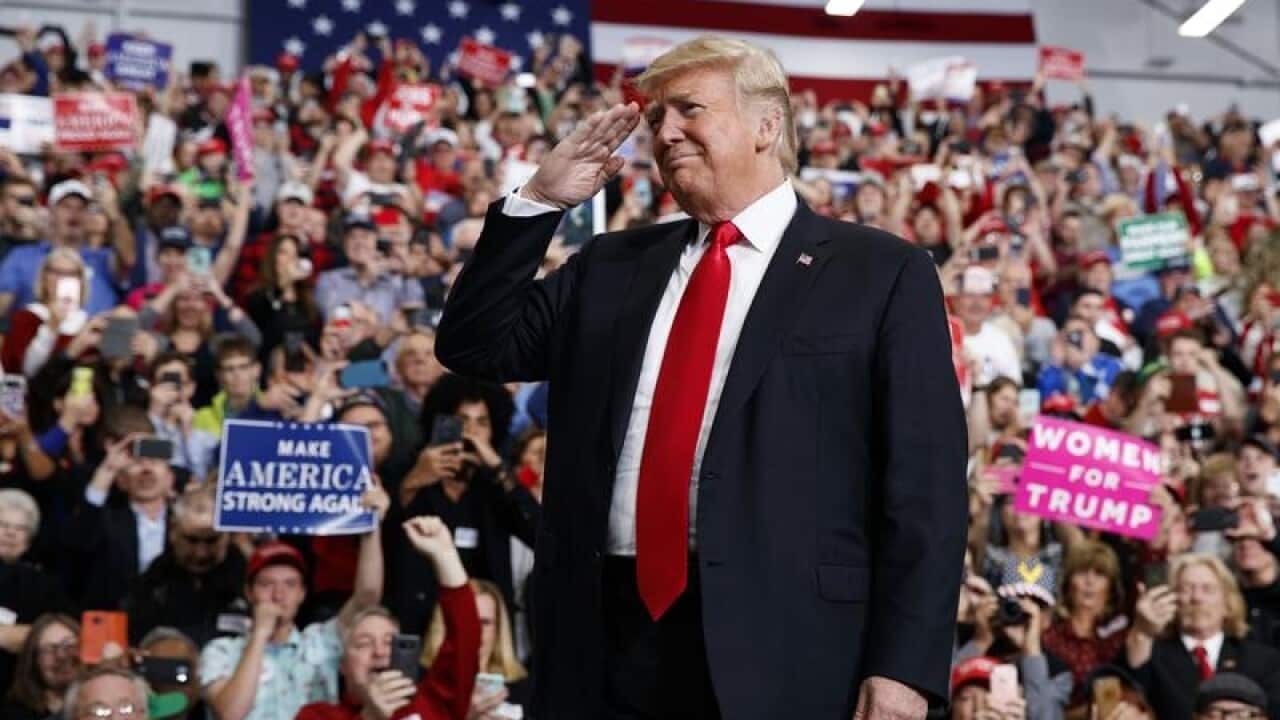
President Donald Trump is in the final stretch of a 44-city blitz for the midterm elections but the America he's glimpsed from the airport arrivals and his armoured limousine is hardly a reflection of the nation as a whole.
The president has mostly travelled to counties that are whiter, less educated and have lower incomes than the rest of the United States, according to Census Bureau data.
It's a sign he is seeking to galvanise the same group of voters that helped carry him to victory in 2016.
Trump has largely eschewed the big metropolises for smaller cities.
He has been to Tampa, Nashville, Cleveland and Houston - where the arenas could accommodate his crowds. But he's primarily been jet-setting to smaller places such as Elko, Nevada (population 20,078). Or, Mosinee, Wisconsin (population 4,023). Or, Belgrade, Montana (population 7,874).
News that makes sense
Your trusted source for staying up-to-date with the world around you. Get free daily news updates and analysis, straight to your inbox.
When Trump stops at Belgrade on Saturday, records suggest he will be the second president to visit the Montana town named after Serbia's capital city.
In 2009, Barack Obama held a town hall there to promote the Affordable Care Act.
Since March, Trump has crisscrossed the country like a salesman with a set territory.
The majority of his trips have been to just nine states: Ohio, Pennsylvania, Tennessee, Florida, Missouri, Montana, Indiana, West Virginia and Nevada.
Trump won eight of them in 2016 but not Nevada. And this year, seven feature a major Senate race with a Democratic incumbent.
The former casino magnate has visited one city twice for the mid-terms: Las Vegas.
Trump has journeyed to counties where it's slightly more of a struggle to reach and stay in the middle class.
Out of his scheduled rallies, 74 per cent are in counties with median incomes that fall below the national level.
But he's brought tidings of a 49-year low unemployment rate and accelerated economic growth to places that mostly lag the median US household income of $US55,032 ($A76,332).
In September, Trump went to Wheeling, West Virginia.
The typical household income in the county surrounding Wheeling is $US41,986 or about $US13,000 below the national level.
The metro area has lost 818 jobs in the 12 months that ended in August, according to the Bureau of Labor Statistics. And for West Virginia, coal mine jobs have declined this year after a hiring bump in 2017.
"Your state is booming like never before," Trump told the crowd in Wheeling.
"And our great coal miners are back to work."
Trump has visited a few affluent counties.
He stopped by Rochester, Minnesota, where incomes are high because of the presence of the world-renowned Mayo Clinic.
And during a special congressional election in August, the president campaigned in Delaware County, Ohio, where the median household income of $US94,234 is just shy of being double the national average.
Just 18.1 per cent of the adults in Elko County, Nevada hold a college degree.
That's compared to 30.3 per cent nationwide. Of the 43 places Trump is visiting, 28 have a below-average share of college graduates.
Elko's economy is unique because it relies on mining gold, instead of the office and health care jobs that often require a college diploma.
The county has five active gold mines, according to the Nevada Commission on Mineral Resources. This makes it something of an outlier in country where mining metal ore accounts for 0.03 per cent of all jobs.
Trump went to Elko in part to help push for the re-election of Republican Senator Dean Heller, who is in a tight race against Democratic Representative Jacky Rosen.
Heller flattered the president - and provided the lone reference to the local economy - by telling him, "I think everything you touch turns to gold."
When Trump has gone to more educated counties, it's often because they have a major college campus and venues where people can gather.
Missoula is home to the University of Montana and 41.8 per cent of its adults are college graduates. The University of Missouri is in Columbia, where 46.8 per cent of adults hold college degrees.
Other than his rallies at big cities, Trump has generally been in communities that are overwhelmingly white.
The US population is 73.3 per cent white but almost three-fourths of the places where the president has stumped for mid-terms are above that average.
In the county surrounding Council Bluffs, Iowa, 88.7 per cent of the population is non-Hispanic whites.
Trump told the crowd at his rally Democrats would allow Central American gangs such as MS-13 to immigrate freely into the United States.
"They want to turn America, these Democrats - and that's what they want - into a giant sanctuary for criminal aliens and the MS-13 killers," Trump said.
In the area around Council Bluffs, 6.1 per cent of the population is of Mexican descent. About 1 per cent are from other Hispanic nations. By comparison, 17.3 per cent of the US population is Hispanic.
The biggest outlier in Trump's schedule may be his rally on Sunday in Macon, Georgia. Its county is 53.9 per cent black, making it the lone place being visited by the president where minorities make up the majority.
Trump is going there to promote the gubernatorial candidacy of Republican Brian Kemp. He is running against Democrat Stacey Abrams, who is trying to become the first black female governor in US history.







