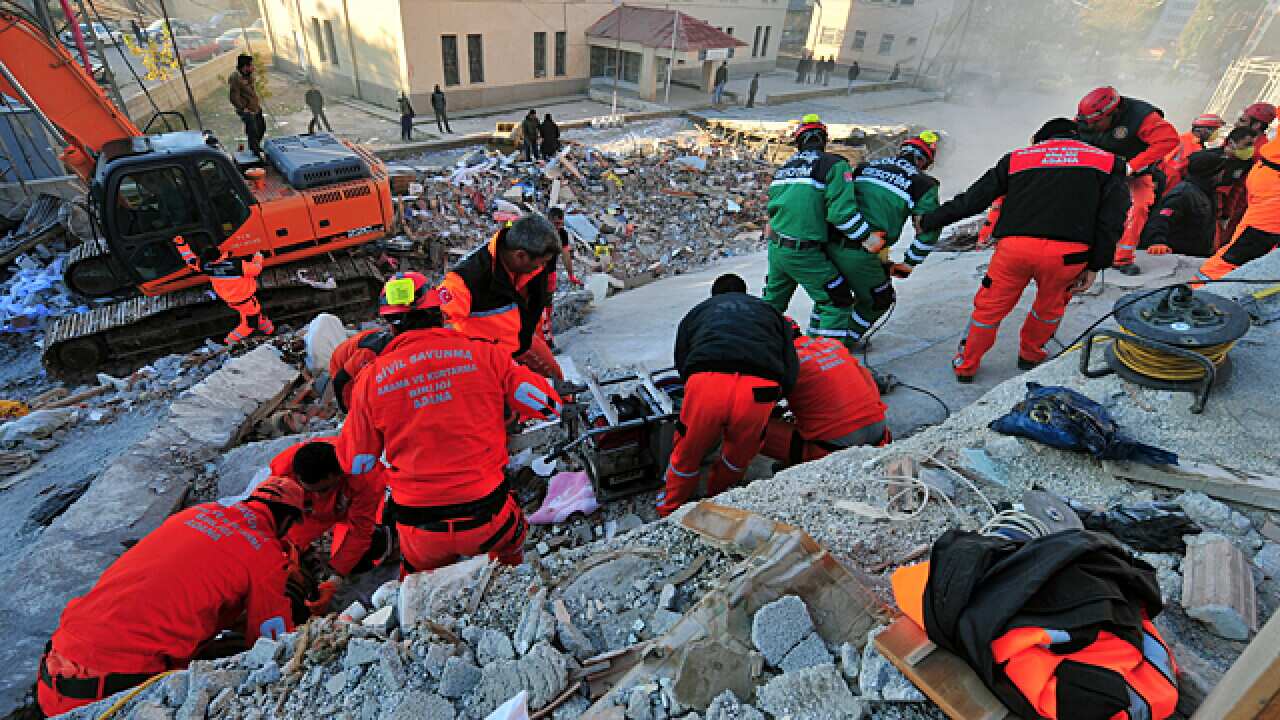
Homeless survivors of Turkey's devastating earthquake shivered in sub-zero temperatures as the government admitted that it was struggling to cope with the demand for shelter.
As the death toll neared 500 and complaints mounted over the speed of the relief effort, authorities were in a race against time to provide some form of shelter with snowfall expected.
After the rescue of a 16-day-old baby and her grandmother sparked scenes of joy on Tuesday, emergency teams managed to beat the odds again on Wednesday by pulling a 27-year-old woman out of the rubble of her home in the eastern town of Ercis, which took the full brunt when disaster struck on Sunday.
News that makes sense
Your trusted source for staying up-to-date with the world around you. Get free daily news updates and analysis, straight to your inbox.
Gozde Bahar, a teacher, was immediately rushed to hospital after being trapped under the rubble for 66 hours.
But her rescue was a rare slice of good news as the number of body bags mounted.
The latest official death toll was 461 but the International Federation of Red Cross and Red Crescent Societies said that "hundreds, possibly thousands" of people are still trapped under the rubble.
And as hopes of finding more survivors receded rapidly, the complaints from those left homeless grew louder.
There was uproar among the crowds when they learned that the local governor's office had stopped distributing tents, instead transferring responsibility to village headmen.
"Yesterday I waited here until midnight and I received nothing. I came back this morning at 3:00 am and have been waiting since then and now the distribution is cancelled," said 29-year-old Erdal Bayram, a construction worker.
"I need a tent for myself and for my father. We made a makeshift tent to sleep under but it rained last night and the wind was blowing."
Hasan Edemem, a 31-year-old teacher, worried that the village headmen would not give priority to those most in need of shelter.
"Now they are transferring the responsibility to village headmen but I am pretty sure they will allocate the tents to their fellows," Edemem said.
On Tuesday, locals had to wait in queues stretching for hundreds of metres outside the governor's office before being handed supplies by the military police.
"They treat us here like animals," said one young local waiting in line.
"We stopped the distribution because there was too much confusion here. It will start as soon as we can restore security and order," said an official in the governor's office.
While the government in Ankara initially refused outside offers of help it reversed that decision late Tuesday.
"We were not expecting such a huge demand for tents," the daily Milliyet quoted Besir Atalay, the deputy prime minister, as saying.
"When people ask for tents for 100,000 households, you cannot meet that demand," Atalay said.
Israel's foreign ministry said that it had been asked to help despite the recent deterioration of ties between the two countries.
Some remote villages in the worst affected Van province have received only rudimentary help so far.
In the village of Guvecli, locals said they had had to recover the bodies of their loved ones by themselves.
"We had to do it by our own means, by shovels and digging tools," Guvecli resident Ahmet Yayin told AFP.
While the Red Crescent had handed out some tents, they were far from enough to go round.
"We are a family of 12 but we could only get one tent," said Abdulaziz Yatkin, another villager. The tents are designed for a maximum of five.
Residents clustered around fires to keep warm on Wednesday. Snow was forecast for later in the day.
In Gedikbulak village, only 70 tents were distributed for a population of 2,000, the NTV news channel reported. Only a few houses remained standing there.
Turkey has a tragic history of earthquakes, including in Van province.
In 1999, two strong quakes in northwest Turkey's heavily populated and industrialised regions left some 20,000 dead. A powerful earthquake in the town of Caldiran in Van province killed 3,840 people in 1976.







