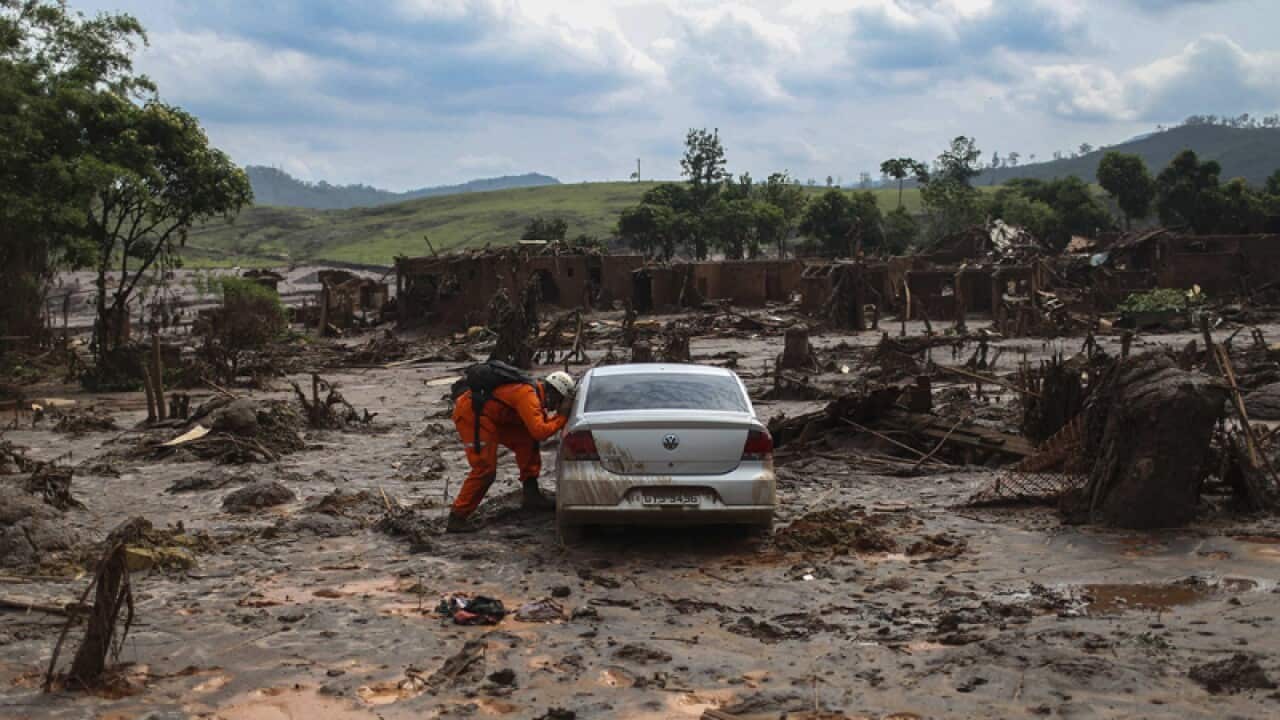
Brazilian authorities are still struggling to determine what caused the rupture in dams at an iron ore mine or even recover the bodies of as many as 28 people believed to have been swept away in the massive mudflow and flood.
The disaster in the mineral-rich southeastern state of Minas Gerais, directly north of Rio de Janeiro, has prompted a rescue and salvage operation involving about 500 people, many of whom are still searching with the help of dogs and special equipment for victims along the floodplain downstream from the dams.
Authorities late on Sunday recovered two more corpses of possible victims that if confirmed would raise the death toll so far to four. Of the 28 people listed as missing late on Sunday, 13 were mine workers.
The intensity of the destruction, with flooding and mud as far as 100km away from the mine, has meant a slow and laborious rescue effort. It has also sparked calls by government officials, environmentalists and outraged residents for Brazil to rethink regulation of the mining industry, one of the country's biggest and a leading source of export revenue.
"We have to learn the lessons of this accident," said Fernando Pimentel, the state governor, in comments to reporters after a flyover of the devastation on Sunday. "Obviously, this wasn't enough," he added, referring to the existing regulatory framework.
News that makes sense
Your trusted source for staying up-to-date with the world around you. Get free daily news updates and analysis, straight to your inbox.
Meanwhile, government leaders and residents criticised what they say has been lax communication by mine operator Samarco, a joint venture between the world's largest mining company BHP Billiton Ltd and the biggest iron ore miner, Vale SA.
On Sunday, BHP said Andrew Mackenzie, chief executive officer of the Australian company, was flying to Brazil to meet with Samarco executives and local authorities to better assess their needs. In a statement, the company said it was providing Samarco "with all the assistance necessary".
Vale, a Brazilian company with a long history of operations in Minas Gerais, has referred all queries about the incident to Samarco.
Displaced residents, whose homes were destroyed or damaged by sludge stained with mineral waste, were especially critical of Samarco for the uncertainty they now face. Authorities said as many as 580 people at present are taking shelter in hotels or with family and friends.
Samarco is paying for accommodations and relocation, but those affected complain that the company has given few answers about how long the displacements might last or how they might eventually repair or replace damaged homes.
"They haven't said until when we can stay or where we'll go afterwards," said Gilberto Perreira da Silva, standing outside a hotel where he is being lodged in the old centre of Mariana, the city closest to the mine. Da Silva's village was washed away by the waters.
Cristiane Temporao, a Samarco employee tending to those at the hotel, asked for patience while the company determines the best course. "When we settle on a plan it's got to be a good one," she said.
While the surge of the waters after Thursday's rupture has receded, authorities are still watching the contaminated residue as it advances through the Rio Doce. The residue is expected to reach the neighbouring state of Espirito Santo by Tuesday.
Until they have a better sense of what might have caused the rupture, authorities are also probing whether indications of possible trouble at the mine might have been ignored.
On Saturday, the Estado de S. Paulo newspaper reported that a study commissioned by the state government in Minas Gerais in 2013 had warned that the dams that burst could be vulnerable.
At a time when iron ore prices have collapsed compared with historic highs in recent years, cleanup and other costs related to the disaster, including regulatory penalties and any litigation Samarco may face, are expected to be high.







