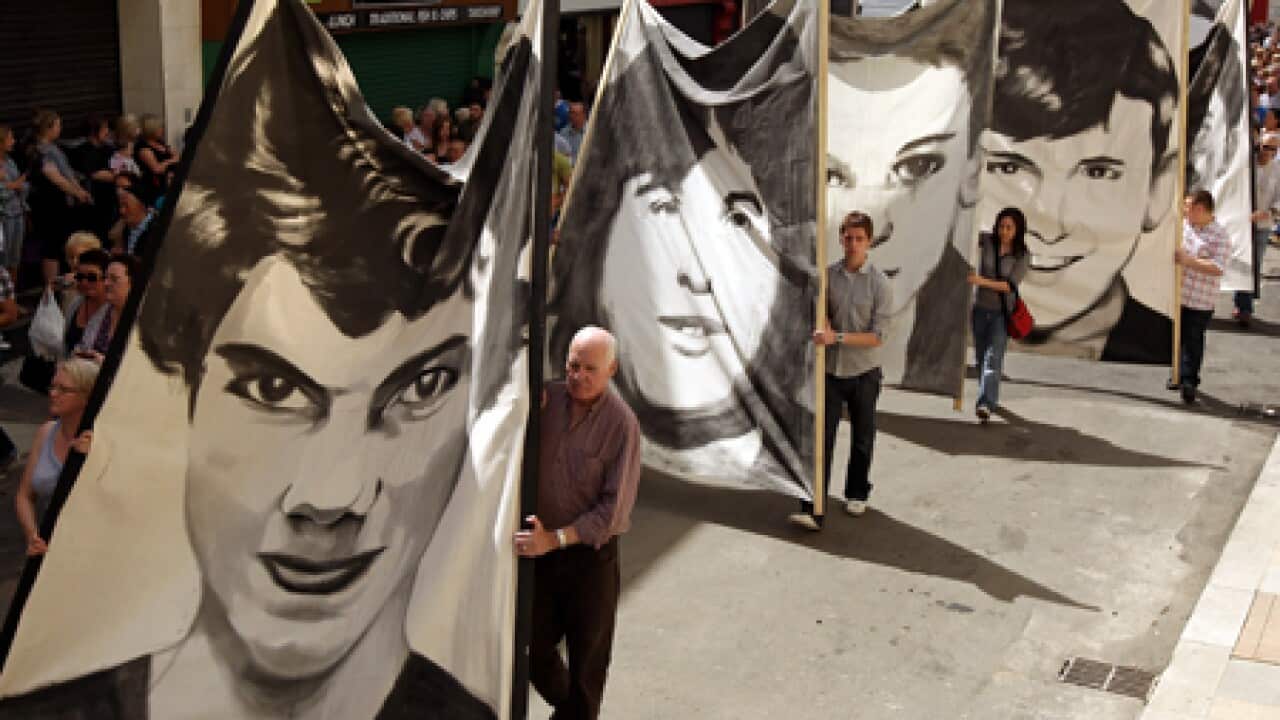
The British government finally apologised Tuesday for Bloody Sunday, one of Northern Ireland's darkest days in which 13 people died, calling the killings "unjustified and unjustifiable".
Prime Minister David Cameron made the admission as a long-awaited report into why British troops opened fire on a civil rights march in Londonderry in 1972 was published, to joy from victims' families.
It concluded that none of the victims were armed, soldiers gave no warnings before opening fire and that the shootings were a "catastrophe" for Northern Ireland, leading to increased violence in subsequent years.
"There is no doubt... what happened on Bloody Sunday was both unjustified and unjustifiable. It was wrong," Cameron told the House of Commons in London.
"The government is ultimately responsible for the conduct of the armed forces. And for that, on behalf of the government, indeed on behalf of our country, I am deeply sorry."
News that makes sense
Your trusted source for staying up-to-date with the world around you. Get free daily news updates and analysis, straight to your inbox.
The new premier's apology was greeted with cheers from relatives and thousands of supporters listening to his statement on a huge screen in Londonderry.
Amid jubilant scenes in Northern Ireland's second city, relatives took turns to voice their relief that their 38-year campaign to clear their loved ones' names had been vindicated.
"Now the world knows the truth," said Liam Wray, whose 22-year-old brother died in the shootings after being shot in the back.
"Jim was murdered, Jim was innocent," Wray added. The killings were among the most controversial in Northern Ireland's history and there had been fears the 5,000-page report could re-open old wounds.
More than 3,500 people died during The Troubles which pitched Catholics against Protestants and were largely ended by a 1998 peace deal, but emotions still run high in Northern Ireland over its violent history.
British soldiers, most of whom were identified only by their rank and initials in the report, could still face prosecution over the shootings.
Northern Ireland's Public Prosecution Service said it was considering whether to prosecute anyone, adding this decision would be taken "as expeditiously as possible" although it gave no date.
But lawyer Stephen Pollard, who represents some of the soldiers involved in the inquiry, rejected claims that the report had opened the door for British troops to be prosecuted. He accused the senior judge who led the inquiry, Mark Saville, of having "cherry picked" evidence to support the investigation's results.
And a reminder of how relevant the events are to the present day came with a reference to the role played on that day by Northern Ireland's Deputy First Minister Martin McGuinness, who was then an Irish Republican Army (IRA) commander.
The report said McGuinness was present on Bloody Sunday and was probably armed with a sub-machine gun which he may have fired. He denied this and the probe said he did nothing to provoke soldiers opening fire.
"There was absolutely no foundation or substance to that allegation, which we all have to remember came from very, very suspect characters," he said after the report's publication on Tuesday. The inquiry, which took 12 years to report at a cost of more than STG190 million ($A326.07 million), aimed to paint a full picture of events.
It is the longest-running and most expensive public inquiry in British history.
The inquiry was commissioned by then premier Tony Blair in 1998 as the peace process gained momentum and after a 1972 probe, immediately after the killings, was dismissed as a whitewash.
Irish Prime Minister Brian Cowen welcomed the report, saying its publication meant "the truth has been set free".







