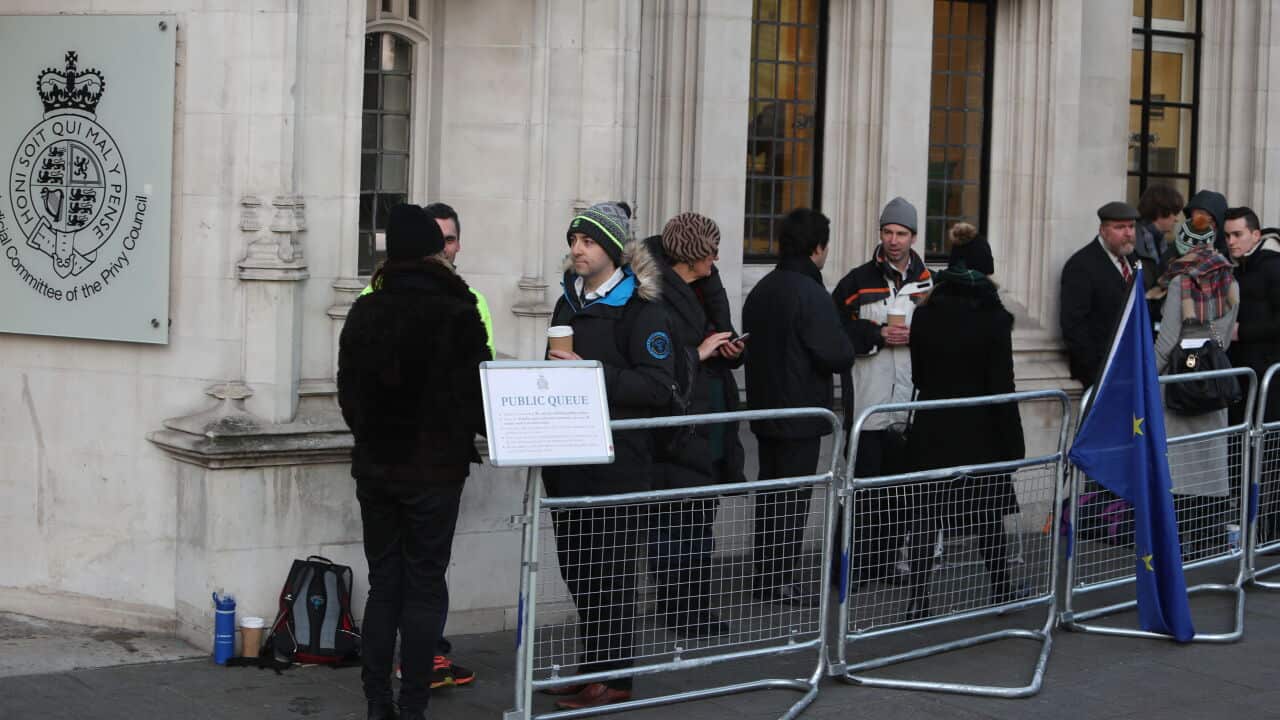
For the first time ever, all 11 Supreme Court judges convened to hear a government challenge against a ruling that Prime Minister Theresa May must seek approval for starting the Brexit process.
Protesters on both sides of the debate rallied outside the court as the four-day hearing began, with pro-Europe demonstrators arriving on a double-decker bus, wearing judges' wigs and waving EU flags.
The High Court ruled last month that the government did not have the executive power alone to invoke Article 50 of the EU's Lisbon Treaty, formally starting exit talks which could take two years.
The decision enraged Brexit supporters and some newspapers who accused judges of thwarting the will of the 52 percent who voted "Leave" in the June 23 referendum.
The vote for Britain to become the first country to leave the 28-nation bloc sent shockwaves across the world and emboldened populists in Europe and the United States.
News that makes sense
Your trusted source for staying up-to-date with the world around you. Get free daily news updates and analysis, straight to your inbox.
Supreme Court president David Neuberger said people involved in the case had received threats and abuse and stressed that judges would rule without political bias in a case that has ignited tensions.
A parliamentary vote on Article 50 could open the door to pro-EU lawmakers delaying or softening Britain's withdrawal from the bloc.
'Threats of violence'
Neuberger said the judges were "aware of the strong feelings" surrounding Brexit but "those wider political questions are not the subject of this appeal", an AFP reporter at the hearing said.
"This appeal is concerned with legal issues, and, as judges, our duty is to consider those issues impartially, and to decide the case according to the law. That is what we shall do," he told the court.
Neuberger said some parties involved in the case had received threats of "serious violence and unpleasant abuse", warning that there were "legal powers" to deal with such threats.
He ordered a ban on the identification of some of the claimants, including a national of Trinidad and Tobago and a Polish national who are concerned about the future status of their families.
Attorney General Jeremy Wright, the government's chief legal advisor, outlined the government's case in the grand courtroom, illuminated by vast stained glass windows and topped by a vaulted roof.
Wright argued that the government had authority over foreign affairs, including the right to withdraw from treaties, under so-called "royal prerogative powers".
The prerogative is "not an ancient relic but a contemporary necessity", Wright said as around 100 people, including legal representatives, press and public, crammed into the neo-Gothic courtroom.
Claimants in the case, led by investment fund manager Gina Miller, maintain that triggering Article 50 would strip British citizens of certain rights established under European law -- which they say only parliament has the power to do.
The proceedings were shown live on television with the presence of all 11 justices "a historic first", according to the court.
Outside the court, Steve Gavin, who wants to see the High Court decision upheld, said: "It's extremely important. We live in a representative democracy with no written constitution."
But Brexit advocate Julia Waller said: "The people have spoken on June 23. They voted to get out of Europe. Instead of giving us a 'grey Brexit', or 'soft Brexit', they should just give us Brexit and leave Europe."
James Eadie, another lawyer representing the government, urged the court to make a decision that "the ordinary man and woman" would understand, when it delivers its verdict in January, suggesting there was an understanding the government would implement the referendum decision.
'Clear case' for Brexit powers
Downing Street voiced confidence in the government's case, despite suggestions from some legal experts that it was destined to lose.
"We believe it's a clear case that we have the legal power to trigger Article 50... we're confident of our case," a spokeswoman for the prime minister said.
If unsuccessful, the government is expected to introduce a short bill which it will seek to push rapidly through parliament to authorise the triggering of Article 50.
May has insisted a parliamentary vote on the legislation would not disrupt her plans to trigger Article 50 by the end of March 2017.
However she faces a potential complication at this week's hearing from representatives of Scotland, Wales and Northern Ireland who will argue that Article 50 must also be approved by the devolved parliaments.
Such a ruling could further derail the prime minister's timetable and set up a stand-off between the nations.







