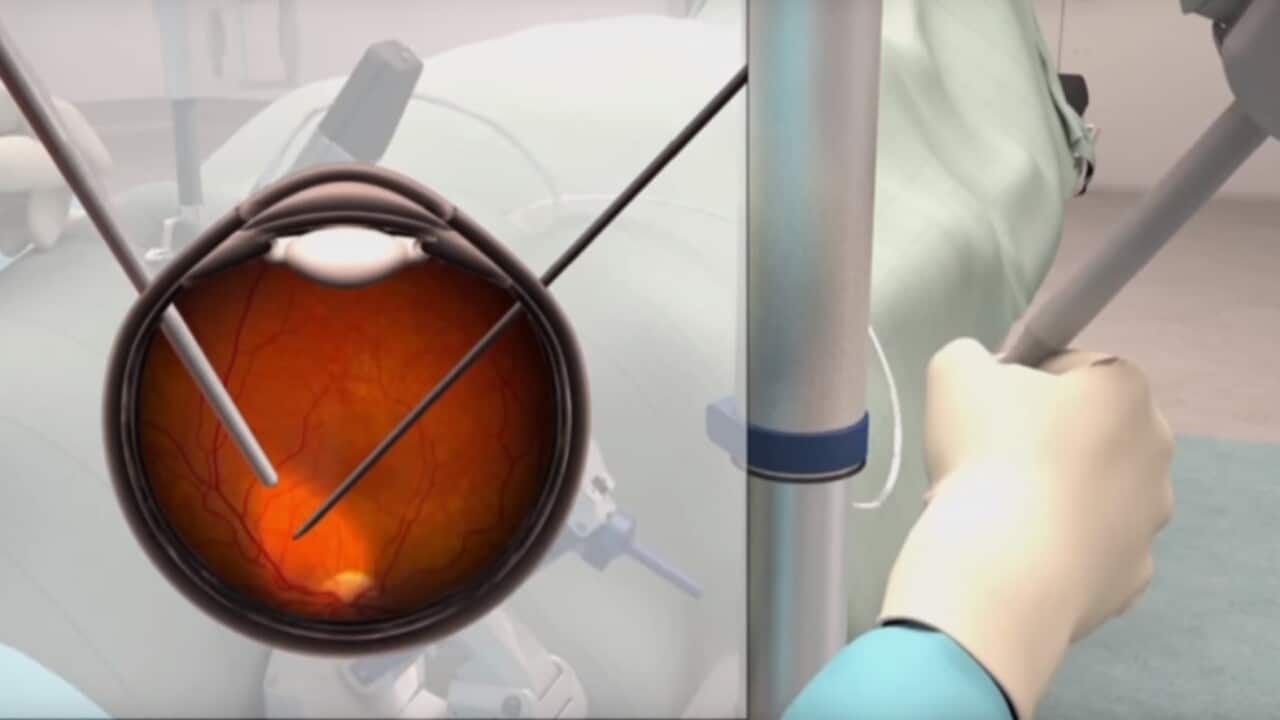
British surgeons have carried out the world's first robotic operation inside the eye - potentially revolutionising the way vision conditions are treated.
Patient Father William Beaver, 70, an associate priest at St Mary the Virgin Church in Oxford, said his eyesight was returning following the procedure, having previously experienced distorted vision similar to "looking in a hall of mirrors at a fairground".
The procedure was carried out by surgeons at Oxford's John Radcliffe Hospital.
On completing the operation, Professor Robert MacLaren said: "There is no doubt in my mind that we have just witnessed a vision of eye surgery in the future.
"Current technology with laser scanners and microscopes allows us to monitor retinal diseases at the microscopic level, but the things we see are beyond the physiological limit of what the human hand can operate on.
News that makes sense
Your trusted source for staying up-to-date with the world around you. Get free daily news updates and analysis, straight to your inbox.
"With a robotic system, we open up a whole new chapter of eye operations that currently cannot be performed."
The procedure was necessary because the patient had a membrane growing on the surface of his retina, which had contracted and pulled it into an uneven shape. The membrane was about 100th of a millimetre thick and needed to be dissected off the retina without damaging it.Surgeons normally tried to do that by slowing their pulse and timing movements between heartbeats, but the robot could make it much easier. Experts said the robot could enable new, high-precision procedures currently out of the reach of the human hand.
The surgeons used a joystick and touchscreen outside the eye to control the robot while monitoring its progress through an operating microscope, giving them a notable advantage as significant movements of the joystick resulted in tiny movements of the robot.
It was the first time a device had been available that achieved the three-dimensional precision required to operate inside the human eye.
Speaking at his follow-up visit at the Oxford Eye Hospital, Father Beaver said: "My sight is coming back.
"I am delighted that my surgery went so well and I feel honoured to be part of this pioneering research project."
Prof MacLaren said: "This will help to develop novel surgical treatments for blindness, such as gene therapy and stem cells, which need to be inserted under the retina with a high degree of precision."
The robotic eye surgery trial involves 12 patients undergoing operations with increasing complexity. In the first part of the trial, the robot has been used to peel membranes off the delicate retina without damaging it.
If that part is successful, as has been the case so far, the second phase of the trial will assess how the robot can place a fine needle under the retina and inject fluid through it.
Experts said that would lead to use of the robot in retinal gene therapy, a new treatment for blindness being trialled in several centres around the world.







