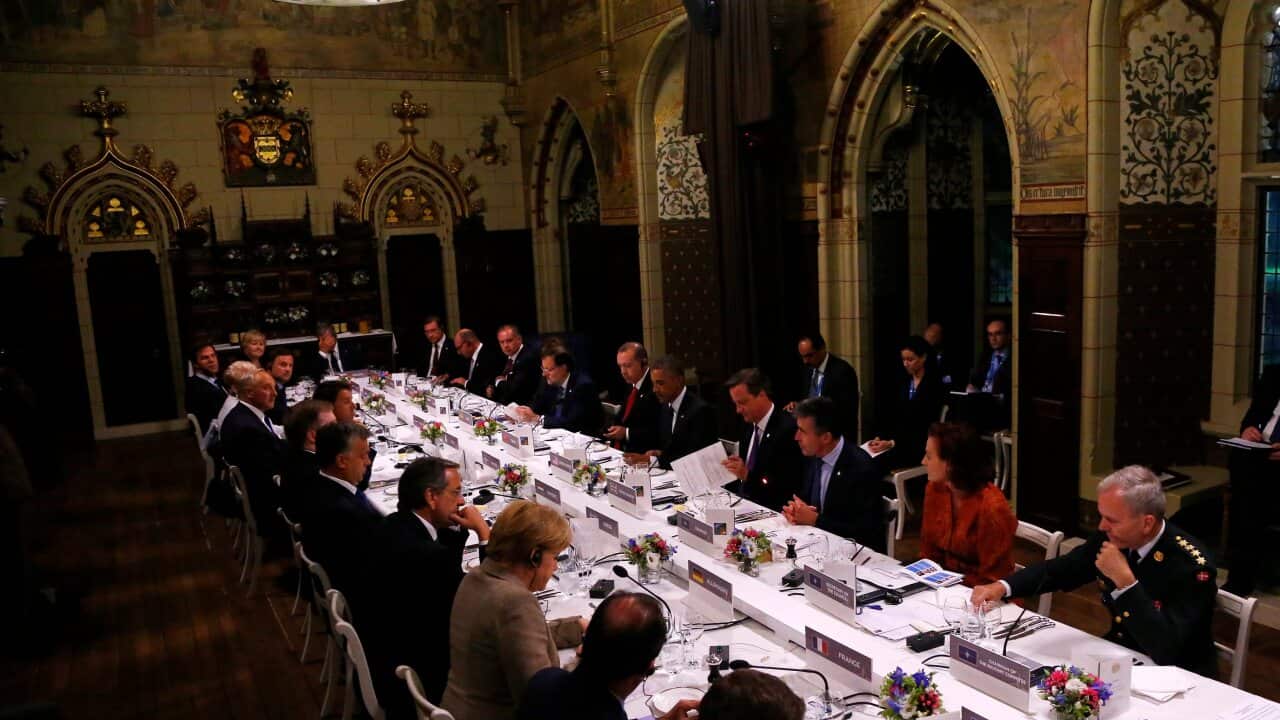
It's been described as one of the most important NATO summits in years, some say, perhaps the most important since the immediate post-Cold War years.
Western leaders meeting in Wales have spent much of this week's talks so far discussing the conflict in eastern Ukraine.
The big question is how to respond to Russia, which has been confidently asserting itself in the crisis.
Darren Mara reports.
(Click on the audio tab above to hear the full report)
News that makes sense
Your trusted source for staying up-to-date with the world around you. Get free daily news updates and analysis, straight to your inbox.
Fresh amateur footage has emerged, allegedly showing missiles being fired near the eastern Ukrainian city of Mariupol.
There is no indication whether it comes from Ukrainian forces or the rebels, but a Ukrainian military source says troops had been bracing for a potential attack on the city.
The violence rages as talk of a ceasefire continues, and as Western leaders meet for a NATO military summit in Wales.
It is considered one of the most important NATO gatherings in years.
Ukraine is top of the agenda -- and how to counter Russia and its influence over pro-Russian rebels in Ukraine's east.
NATO Secretary General Anders Fogh Rasmussen has met with Ukraine's President Petro Poroshenko on the sidelines.
The Secretary General says Russian involvement is exacerbating the Ukraine crisis but diplomacy is still the preferred way forward.
"Honestly speaking, I don't think anyone would want war or armed conflict to solve this issue. We do believe that the best way forward would be to find a political solution, and, to facilitate such a political solution, I firmly believe that the international community must respond determinedly if Russia were to intervene further in Ukraine -- respond through deeper, broader, tougher economic sanctions that would definitely hurt the Russian economy and isolate Russia further."
NATO is demanding Russia withdraw tanks and troops from Ukrainian territory, although Russia denies sending in arms and soldiers.
There are also reports fresh sanctions are being prepared, targeting Russia's defence industry, state-owned banks and associates of President Vladimir Putin.
Meanwhile, ceasefire talks are taking place in Belarus, involving Ukraine, Russia and the rebels.
One of Ukraine's main conditions is a deal on a new peace plan to end the five month war in Ukraine's east, where some 2,600 people have died.
Petro Poroshenko says he is optimistic a ceasefire will be signed in Minsk.
"Because, beforehand, it was the statement of the Russian authorities and the Russian president. And it was in response to the statement of the so-called Luhansk and Donetsk People's Republic, that they are ready for an immediate ceasefire. And now it is very important to have the support of the OSCE for the monitoring and verifying mission, and to immediately release the hostages which are illegally kept by the terrorists, and to put the situation under control on the Ukrainian-Russian border, and to withdraw all the Russian troops."
But Russia's Foreign Minister Sergei Lavrov has issued a warning to NATO and the United States to keep out of Ukraine and to stop forcing its will on the country.
"The surge of anti-Russian rhetoric that we observe at the very moment when the most active efforts are being made to find a political settlement means only that the war party, which is situated in Kiev, receives active support from the outside -- in this case, from the United States."
Meanwhile, there have been questions over whether Australia, as chair of the G20, should seek to exclude the Russian leader from that summit in Brisbane in November.
But Foreign Minister Julie Bishop says there is still a chance the situation in Ukraine could be resolved before then, allowing Vladimir Putin to attend the G20 without issue.
She says she remains suspicious about Mr Putin's motives in Ukraine, though.
"His actions will be judged. Words are one thing, but actions are another. Unless there is a complete resolution of the conflict in Ukraine, I fear that it will escalate, and that's why it's the subject of considerable discussion here. I expect that we will see more steps towards trying to contain Russia's aggression through the imposition of sanctions. I believe that's under active consideration."
The NATO summit wraps up with Iraq and Islamic State militants also on the agenda.







