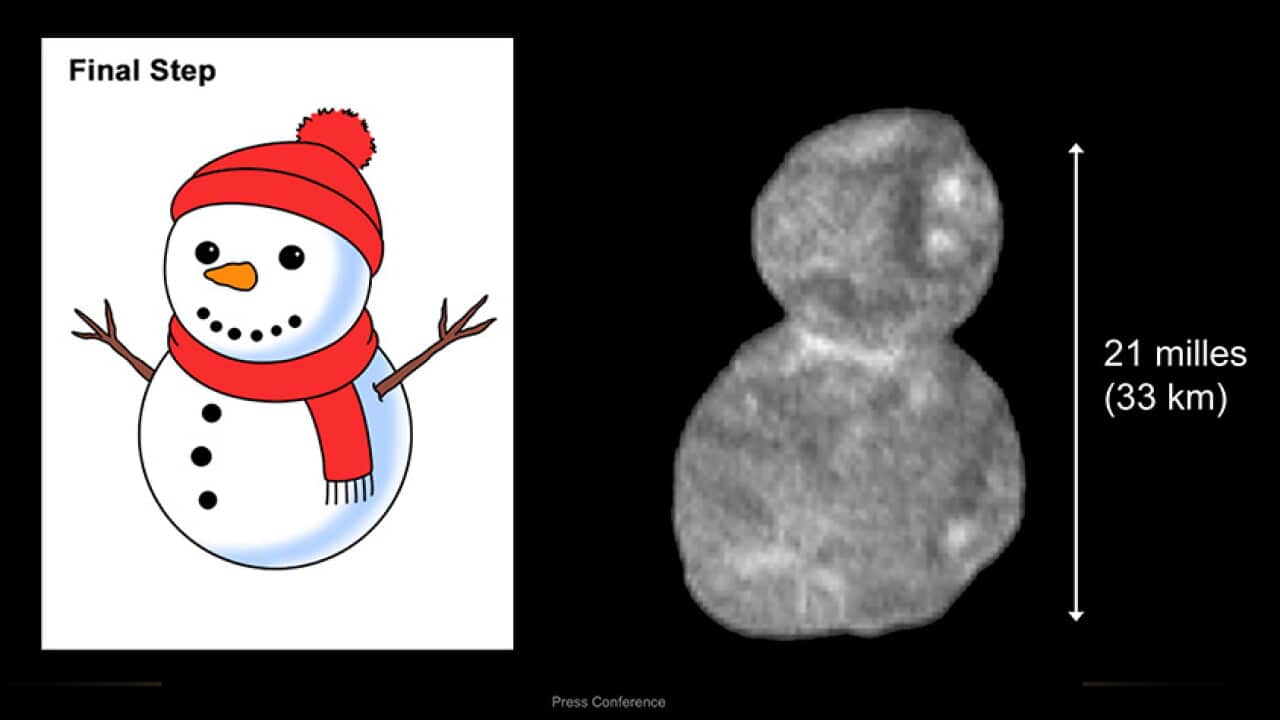
The returned New Horizons spacecraft has sent back the first image of the ice world, Ultima Thule.
Ultima Thule is one of hundreds of thousands of space rock in the uncharted heart of the Kuiper Belt, a ring of icy celestial bodies just outside Neptune's orbit.
Investigating the ice world is expected to reveal clues on how all planetary bodies came into being some 4.6 billion years ago.
The first detailed picture from Tuesday's flyby of the world reveals a double body shape - or snowman shape as scientists have called it.
The larger sphere is "Ultima" and measures 19 kilometres across. The smaller sphere is "Thule", measuring 14 kilometres across.
News that makes sense
Your trusted source for staying up-to-date with the world around you. Get free daily news updates and analysis, straight to your inbox.
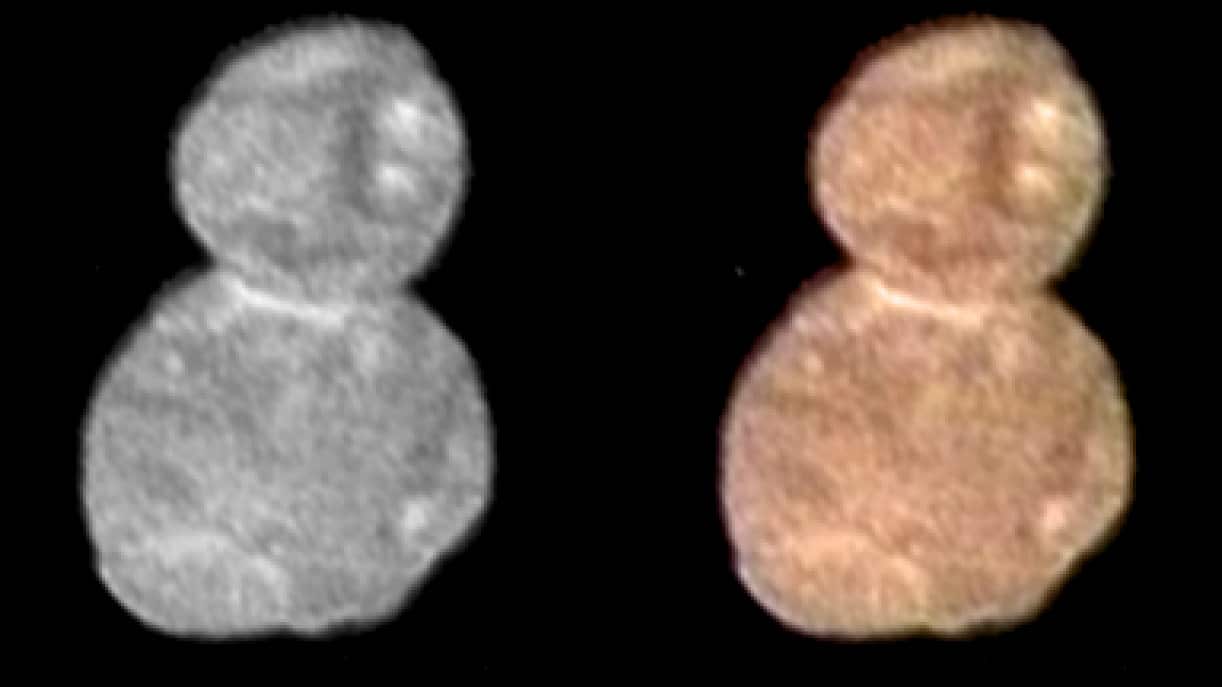
Jeff Moore, New Horizons Geology and Geophysics team lead, said the appearance of Ultima Thule is remarkable.
"New Horizons is like a time machine, taking us back to the birth of the solar system. We are seeing a physical representation of the beginning of planetary formation, frozen in time," he said.
"Studying Ultima Thule is helping us understand how planets form — both those in our own solar system and those orbiting other stars in our galaxy."
The colour of the object is now confirmed as red.
The ice world also is a relatively dark object, reflecting very little light.
Scientists say the brightest areas reflect just 13 per cent of the light falling on them; the darkest, just six per cent.
Data from the New Year's Day flyby will continue to arrive over the next weeks and months, with much higher resolution images yet to come.
NASA rang in the New Year on Tuesday with a historic flyby of the farthest, and quite possibly the oldest, cosmic body ever explored by humankind.
The flyby took place about a billion miles beyond Pluto, which was until now the most faraway world ever visited up close by a spacecraft.
Hurtling through space at a speed of 51,000km/h, the spacecraft made its closest approach within 3,500 kilometres of the surface of Ultima Thule.
- with AFP







