Japan has welcomed a decision by delegates at a UN wildlife trade meeting to reject a ban on cross-border trade in rapidly declining Atlantic bluefin tuna, a sushi mainstay.
Backers of a ban, the European Commission (EC) and the United States regretted the result, with the EC warning the consequences could be catastrophic for the future of the species.
After aggressive lobbying by the Japanese, the controversial proposal was crushed at a meeting in Doha of the Convention on International Trade in Endangered Species (CITES).
News that makes sense
Your trusted source for staying up-to-date with the world around you. Get free daily news updates and analysis, straight to your inbox.
Many abstinations
The proposal, which had been put forward by Monaco with the backing of the United States and European Union, needed the support of two thirds of the nations present.
In the end, there were 68 votes against the measure, 20 in favour and 30 abstentions.
"We welcome the rejection" of a ban on cross-border trade of bluefin caught in the Mediterranean and eastern Atlantic as well as an amendment to allow a moratorium on the ban, a Japanese foreign ministry statement said.
"We will continue our efforts to get understanding of our country's position" so that the rejection will be adopted at a general meeting on March 24-25, it added.
The decision 'a setback'
US Assistant Secretary of the Interior for Fish and Wildlife and Parks Tom Strickland lamented the vote as "a setback for the Atlantic bluefin tuna," but vowed to "keep fighting" for the sustainable management of the fishery.
The European Commission warned that rejecting the ban threatened the species with extinction.
"If action is not taken, there is a very serious danger that the bluefin will no longer exist," said the EU's Environmental Commissioner Janez Potoznik in Brussels.
Patrick van Klaveren, head of the Monaco delegation, was even more pessimistic.
"It will not be CITES that is the ruin of professional (fisheries), it will be nature that lays down the sanction, and it will be beyond appeal," he said.
'Disasterous for the future'
Environmental groups and experts also slammed the result.
"The abject failure of governments here to protect Atlantic bluefin tuna spells disaster for its future and sets the species on a pathway to extinction," said Oliver Knowles of Greenpeace International.
Sue Lieberman, policy director for the Pew Environment Group in Washington, called the decision "very disappointing and very irresponsible".
The bluefin's fate was now in the hands of the International Commission for the Conservation of Atlantic Tunas (ICCAT), the inter-governmental group responsible for managing bluefin stocks.
"This is the very body that drove the species to the disastrous state it is in now" by failing to enforce its own quotas, Liberman said.
Reproductive capacity dropped
Monaco's Van Kaveren recalled that a proposed Atlantic bluefin ban was withdrawn from CITES in 1992 after ICCAT promised stricter oversight.
"The result is that the reproductive capacity has dropped from 200,000 to 60,000 in 20 years, tunas are half as small, and illegal fishing has tripled," he said.
Former ICCAT president Masanori Miyahara, now head of Japan's delegation and the country's top fisheries official, acknowledged there had been shortcomings with ICATT in the past.
"We have heavy homework with ICCAT now," he told AFP.
"We made the commitment to ensure the recovery of the stock with specific measures and restrictions."
Last November, ICCAT agreed to cut its catch of bluefin tuna in the Eastern Atlantic and Mediterranean regions by 40 per cent, from 22,000 tonnes in 2009 to 13,500 in 2010.
High price for fish
Industrial-scale harvesting on the high seas has caused bluefin stocks to plummet by up to 80 per cent in the Mediterranean and eastern Atlantic, the two regions which would have been affected by the ban.
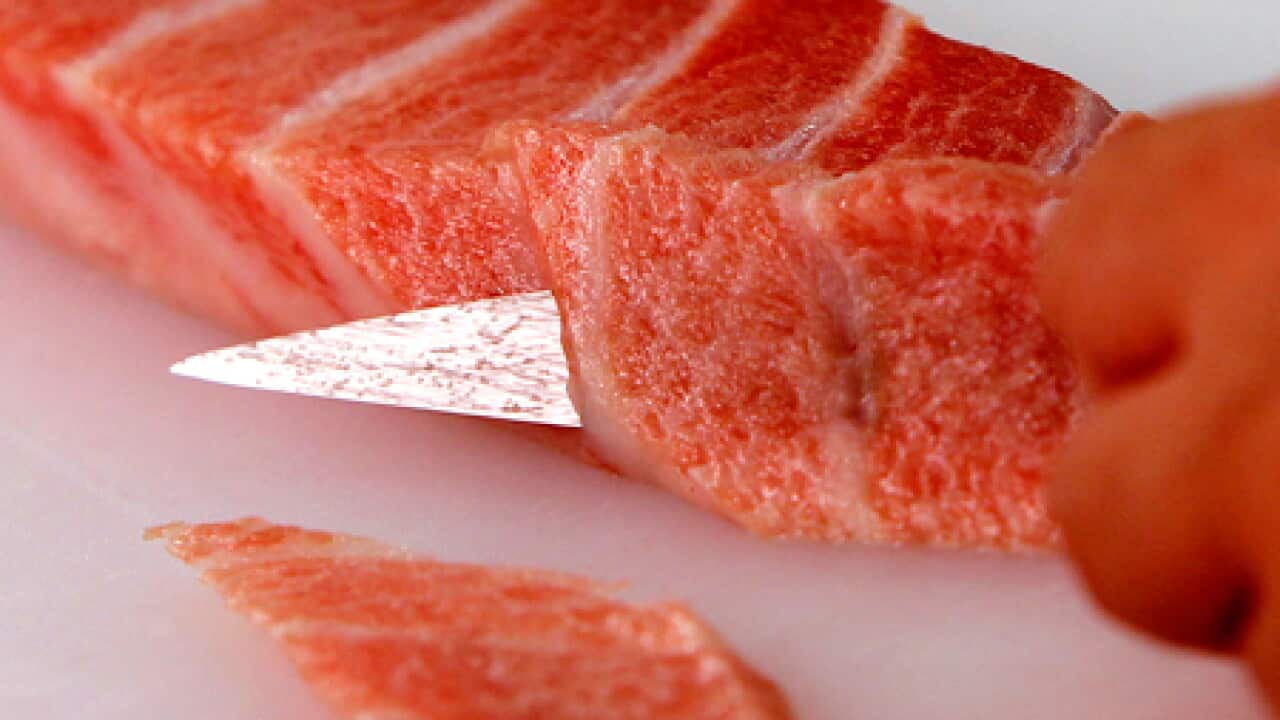
A single 220kg fish can fetch $US160,000 ($A173,840) at auction in Japan, which consumes three quarters of all bluefin caught in the world, mainly as sushi and sashimi.
Meanwhile, the International Union for Conservation of Nature (IUCN) warned that another expensive delicacy, caviar, had pushed sturgeon into the most threatened creature on the planet.
"Four species are now possibly extinct," it said in a report on the conference sidelines.







