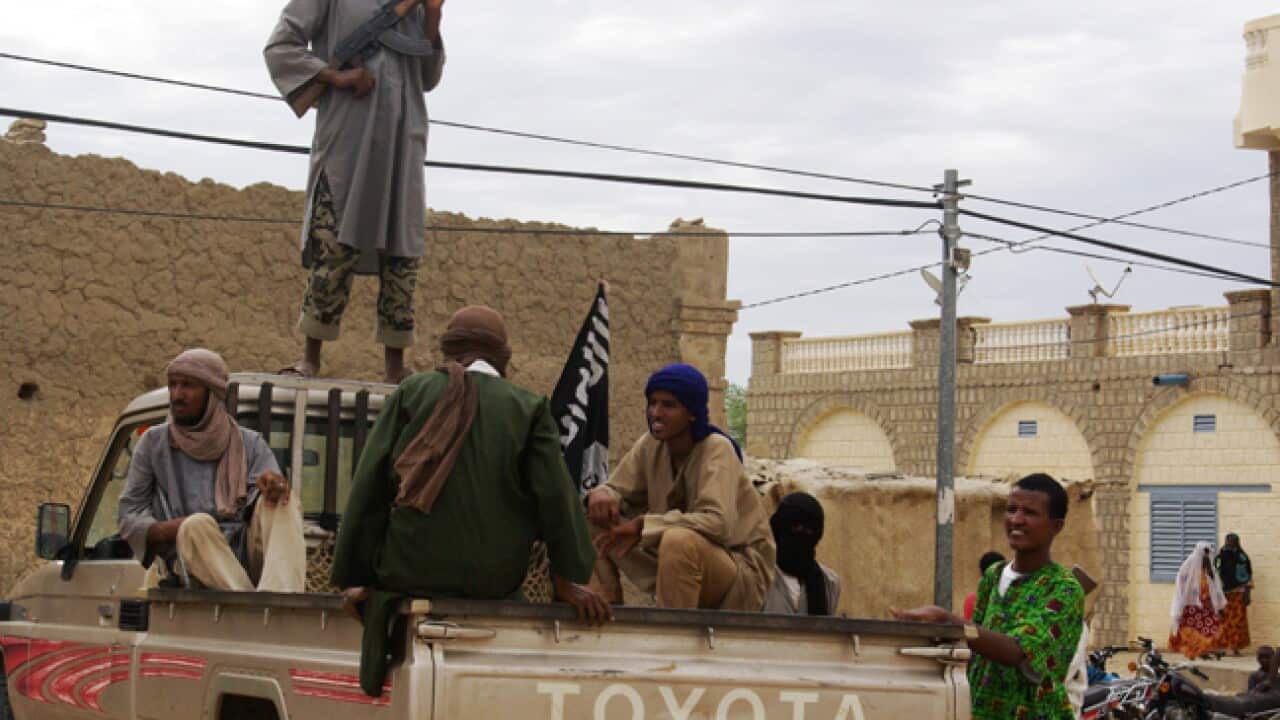
Mali's president has asked the United Nations and France for help to fight off an offensive by Al-Qaeda linked Islamists, and Paris will announce what action it will take, envoys said.
Alarm over an advance by Islamist forces was raised after a UN Security Council meeting that called for the "rapid" deployment of an African-led intervention force to help the Mali authorities.
The Islamists who rule northern Mali have clashed with government forces for the first time in nearly a year, seizing a strategic city.
The capture of the city of Konna on Thursday marks a dangerous escalation in the Islamists' confrontation with the government, which is based hundreds of kilometres to the south in the capital, Bamako.
News that makes sense
Your trusted source for staying up-to-date with the world around you. Get free daily news updates and analysis, straight to your inbox.
The fighting in central Mali also comes amid speculation that a regional military intervention to oust the extremists may not come until September at the earliest.
The Islamists seized the town of Douentza four months ago after a brief standoff with a local militia, but pushed no further until clashes broke out late on Wednesday in Konna, a town of 50,000 people, where fearful residents cowered inside their homes.
"We have chased the army out of the city of Konna," declared Sanda Abou Mohamed, a spokesman for the Ansar Dine militant group, speaking by telephone from Timbuktu.
A Mali army spokesman refused to comment on the loss of Konna, which is 70 kilometres from the government-held town of Mopti, a strategic port city along the Niger River.
A soldier said the army had retreated from Konna.
He said several soldiers were killed and wounded, though he did not have precise casualty figures. "We didn't have time to count them," he said.
The United Nations said it was concerned about the reported military movements by rebel groups along the front line in Mali, and urged them to adhere to a December 4 ceasefire, UN spokesman Martin Nesirky said.
While Konna is not a large town, it has strategic value as "the last big thing ... on the road to Mopti," said J Peter Pham, director of the Africa program at the Washington-based Atlantic
Council.
"I think the real target here is to seize the airstrip in Mopti, either to hold it or blow enough holes in it to render it useless," Pham said. "If you can seize the airstrip at Mopti, the Malian
military's and African militaries' ability to fly reconnaissance in the north is essentially clipped."







