(Transcript from World News Australia Radio)
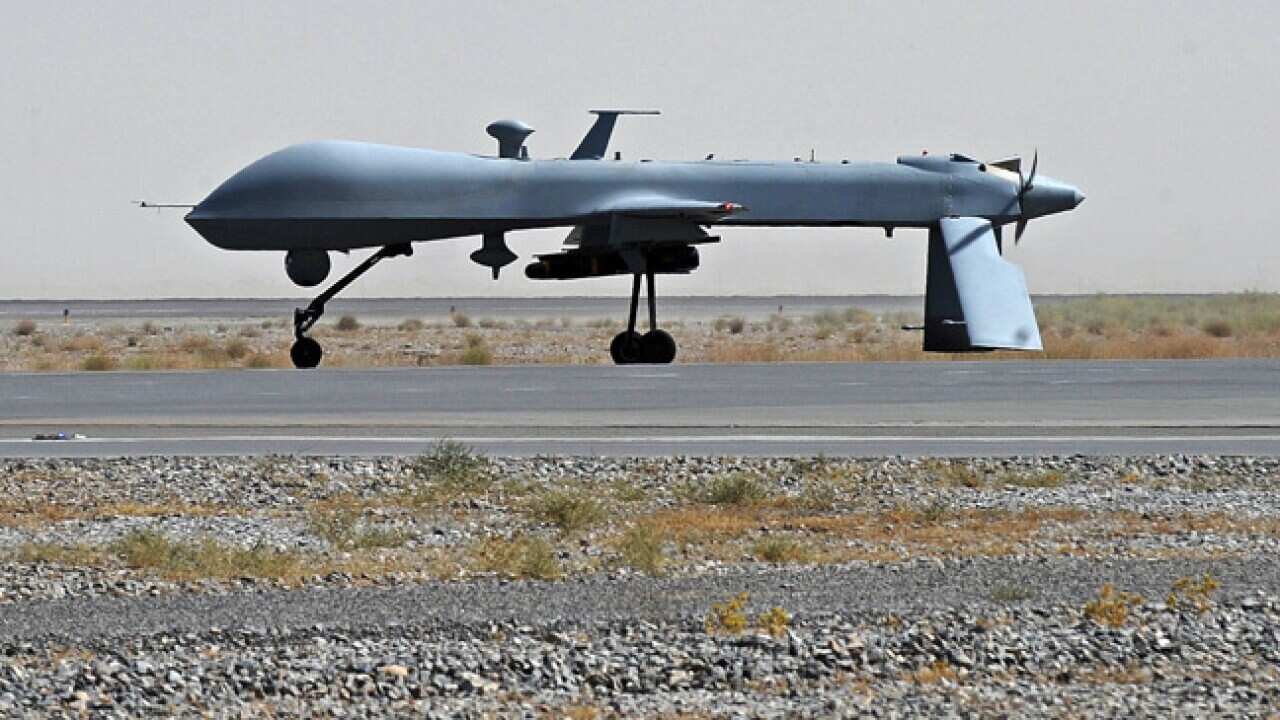
A United States Senator claims 4,700 people have been killed by the US unmanned aerial craft, known as drones.
Republican senator Lindsey Graham is a supporter of the drone program, primarily in use by the U-S in Afghanistan and northwest Pakistan.
News that makes sense
Your trusted source for staying up-to-date with the world around you. Get free daily news updates and analysis, straight to your inbox.
Senator Graham says while some innocent people have died, the program has managed to kill some senior members of al-Qaeda.
His comments come as President Obama tries to get the architect of the program, John Brennan, confirmed as the new head of the Central Intelligence Agency, and as the United Nations investigates the legality of drone strikes.
Drones have proven to be effective killing machines for the United States.
Under the Obama administration, there's been an increase in drone strikes which have killed al-Qaeda figures the US says have been plotting attacks against America.
In a recent interview with CNN, President Barack Obama reiterated his previous assurances that the secretive drone program is tightly controlled.
"We have an extensive process, with a lot of checks, a lot of eyes looking at it. Obviously as president ultimately I'm responsible for decisions that are made by the administration but I think what the American people need to know is the seriousness with which we take both the responsibility to keep them safe but also the seriousness with which we take the need for us to abide by our traditions of the rule of law and due process."
Mr Obama says civilian casualties have been kept to a minimum but his assurances have counted for little in countries like Pakistan, where allegations of civilian deaths from drone strikes have tested the bilateral relationship between Washington and Islamabad.
Neil James, from the Australia Defence Association, says the US drone program has resulted in fewer civilian casualties because drone strikes are far more precise than conventional aerial bombing raids.
"Drones appear to have a significantly lower collateral damage rate than conventional airstrikes. Now this is a two-edged sword that in turn, whilst it's good in moral terms, it can lead politicians - particularly one seeking an easy way out in some circumstances - to rely on drones more than on boots on the ground, UN-type interventions. This is one of the big internal criticisms of the Obama administration in the United States at the moment: that they're too prone to using drones."
But whether it's Pakistan, Iraq, Yemen, Somalia or Afghanistan, there are divergent views on whether drone attacks are actually legal.
Ben Emmerson is a British lawyer who's the UN's special rapporteur on human rights and counter-terrorism.
He's leading a UN investigation which will examine the legality of 25 drone strikes by the US, British and Israel military which reportedly led to civilian casualties.
The investigation was launched after Pakistan complained far too many civilians had died in drone attacks carried out in its country.
Mr Emmerson has told Al Jazeera there's much debate among the international lawyers.
"Well there are at least three completely separate competing and to a large extent conflicting legal theories, ranging from those who insist that outside situations of recognised international armed conflict drones are unlawful, right the way across to the global war paradigm favoured by international lawyers in the United States and advanced by John Brennan, the leader-designate of the CIA, with at least one very major theory in between. This is an unacceptable state of affairs and clearly the international community needs to move forward in order to agree a framework."
The United States killed an American-born citizen on foreign soil when it used a drone against Anwar al-Alawki, an American cleric who had joined al Qaeda in Yemen.
Earlier this month, the Justice Department released a 2010 memo from its Office of Legal Counsel which provides a justification for the 2011 killing.
Its release came just ahead of a confirmation hearing for John Brennan, President Obama's choice as the next director of the CIA.
Mr Brennan has been the architect of the drone program in his role as Mr Obama's counter-terrorism adviser.
President Obama told CNN the killing was justifiable.
"When an American has made decisions to affiliate itself with al-Qaeda and target fellow Americans, there is a legal justification for us to try to stop them from carrying out plots. What is also true though is that an American citizen, they are subject to the protections of the constitution and due process."
But what about using drones to kill Americans on American soil?
President Obama has said he has no intention of using drones inside the US, but US Republican senator Rand Paul says that statement is much too vague.
"There should be an easy answer from the administration on this. They should say absolutely no, we will not kill Americans in America without an accusation, a trial and a jury. We're not talking about people engaged in lethal force, I'm talking about people sitting in a café having coffee. People like this are being killed around the world, we should not do this in America and it's inexcusable that the administration will not answer absolutely no, we will not do this."
The United States has just sent about 100 troops to Niger in West Africa to set up a new base for deploying unarmed predator drones on surveillance missions.
President Obama says the drones could assist French forces conducting operations in Mali, where insurgents have taken over half the country.
Meanwhile, Australian forces have deployed Israeli-owned drones in Afghanistan on lease from a Canadian company but the Australia Defence Association's Neil James says it's unlikely Australia would use its own armed drones.
"It would have to be a high-end war and there isn't one of them on the horizon. And also, to an extent, the nature of our strategic problem being an island continent is different. We'll certainly use remotely piloted aircraft for surveillance in the future increasingly particularly for maritime surveillance out over the oceans but the prospect of having Australian drones roaming the mountains of say central Asia, shooting missiles at people, isn't worth thinking about."
Australia's Defence Minister Stephen Smith says there are no plans to use armed drones but he says he's not opposed to the notion of Australia considering the idea of using armed drones in the future.
Neil James says Australia does have orders in for two types of drones, one of which is capable of carrying weapons.
"One is a very large, in effect jet-powered one for ocean surveillance and the second one is a smaller drone to be used to help the military on the ground for reconnaissance and surveillance. It's not envisaged that either of these remotely piloted vehicles would ever be armed, although there's an outside chance in the longer run the ocean-going ones could be because they're bigger, they can carry the weaponry and you might actually put a torpedo or some form of anti-shipping cruise missile but that's all way in the future and I don't think you and I will see it any time soon."
The UN investigation is also expected to examine what are called 'double tap' drone strikes, where rescuers going to the aid of people affected by an initial strike are targeted by a second, follow-up drone attack.
The UN's special rapporteur, Ben Emmerson, says this form of drone warfare could be judged to be a war crime.
Whether the United States is prepared to co-operate with his inquiry is unclear.
The US ambassador to the United Nations, Susan Rice, says only that Washington has not ruled out full cooperation.







