(Transcript from SBS World News Radio)
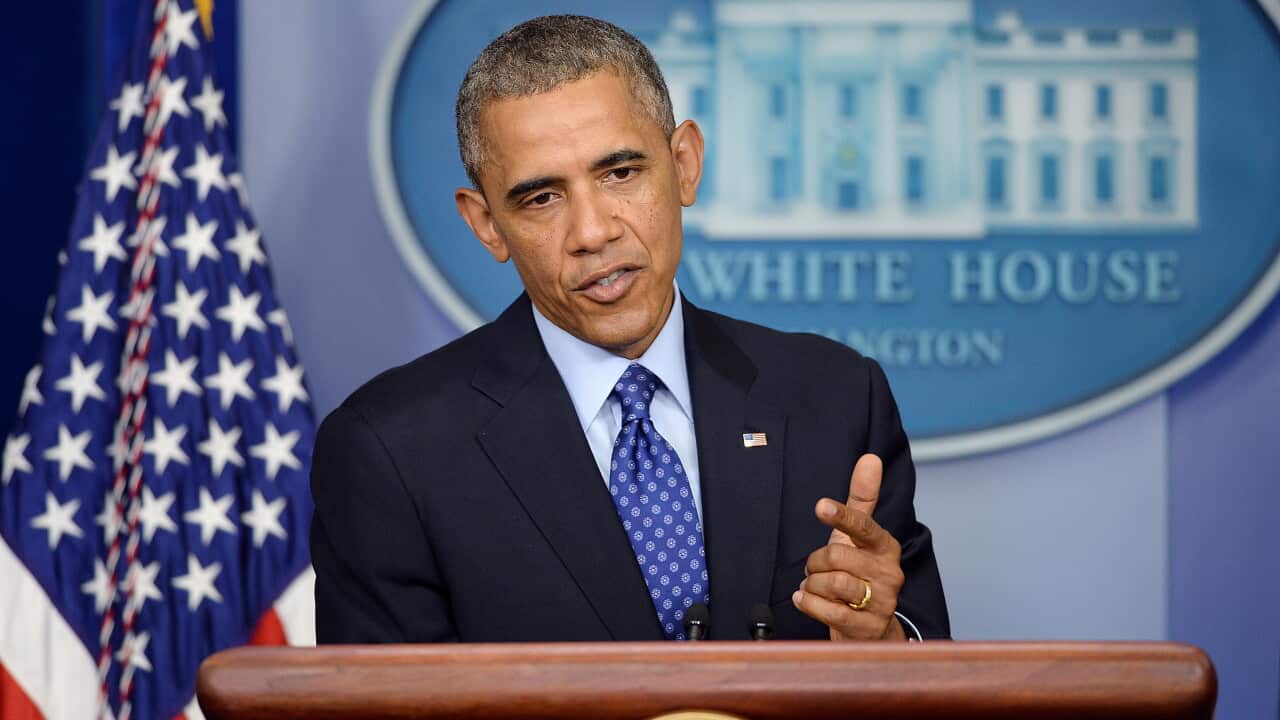
President Barack Obama says he's sending up to 300 United States military advisors to Iraq to support Iraqi troops fighting an offensive by ISIS militants.
But Mr Obama is also adamant that US troops will not go back into direct combat in Iraq.
Peggy Giakoumelos reports.
(Click on the audio tab above to hear the full report)
News that makes sense
Your trusted source for staying up-to-date with the world around you. Get free daily news updates and analysis, straight to your inbox.
President Barack Obama says the United States is ready to deploy what he calls advisors to assist Iraqi forces, adding that the US has already increased its intelligence capabilities in the country.
He says it's a good investment for the US to intervene in Iraq if it prevents Islamic State of Iraq and Syria fighters from establishing bases that could threaten the West.
Mr Obama says the US military advisers will support Iraqi security forces and create joint operation centres in Baghdad and northern Iraq to share intelligence, and coordinate planning to confront the insurgents.
But he insists that US troops will not go back into direct combat in Iraq two and a half years after the last US soldier was sent home.
"I think we always have to guard against 'mission creep' (the mission changing its nature once troops are deployed) so let me repeat what I've said in the past: American combat troops are not going to be fighting in Iraq again."
The United States invaded Iraq in 2003 to topple President Saddam Hussein.
It withdrew its troops from the country in 2011, handing over responsibility for security to the government of Prime Minister Nuri al-Maliki.
Mr Obama says the Iraqi government must take steps to heal the political rift among Sunnis, Shi'ites and Kurds before he will consider any military action against ISIS.
"I don't think there's any secret that right now at least there is deep divisions between Sunni, Shia, and Kurdish leaders. And as long as those deep divisions continue or worsen, it's going to be very hard for an Iraqi central government to direct an Iraqi military to deal with these threats. And so we've consulted with Prime Minister Maliki and we've said to him privately, we've said it publicly, that whether he is Prime Minister or any other leader aspires to lead the country, it has to be an agenda in which Sunni, Shia and Kurd all feel that they have the opportunity to advance their interests through the political process."
Executive director of the Australian Strategic Policy Institute, Peter Jennings, doesn't think the U-S response is strong enough.
He has told the ABC that the US should have started air strikes as soon as fighting began.
"I would have been looking to have a targeted air campaign, to stop the ISIS advance onto Baghdad. Secondly to go after their command facilities. Because really the big risk is what we're seeing as the consolidation of an ISIS control over territory."
Meanwhile, large numbers of Shi'ite Muslims are reportedly pouring in to Iraqi military recruitment centres to join the fight against ISIS.
They've been responding to a call by the country's most influential Shi'ite cleric to take up arms against the Sunni militant insurgency.
This man decided to volunteer after hearing the call.
"I came in response to a call by the highest religious Marjiya to fight the militants. We are ready and all the Iraqis are united as Shi'ites, Sunnis, Sabians and all other sects. We will remain loyal soldiers for a greater Iraq." (Arabic ends)
The Australian government says it's continuing to monitor the situation in Iraq and will consider sending military support if asked.
Coalition frontbencher Christopher Pyne says the West can't allow Iraq to fragment in a sectarian civil war.
He says the Iraqi government hasn't asked Australia for assistance yet, and should such a request come, Canberra would weigh up what to do.







