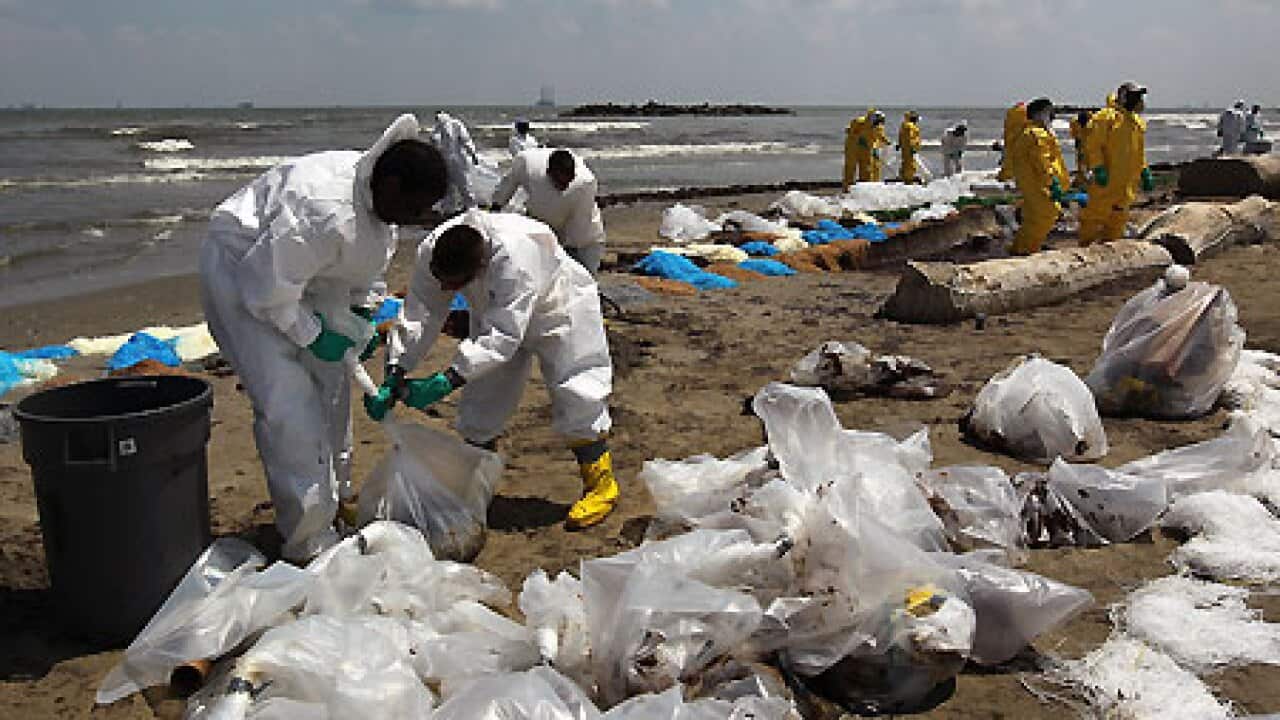
The US government has threatened to take over the response to the Gulf of Mexico oil slick, as pressure mounts on BP to get control of the month-old environmental disaster.
Interior Secretary Ken Salazar says if it is found that BP isn't doing what it's supposed to be to repair the damage from the Deepwater Horizon, authorities will push the firm out of the way.
He has lashed out at BP for missing deadline after deadline, with its latest attempt to cap the leak hit with further delays.
News that makes sense
Your trusted source for staying up-to-date with the world around you. Get free daily news updates and analysis, straight to your inbox.
Meanwhile, wildlife rescue crews are bracing for an influx of oil-blackened birds and animals as a heavy black tide seeps deeper into Louisiana's fragile coastal wetlands.
Oiled birds, wildlife
"No one should believe that because we haven't recovered thousands of oiled wildlife that the impact will not be widespread," said Ralph Morgenweck, a senior science advisor to the US Fish and Wildlife Service.
"We expect the number of affected wildlife to increase as time goes on."
A total of 39 oiled birds have been recovered alive and 85 visibly oiled birds have been found dead, officials said Sunday.
Some 19 dolphins and 193 sea turtles have also been found on coastal beaches since oil started gushing out of the wreckage of the BP-leased rig some 52 miles offshore on April 22, but officials have not yet determined the cause of their deaths.
The gushing Gulf spill threatens to eclipse the Exxon Valdez disaster of 1989, the worst environmental disaster in US history - and a dark standard for the destruction of fish and wildlife.
Oil slick on beaches
The supertanker rupture in Prince William Sound, decimated Alaskan wildlife, including an estimated 250,000 seabirds, 2,800 sea otters, 300 harbor seals, 250 bald eagles, up to 22 killer whales, according to a the Exxon Valdez Trustee Council, a nonprofit formed to oversee restoration of the injured ecosystem.
Today, hundreds of Fish & Wildlife employees and citizen volunteers are fanning out across the Gulf coast looking for oiled birds and animals to rescue.
The main concern at this stage in the oil crisis is that untrained rescuers will try to clean oiled birds as soon as they are plucked from the blackened marsh - a potentially fatal move.
"We don't want people cleaning them on the (rescue) boats because birds can get hypothermia and die - even on a hot day," said Barbara Callahan, a wildlife rehabilitator at the a centre in Fort Jackson, Louisiana.
Oiled birds can also die from ingesting the sludge. Crippled by crude, the wild fowl can also drown.







