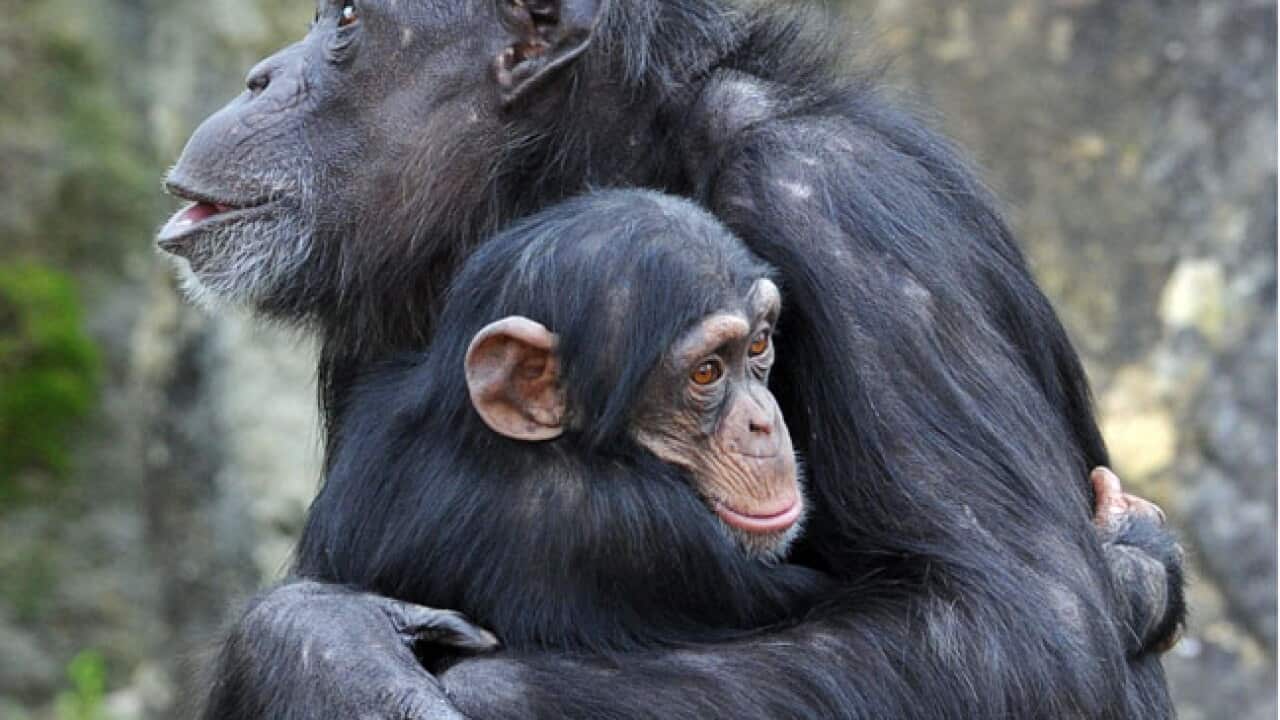
The leading US medical research agency said Thursday it would review all government-funded experiments on chimpanzees after an independent panel of experts urged strict limits on use of the primates.
The head of the National Institutes of Health, Francis Collins, said he agreed with the findings of the non-governmental Institute of Medicine and would move quickly to implement the changes it advised.
While stopping short of an outright ban, the IOM called for research on the great apes to continue only if there is no other model available, the research could not be performed ethically on humans, and it would hinder progress against life-threatening conditions if halted.
News that makes sense
Your trusted source for staying up-to-date with the world around you. Get free daily news updates and analysis, straight to your inbox.
"The committee concludes that while the chimpanzee has been a valuable animal model in the past, most current biomedical research use of chimpanzees is not necessary," the IOM said in its report.
Chimps may still be necessary in the development of vaccines against hepatitis C, for short-term continued study of monoclonal antibody research against bacteria and viruses, comparative genome studies and behavioral research, the IOM said.
The IOM is a respected group of medical experts that advises decision-makers and the public on matters of health and policy.
When chimpanzees are used, the studies should "provide otherwise unattainable insight into comparative genomics, normal and abnormal behavior, mental health, emotion or cognition," the report said.
In addition, all experiments must be performed "in a manner that minimizes pain and distress, and is minimally invasive."
In response, Collins said he would move as quickly as possible to implement its recommendations, reviewing ongoing research with NIH-owned chimpanzees on a "project-by project" basis, but declined to say how long a formal review might take.
"Projects that are found not to meet those will be phased out, but in a fashion that preserves the value of research already conducted," he said.
"Effective immediately, NIH will not issue any new awards for research involving chimpanzees until processes for implementing the recommendations are in place."
As of May, there were 937 chimpanzees available for research in the United States. The US government supports 436 of them, and the rest are owned and used for research by private industry.
Despite a swell of controversy in recent years, the United States has continued to allow medical studies on chimps ranging from HIV/AIDS vaccines, hepatitis C, malaria, respiratory viruses, brain and behavior.
However, these studies are quite rare, making up just 53 of the 94,000 active projects sponsored by the NIH in 2011, or 0.056 percent of all federally-funded US research.
Animal rights groups say the United States spends $30 million a year on chimp research and care that could be directed to better alternatives, especially given the intelligence of chimps and their endangered status in the wild.
"There are so many reasons why we have ethical concerns," Humane Society spokeswoman Kathleen Conlee told AFP, applauding the NIH move but urging federal protective legislation and a phase-out of all chimp research over three years.
People for the Ethical Treatment of Animals also welcomed the IOM report and said "a blanket denunciation of all experiments on chimpanzees should be the next step."
A group that represents scientists who use animals for research, the National Association for Biomedical Research, recalled that chimps "have made invaluable contributions to science and medicine, including the development of vaccines for hepatitis A and B."
However, their use has been "on a natural decline due to both scientific progress and commitment to alternative research methods," it said.
Vice president Matt Bailey said "NABR goes where the science takes us and the IOM recommendation is supported by extensive scientific data."
An NIH proposal to reintroduce 200 retired chimpanzees into research colonies last year caused mounting public outcry and led to the review of chimp research by the IOM.
The NIH called for a moratorium on breeding chimps for research back in 1995, and as a result the US federally funded research population will "largely cease to exist" by 2037, the IOM said.
European Union facilities have not conducted any research on chimps since 1999, and a formal ban on using great apes in research -- including chimpanzees, gorillas and orangutans -- was issued last year.







