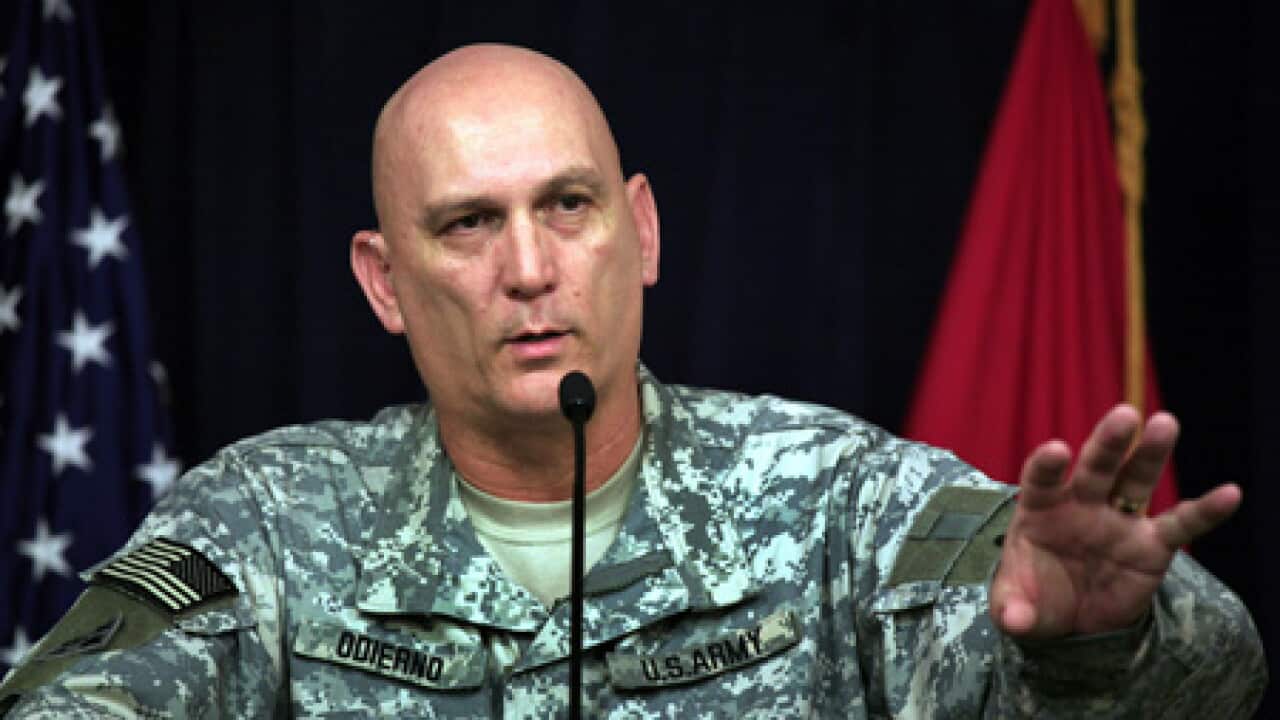
The top US commander in Iraq admitted Sunday that a "complete failure" of Iraqi security forces could oblige the United States to resume combat operations there, but he called this an unlikely scenario.
The last US combat brigade withdrew from Iraq on Thursday. On August 31 combat operations officially end and the role of the remaining 50,000 American troops switches to one of providing advice and assistance.
General Ray Odierno told CNN's "State of the Union" that the ability of the Iraqi police and army to keep a lid on the violence was improving, but refused to rule out a return to US combat missions if things went sour.
News that makes sense
Your trusted source for staying up-to-date with the world around you. Get free daily news updates and analysis, straight to your inbox.
The commander said security advances meant the country was on target to be able to handle its own security after 2011 when the remaining US troops are due to be withdrawn.
"My assessment today is they will be (ready)," Odierno told CNN, speaking from Baghdad. "I think that they continue to grow. We continue to see development in planning and in their ability to conduct operations.
"The Iraqi people are resilient. They want this. They want to have a democratic country. They want to be on their own. They want to be moving forward and be a contributor to stability in the Middle East."
Despite the advances in building up Iraq's security apparatus, Odierno conceded there were scenarios where the US military might have to step back in and resume combat operations.
"If, for example, you had a complete failure of the (Iraqi) security forces. If you had some political divisions within the political forces that caused them to fracture, but we don't see that happening," he said.
"They have been doing so well for so long now that we really believe that we are beyond that point."
Massive security challenges remain, and the extent of the country's political problems was highlighted this week when the winner of the general election five months ago broke off coalition talks with his main rival.
Thursday's pullout, a major symbolic step in the handing back of power to the Iraqi people, came two days after a suicide bomber killed 59 people at a Baghdad army recruiting center in Iraq's deadliest attack this year.
Iraq's top military officer warned earlier this month that American forces may be needed in the conflict-wracked nation for a further decade.
US President Barack Obama will make a major speech on Iraq on his return next week from his summer vacation in Martha's Vineyard, Massachusetts, a senior administration official said.
Obama, who was an opponent of the Iraq war from the beginning and promised on the road to the White House to withdraw US forces as quickly as possible, has insisted the ongoing pullout is on schedule and will not be altered.
Under a bilateral security pact all US forces must leave Iraq by the end of 2011, but in a second interview with CBS's "Face the Nation," Odierno said that if asked to the US military would consider staying beyond 2011.
"But that would obviously be a policy decision that would be made by the national security team and the president over time," he added.
Anthony Blinken, national security advisor for Vice President Joe Biden, suggested earlier this month that the US military presence in Iraq post-2011 could be just "dozens" or "hundreds" of troops under embassy authority.
The August 31 formal end to US combat operations comes almost seven and a half years after the start of the US-led invasion to topple Saddam Hussein, ordered by Obama's predecessor George W. Bush.
Asked if the war had now been won, Odierno told CBS: "I would say to determine whether we've won the war or not, we can see that in three to five years as we see how Iraq turns out."







