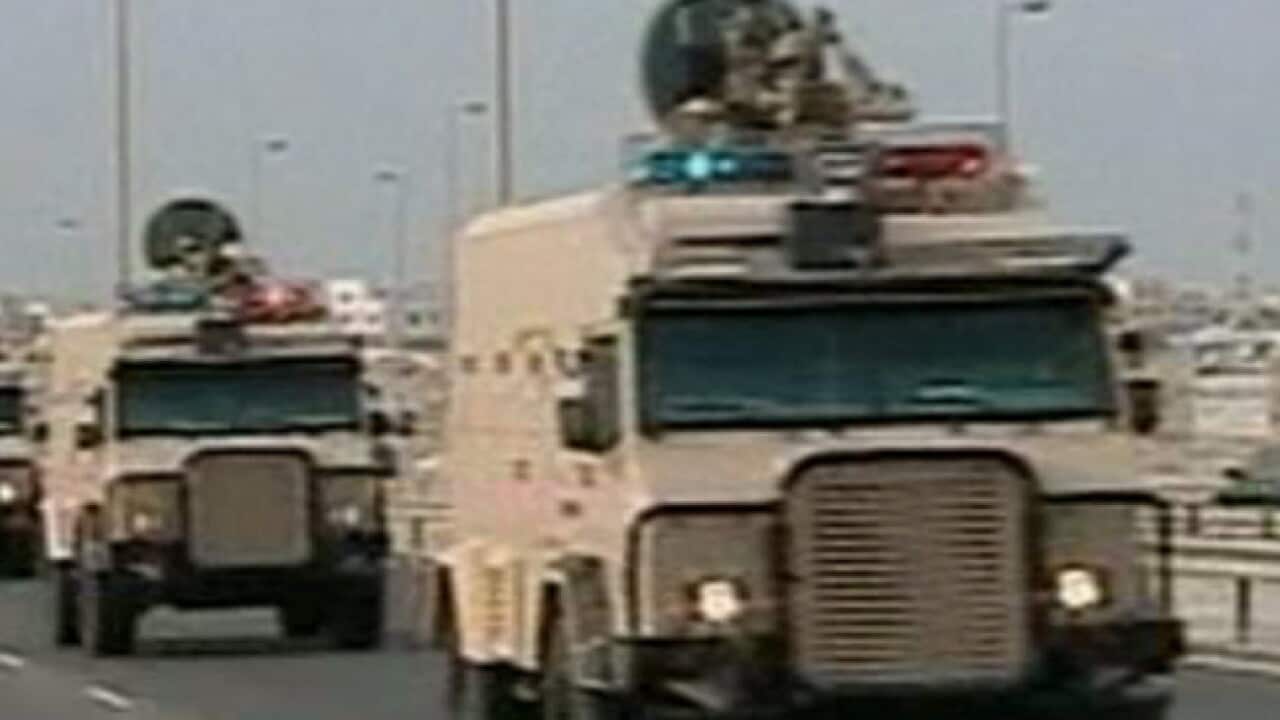
The United States warned Gulf states on Monday to respect the rights of the people of Bahrain, after troops from nations including Saudi Arabia crossed into the violence-wracked kingdom.
But Washington said the entry of foreign troops was "not an invasion" and declined to call for them to be pulled back from the strategically important country, rocked by Shiite protests against the minority Sunni government.
"We are calling on the countries in the region to show restraint," White House spokesman Jay Carney said after the Gulf Cooperation Council invoked a collective security agreement and agreed to reinforce Bahrain forces.
News that makes sense
Your trusted source for staying up-to-date with the world around you. Get free daily news updates and analysis, straight to your inbox.
US Secretary of State Hillary Clinton also called for restraint Monday by all forces in Bahrain, including Gulf Arab forces, in Paris talks with Emirati Foreign Minister Sheikh Abdullah bin Zayed al-Nahyan, a US official said.
"The secretary expressed deep concern about the dangerous situation in Bahrain," said the official, who asked to remain anonymous.
The official added Clinton was referring to all events unfolding in Bahrain, including the "increasingly provocative" acts by protesters and government supporters as well as the arrival of Gulf forces.
More than 1,000 Saudi troops have entered Bahrain, where anti-regime protests have raged for a month, a Saudi official said Monday, as demonstrators took over Manama's central business district.
The United Arab Emirates also said it had sent some 500 police to help "defuse tension," Nahayan said.
The US official said that Saudi Arabia had informed Washington of its intervention in Bahrain before it took place.
"We received word that they were planning to head into Bahrain, but not with a significant amount of lead time," the US official said.
"We came to know that...(Saudi) troops were going to cross the causeway into Bahrain before they went in," but not long before it happened, the official said, adding: "My understanding is that we knew in advance."
It was not clear if other GCC members were participating. The GCC groups Bahrain, Kuwait, Oman, Qatar, Saudi Arabia and the UAE.
The Pentagon had said earlier it had no advance warning that Saudi troops and others were being deployed to keep a lid on protests in the Gulf kingdom, even though Defense Secretary Robert Gates was in Bahrain a few days ago.
Bahrain, a tiny, oil-rich ally of the United States hosts the headquarters of the US Fifth Fleet and is adjacent to an oil-producing province in Sunni-ruled Saudi Arabia where Shiites also complain of unfair leadership.
Though Carney urged restraint, he did not accept a reporter's invitation to call for Saudi and other foreign troops to leave Bahrain.
"This is not an invasion of a country," Carney said, walking a fine diplomatic line.
The Saudi government said it had responded to a call for help from its neighbor as Saudi-led forces from the Gulf region's joint Peninsula Shield Force crossed the causeway separating the two countries.
It said that under a GCC agreement "any harm done to the security of a member state is considered a harm done to the security of all members."
The Shiite-led opposition alliance said any foreign force would be treated as an invading army.
"We consider the arrival of any soldier, or military vehicle, into Bahraini territory... an overt occupation of the kingdom of Bahrain and a conspiracy against the unarmed people of Bahrain," said an opposition statement.
In a major concession to the opposition demands, Crown Prince Salman said Sunday he supported the creation of a parliament with full powers and pledged to tackle corruption and sectarian tensions.







