Twenty-four people were killed as Syrian forces fought rebels near the Turkish border and shelled restive central provinces, while UN monitors began logistical preparations to shore up the shaky UN-backed ceasefire.
"Our fieldwork will start very soon," said Ahmed Himmiche, head of the United Nations observers mission to Syria.
Khaled al-Masri, UN spokesman in Syria, told the German news agency DPA that before the mission started work in the field, the five-member team would have to first "sign cooperation protocol with Syrian authorities because the United Nations cannot carry out its work without this agreement".
News that makes sense
Your trusted source for staying up-to-date with the world around you. Get free daily news updates and analysis, straight to your inbox.
Although al-Masri described the atmosphere as "positive" between the UN team and the Syrian authorities, a western diplomatic source in Damascus told DPA "that there are a lot of obstacles and this can delay the deployment of the rest of the observers until May."
"Some more observers will arrive in Syria in the coming 48 hours, but the larger group will be delayed due to logistical issues and also because the UN team does not have all the freedom they want to have on the ground to carry our their mission properly," a western diplomat explained in Beirut.
The opposition Local Coordination Committees, which document violence across the country, said at least 14 of those killed were in the central provinces of Homs and Hama, while more than 50 others were wounded.
Activists in Homs told DPA that the shelling on the restive neighbourhoods of Al-Khaldiyeh and Bayyada had set at least 10 buildings on fire. Activists said 40 per cent of Homs was still in the hands of the opposition rebels.
In the northern province of Idlib, fierce clashes broke out at dawn between forces loyal to President Bashar Assad and rebels, said the London-based Syrian Observatory for Human Rights.
More than 11,100 people, including civilians, rebels and soldiers, have been killed in 13 months of uprising in Syria, the monitoring group said on Monday. That included 55 since the ceasefire, brokered by UN-Arab League envoy Kofi Annan, took effect five days ago.
It is hard to verify news from Syria as the government bars most foreign media from restive areas. According to UN estimates, more than 9000 people have been killed since mid-March 2011, when the uprising against al-Assad began.
Syria's state news agency, SANA, said the government wanted the UN team to witness the "crimes" being carried out by "armed terrorist groups."
UN Secretary-General Ban Ki-moon called on both the government and opposition forces to abstain from any violence.
"This cessation of violence process is very fragile, (so) that requires full support and cooperation by all the parties concerned - Syrian authorities and opposition forces," Ban said during a visit to Brussels.
"Any small unintended gunfire may break this very fragile process," the UN chief said, urging the Syrian government to ensure the safety and freedom of movement of the team.
European Union President Herman Van Rompuy said the UN resolution would "hopefully open the way to a full-fledged UN observer mission in Syria."
"In light of the fragile ceasefire, the government of Syria needs to comply fully and immediately to Annan's plan," he added in a joint press conference with the UN chief.
VIOLENCE 'CALLS INTO QUESTION THE WISDOM' OF UN MISSION: US
Meanwhile, the United States has warned that heightened violence in Syria threatens the sending of a full UN ceasefire observer mission as it voiced fear that a ceasefire is "eroding."
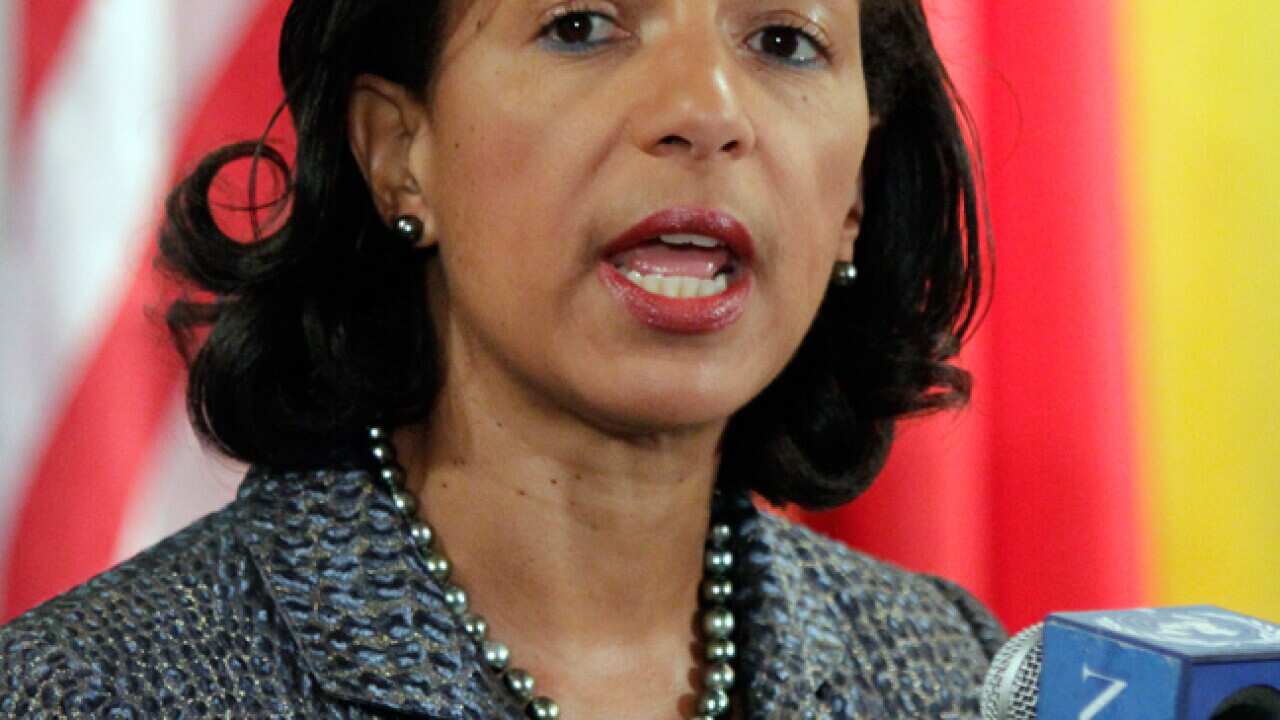
The US ambassador to the United Nations, Susan Rice, said new attacks by government forces "call into question the wisdom and viability" of sending the full 200 international monitors.
The first six unarmed UN military observers started work in Damascus on Monday. The UN Security Council has said, however, that the full force cannot go if there is a safety threat.
"We are gravely concerned ... that the violence continues, that the government seems to continue, if not in recent days intensify, bombardment in Homs in particular," Rice told reporters.
The government violence was "unacceptable" and against commitments made to UN-Arab League envoy Kofi Annan, she added.







