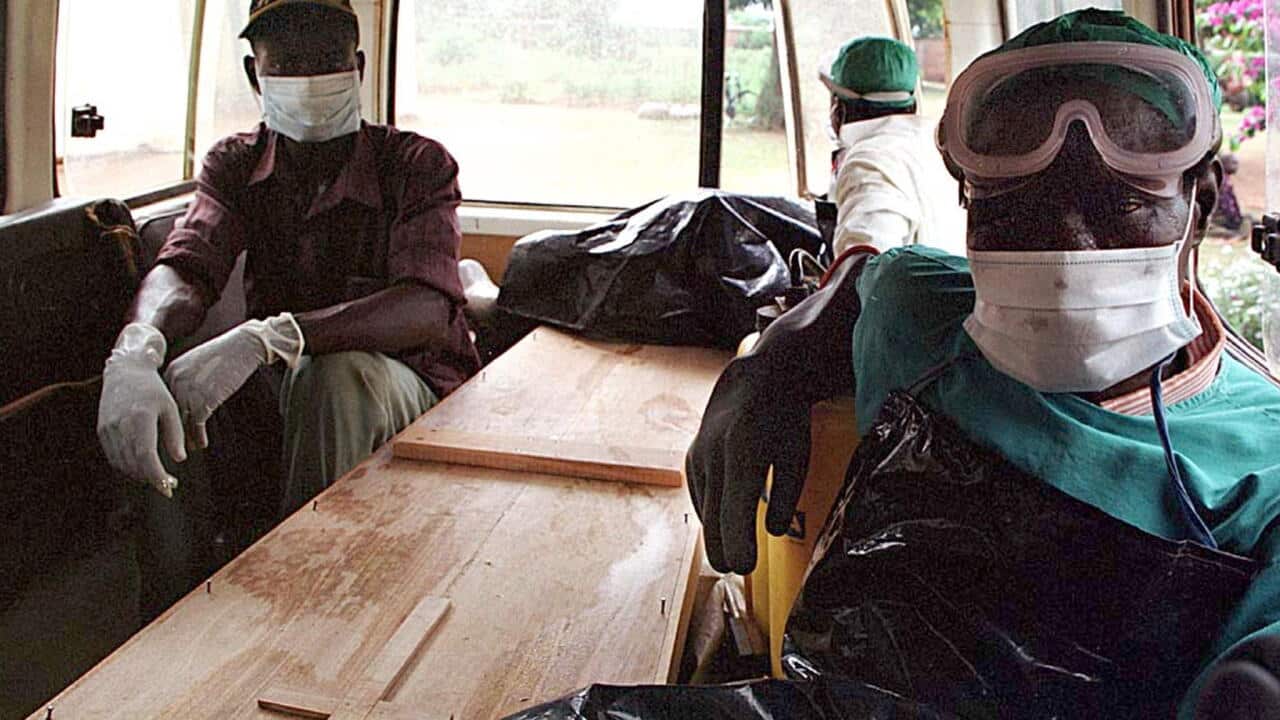
The World Health Organization has warned that Ebola could spread beyond hard-hit Guinea, Liberia and Sierra Leone to neighbouring nations, but insisted that travel bans were not the answer.
"We want other countries in west Africa to be ready," WHO Ebola specialist Pierre Formenty said on Friday.
"I'm talking about bordering countries like Ivory Coast, Mali, Senegal, Guinea-Bissau," he told reporters.
Those countries are among 11 nations due to attend WHO-brokered Ebola talks in Ghana next week.
To date, there have been 635 cases of haemorrhagic fever in Guinea, Liberia and Sierra Leone, most confirmed as Ebola.
News that makes sense
Your trusted source for staying up-to-date with the world around you. Get free daily news updates and analysis, straight to your inbox.
A total of 399 people have died, 280 of them in Guinea.
The outbreak is the first in west Africa, and the largest since Ebola first emerged in 1976 in what is now the Democratic Republic of Congo.
Formenty said highways appeared to be key to the virus's spread from a forested region between Guinea, Liberia and Sierra Leone.
But he said draconian measures on travel would not help.
"We are not recommending any travel or trade restrictions to be applied to Guinea, Liberia and Sierra Leone," he underlined.
"If we try to institute measures that are going to be seen as restrictive by the population, we are going in fact to fuel the outbreak," he said.
"We favour dialogue with the affected families, the affected villages, the affected districts, rather than trying to be a sort of sanitary police."
Last week, Formenty told AFP that a recent surge in cases was partly because efforts to contain the virus were relaxed too quickly after the outbreak appeared to lose pace in April.
Ebola causes severe fever and muscle pain, vomiting and diarrhoea - and in some cases, organ failure and unstoppable bleeding.
It is deadly in up to 90 per cent of cases, and there is no vaccine.







