
in brief
- The melons gifted to Anthony Albanese by the Japanese prime minister hold cultural significance.
- Albanese's discussion of the gift has prompted accusations of cultural faux pas and disrespect.
As Anthony Albanese's weeks-old comments about melons continue to fuel political drama, the fruit at the centre of the controversy has largely been overlooked.
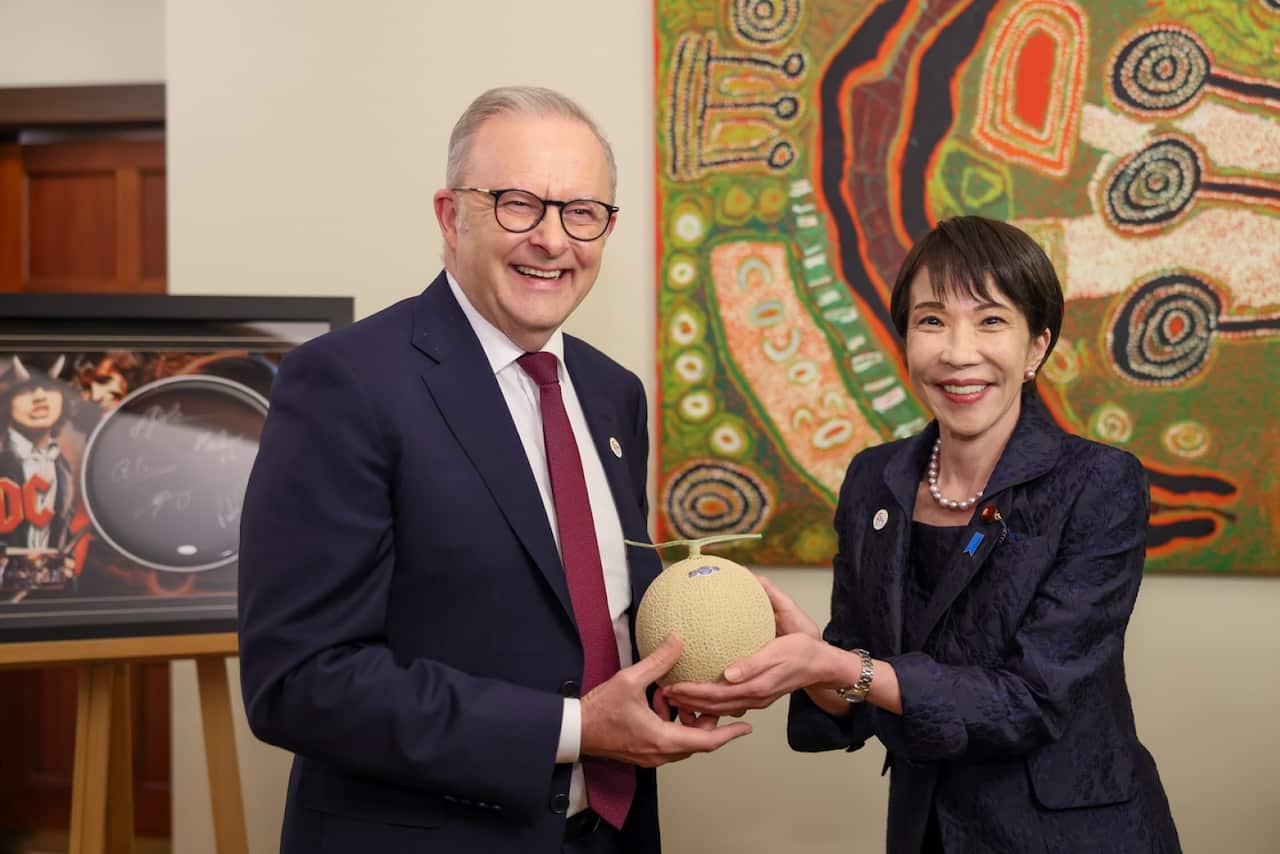
Yet the crown melons gifted to the prime minister by Japanese Prime Minister Sanae Takaichi are no ordinary fruit.
In Japan, they are among the country's most prized gifts.
During an appearance on Nikki Osborne's Deep Bush podcast last month, Albanese described the melons as a "pretty strange" gift before praising their quality.
Hand gestures he made while discussing the fruit have since drawn criticism, an interpretation his office has rejected.
News that makes sense
Your trusted source for staying up-to-date with the world around you. Get free daily news updates and analysis, straight to your inbox.
But what exactly did Takaichi's gift represent?
What are crown melons?
Both the fruit and gift-giving hold deep significance in Japanese culture.
Waka Ikeda, writing in the Japan Times, describes a crown melon as "perfection, based on the Japanese artisan spirit of takumi" — something you bring when you wish to honour someone. Her op-ed highlighting Albanese's comments on the podcast kickstarted the furore that has spilled over onto the international stage
Gwyn McClelland, senior lecturer in Japanese studies and president of the Japanese Studies Association of Australia, told SBS News that he shared the Japan Times story with his students to express how "incensed" he was by the prime minister's gesture.
His students were "also quite embarrassed", he said.
"I was just really annoyed that he didn't realise the giving of fruit could be really lovely and important," he said.
"In an Australian context, that doesn't look like an amazing gift, necessarily ... [but] I was upset that Albanese hadn't thought about gift-giving culture because it is very central in Japan.
"For me, the faux pas was really not taking the gift-giving seriously."
However, even for Japanese people, social etiquette around giving and receiving gifts is not straightforward. Eri Dennis, former officer at the Australian embassy in Tokyo and current cultural consultant at manufacturing consultancy Shinka Management, told SBS News the practice is deeply ingrained and "definitely an important part of our culture".
"Whenever we visit someone, even a family member or your friend, for some significant occasion, or if you haven't met them for some time, it's just a natural part of our culture that we bring along gifts," she said. "It doesn't have to be an expensive gift, but it's a gesture that we care about you."
Shizuoka Crown Melons are considered by some in Japan as closer to an art form than a fruit. Much like champagne, the "king of fruit" can only be produced in the Shizuoka prefecture on the south coast, grown in raised beds, hand-pollinated, and massaged to improve their look and sweetness.
Dennis notes that melons — grown throughout Japan with varieties tied to each prefecture — are associated with wealth and considered a "very expensive fruit". Typically, a valuable melon would be presented as a gift with ornate wrapping and placed in a special box.
"Japanese people, we enjoy the beauty of fleeting nature," he said, noting that gifts from nature are also tied up in aspects of Shinto Buddhist cultural understanding.
Shizuoka Crowns have a clean, highly concentrated honey-like flavour and a melt-in-your-mouth texture. Eating them is generally a communal act, shared between the family of those who have been presented with the melon, once it has been chilled in the fridge and the guest has long departed.
Dennis explains that the agricultural industry has significant sway in Japanese politics and that a gift of fruit or vegetables is also seen as a way to honour the farmers who laboured to produce it. With each region boasting particular types of produce cultivation, regional and national pride stems from the growers themselves.
Yosuke Suzuki, a senior official at Shizuoka Prefecture Greenhouse Agricultural Cooperative, which has been producing Shizuoka Crown Melons since 1921, told SBS News that their cultivation techniques have been passed down through generations.
"One of the distinctive features of our melons is a cultivation method known as "ichiboku ikka" — one fruit per plant. We grow just one melon on each plant, so all the nutrients are concentrated into that single fruit. That allows us to produce an exceptionally delicious melon," he said.
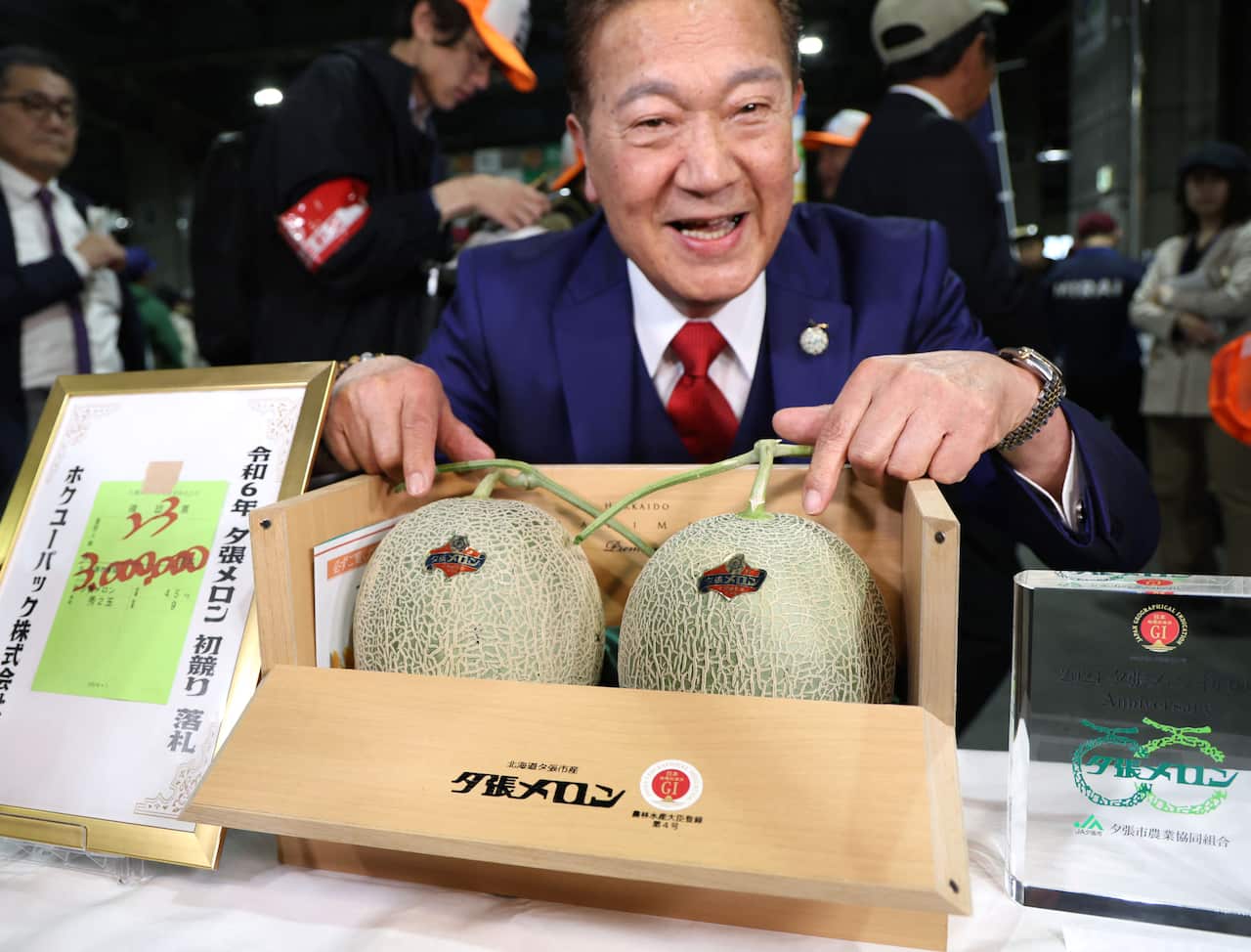
Crown melons are a type of muskmelon, which are so called because they have been bred to omit a fragrant odour that fills the room when cut. They are graded for their appearance and prized for their T-shaped stems, with the most symmetrical melons fetching eye-watering sums at auction.
In 2019, a pair of Yubari King melons grown in Hokkaido sold for ¥5 million ($44,400). More typically, top-grade melons retail for upwards of $300.
"It isn’t just about the taste. We also place great importance on their appearance. The netting pattern on the surface is beautifully and evenly distributed. That is the result of the tremendous care producers put into each melon, tending to them every single day," Suzuki added.
Takaichi brought the melons from Shizuoka for Albanese in May in celebration of the Australian import standards being relaxed to allow their sale here. Suzuki notes that his company are targeting 3,000 melons for sale on the domestic market.
High-end Japanese restaurants have already received the first batch of Shizuoka Crowns, according to Japanese media; however, SBS News could not locate any of the recipient restaurants and was told by one high-end importer that they were unaware of the rule change.
On Wednesday, the Opposition referred the issue to the Australian Federal Police, which confirmed to SBS News that it has received correspondence about confidential communications via Japanese official channels.
Dennis doesn't believe that Albanese "did anything wrong", although she can see how describing the gift as "strange" could be seen as disrespectful to some.
"Maybe the older generation might think 'how rude', but I think it's just part of cultural exchange and we move on," she said.
That said, she expects the incident has been an incredible boost to the Japanese melon industry and expects that many Australians will be eager to try the fruit that has caused such a fuss.
This story was produced in collaboration with SBS Japanese.
For the latest from SBS News, download our app and subscribe to our newsletter.







