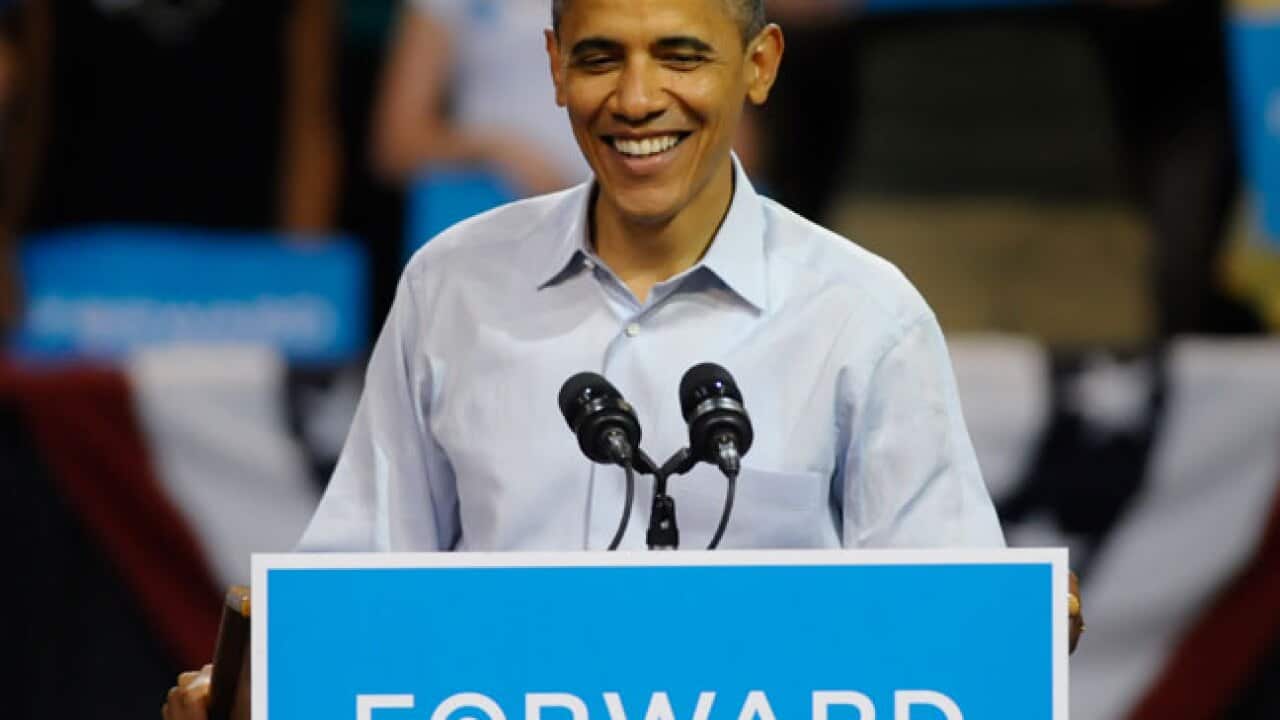
After four years in the White House and with a re-election campaign underway, how much has US President Barack Obama achieved during his first - and possibly, only - term?
US Political Analyst Tom Schaller tells SBS reporter Rhiannon Elston the US President has marked off a number of significant policy measures during his time in office.
RE: Tom, I want to ask you first up about Barack Obama's campaign slogan, which of course this year is 'Forward'. Does this indicate he's not really keen to spend a lot of time looking back at the last four years?
TS: Well, for one thing when you're running for re-election you can't run on 'Change' like you can when you're first running for election, which Obama did in 2008.
News that makes sense
Your trusted source for staying up-to-date with the world around you. Get free daily news updates and analysis, straight to your inbox.
And secondly, the President's approval ratings are mixed; slightly more people approve of his performance than disapprove, by about a margin of three, four, five per cent depending on the polls.
There are a lot of Americans that are disaffected with him and you know, the President has quite a few accomplishments, so some of the things he deemed to be an accomplishment are things that aren't particularly popular.
RE: Just on that point. Much has been made of ObamaCare, of Bin Laden's capture and death, and of the repeal of the military policy 'Don't Ask Don't Tell'. What do you think are going to be the key things that people remember when they look back at Obama's presidency?
TS: Well, the domestic front as you mentioned, the ObamaCare is the biggest single domestic initiative. Of course the stimulus bill that was passed in February 2009 to keep the economy from sinking farther into financial crisis is going to be primarily on his first-term resume, his only first-term resume if he doesn't win.
I think on the domestic front he's the first president to come out favourably for gay marriage and repealing 'Don't Ask Don't Tell' a will be signature moment in the, sort of, culture wars. There haven't been any major changes or surprises in terms of the President's support for things like abortion and contraception rights.
You know, and then on foreign policy, ending the Iraq War, I think, will be the signature moment. About 75 per cent of Americans approved of that decision in October of the year before last, and then of course the killing of Osama Bin Laden is the signature moment of the Obama security policy Presidency in the first term.
RE: What would you say have been Obama's least popular policy campaigns?
TS: Well certainly ObamaCare is not popular but there's an irony there when the pollsters ask people about a generic healthcare policy that has the following provisions, most of the provisions of ObamaCare are supported by a plurality of Americans, if not a majority of Americans.
In other words, more Americans like it than dislike it, with the exception of the individual mandate, which of course is the lynchpin to the whole thing, because it requires people who are healthy and young to get insurance, and the insurers will certainly not want to cover catastrophic, people with catastrophic illnesses or people who have gotten sick right before they try to get insurance and are now required because there's no denial the only way for access to work is for the individual mandate but the individual mandate doesn't poll well but the rest of ObamaCare polls well when not identified as ObamaCare. They do polls asking people about the provisions and they like it and then they say, do you like ObamaCare and they don't like it. There's a schizophrenia operating there with the public.
RE: Economy continues to be a big focus during this election campaign. How would you rate Obama's handling of the US economy in the past four years?
TS: Well, Presidents get unfairly blamed for bad economies and unfairly credited for good ones, but I think overall, Obama deserves high marks. I mean, the economy would have been in much worse shape and that's hard to prove as a kind of factual, and people are upset that unemployment is still at eight per cent and the job numbers aren't as great as they would like and certainly as the president would like.
But when you look at how both sides of the Atlantic responded to the financial crisis and you have people rioting in places like Madrid and Athens calling for government stimulus and fighting against austerity in Europe when European governments went for austerity and then in the United States, you had the opposite.
You have the Tea Party protesting government spending and they don't like the stimulus or ObamaCare and the other investments but look who's done better, look which economy is doing better – the United States or European economies and the answer is the US did the right thing with the stimulus and the stimulus has been a mild though not perfect success even though the president doesn't get much credit for it.
RE: One of the criticisms made of Barack Obama is that he made a lot of promises in the early days of the 2008 campaign. What has he not achieved that he said he would.
TS: I guess the biggest thing he didn't achieve is that he would take a Red America and a Blue America and unite it as a United States of America. I don't know that any president could have done that and I don't know if Obama believed it when he promised it, and of course Bush promised to be a uniter, not a divider, as well. Presidents keep talking about ending the partisan politics and the bitterness and the polarisation, but I think we are too polarised of a country to solve that.
RE: Tom Sheller, thanks so much for your time today.
TS: Great to be here. Cheers.







