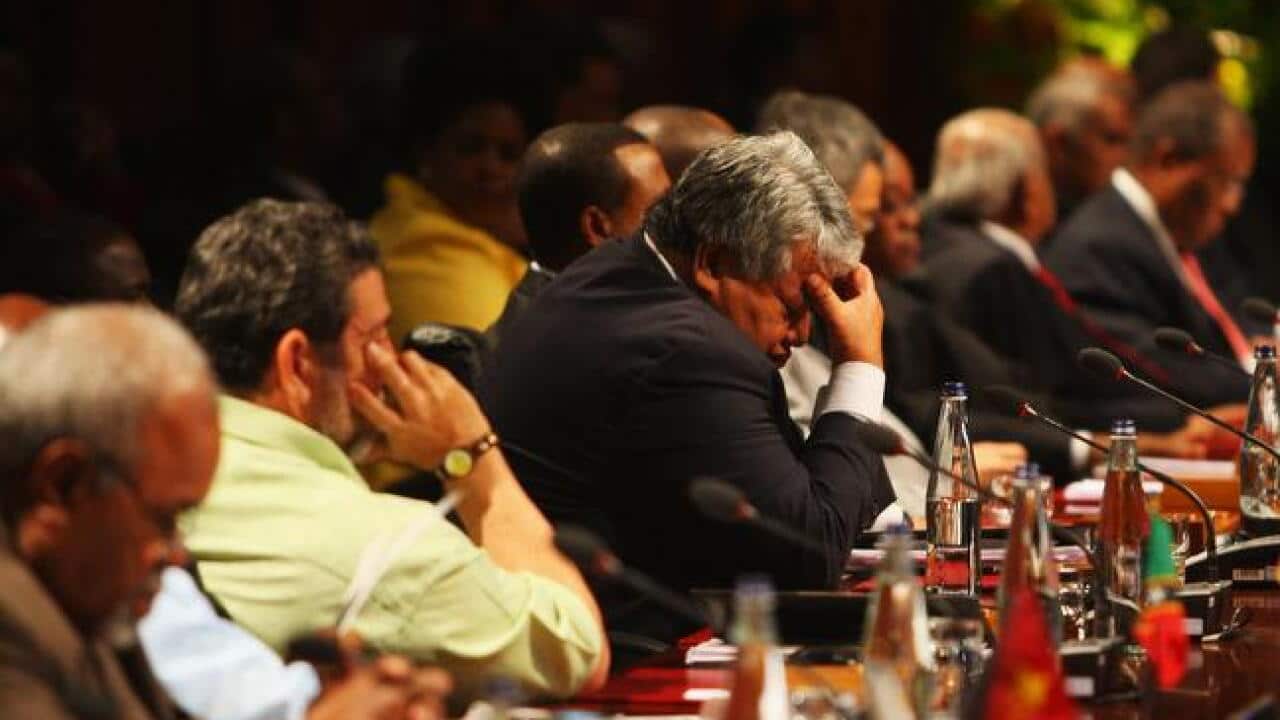
Commonwealth Heads of Government Meetings, commonly known as CHOGMs have been held since 1949.
Clare Atkinson reports.
CHOGMs set action plans to be implemented by the London-based Commonwealth Secretariat over the following two years, until the next meeting.
Sometimes there are declarations of principles - for example the Gleneagles Agreement in 1977.
Agreed unanimously, the declaration set out the Commonwealth's opposition to racial prejudice in South Africa.
News that makes sense
Your trusted source for staying up-to-date with the world around you. Get free daily news updates and analysis, straight to your inbox.
It agreed to combat what it called the the evil of apartheid by discouraging any form of sporting contact with teams or individuals from South Africa.
At heads of government meetings, statements are drafted and redrafted until there is general agreement by consensus, without any voting.
Former Australian diplomat Hugh Craft says this is what distinguishes the Commonwealth from other international organisations and groupings.
"Over a three day period they (Commonwealth leaders) will be talking seriously across the table, set topics but no set speeches, arriving at consenual agreements about international political developments, economic developmental aspects of its work and out of that will become a declaration and a communique which will unite the Commonwealth at its core, that is, with its 54 leaders."
At the previous CHOGM in Trinidad and Tobago, 53 leaders gathered under the theme of "partnering for a more equitable and sustainable future".
Much of the focus was on climate change in the lead up to the international climate change talks in Copenhagen.
During her opening address to the 2009 CHOGM, Queen Elizabeth noted the Commonwealth's desire to shape the international response to emerging global challenges.
"The Commonwealth has an opportunity to lead once more. The threat to our environment is not a new concern. But it is now a global challenge which will continue to affect the security and stability of millions for years to come. Many of those affected are among the most vulnerable and many of the people least well able to withstand the adverse affects of climate change live in the Commonwealth."
The 2009 CHOGM was even attended by non Commonwealth leaders, including the United Nations Secretary General Ban Ki-Moon, French President Nicholas Sarkozy and Danish Prime Minister Lars Rasmussen.
They held discussions with various leaders at the CHOGM on the issue of climate change, in the hope that it would contribute to an agreement in Copenhagen.
Mr Rasmussen was happy with the outcome.
"I am encouraged that leaders pledged to support the concept for the Copenhagen agreement that we have put forth. This buy in from sample leaders from more than 50 countries shows a real commitment towards reaching a substantial outcome in Copenhagen."
The Perth CHOGM has the theme "Building National Resilience, Building Global Resilience".
Prime Minister Julia Gillard has said as host, Australia will seek to strengthen the Commonwealth's effectiveness in supporting democracy, the rule of law, and good governance.
These are among the issues broadly covered in a key report commissioned by the 2009 CHOGM for consideration in Perth.
The report is meant to be a blueprint for reforms that will guarantee the Commonwealth's ongoing relevance in international affairs into the 21st Century.
It has been drawn up by a so-called Eminent Persons Group, including former Australian High Court judge Michael Kirby.
"The good thing is that it was the Commonwealth Heads of Government and State that invigorated the Eminent Perons Group who asked for it to be formed, who gave it its mandate and therefore on the face of things they are keen to find out how they can in the brief time they hold offices ahead of government and the Commonwealth, how they can make sure the Commonwealth is strengthened and goes into this new century with renewed relevance."
The Prime Minister says Australia will also use the Perth CHOGM to address the challenges of food security, sustainable development, and natural resource management.
Such issues will also be discussed in Perth in the days ahead of the CHOGM by a so-called People's Forum, which will produce a statement to send to the leaders' meeting.
Sue Ash is the Chairwoman of the Commonwealth People's Forum Steering Committee.
She says some strong themes emerged from a series of regional consultations, ahead of the Forum involving representatives of civil society organisations across the world.
"The impact of climate change particularly on small island developing states. There is a growing theme of really the movement of people, but particularly skilled people around the Commonwealth. There are issues relating to women and women's health and particularly primary health. There is a really consistent discussion around governance and human rights."
Ahead of the CHOGM, activists have also been lobbying for leaders to take specific action on some issues, rather than just make broad statements.
For example, the charity and education group, the Royal Commonwealth Society, is hoping leaders will endorse a Commonwealth-wide ban on child and forced marriages.
The Society's head of external affairs Joanna Bennett says she hopes the campaign will have the support of a number of delegations at the Perth CHOGM.
"We are working hard to build a strategic alliance of countries who will all endorse our call for leaders to recognise this issue. In particular, we are working to get the support of countries like Bangladesh, Rwanda, Trinidad and Tobago and a number of others. I think this is an issue that affects so many different Commonwealth countries that it is important we don't just go with the backing on one delegation but that we have all of those different voices behind us."
Despite the name, CHOGMs are not necessarily attended by all Heads of Government.
One notable absentee from the Perth meeting will be India's Prime Minister Manmohan Singh, whose early withdrawal was a big disappointment to organisers.
In fact, the biggest democracy in the Commonwealth has opted to be represented only by its largely ceremonial vice head of state, Vice President Hamid Ansari.
International politics lecturer at the University of Adelaide, Doctor Priya Chacko says theIndian Prime Minister may have come to the CHOGM if bilateral relations between Australia and India were better.
But she does not believe what some may see as a snub to Australia has anything to do with the refusal to approve uranium sales to India.
"If India had a closer relationship with Australia he might have made a bigger effort to come to this meeting. So I think this decision is really reflective of a generally indifferent relationship between Australia and India, rather than a single specific issue like the uranium sales."







