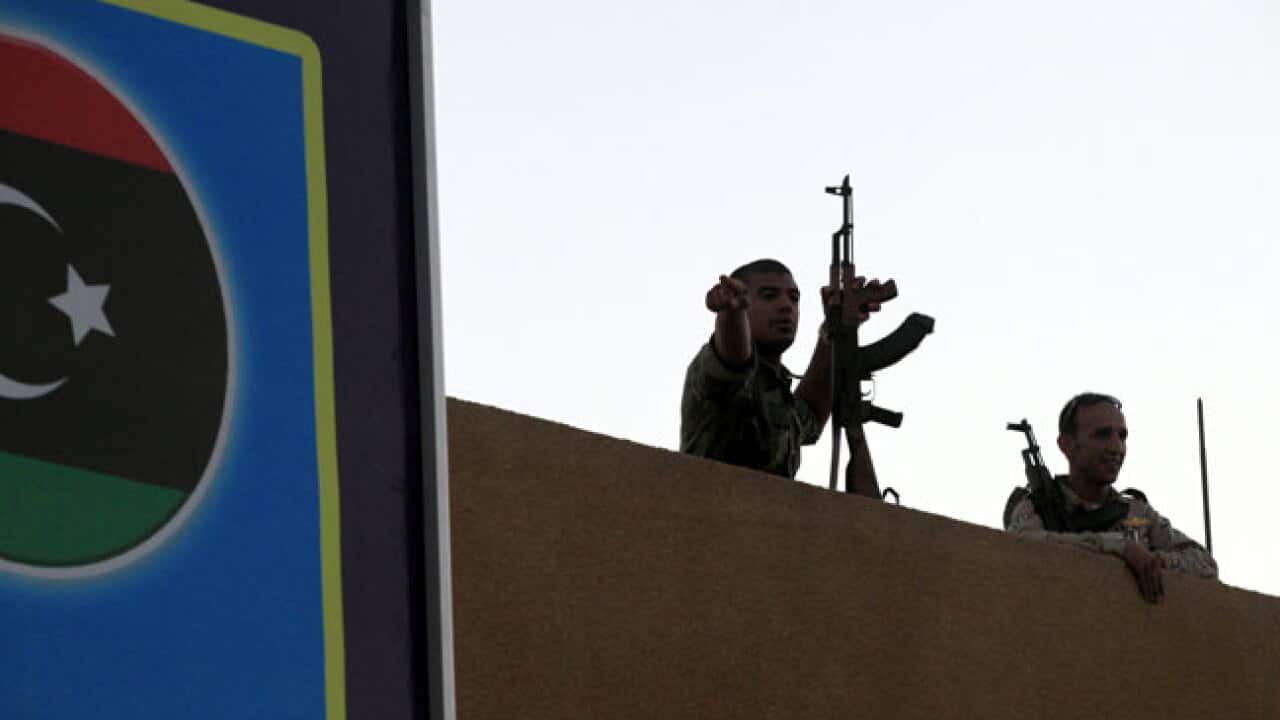
Libyan voter (by septimius severus)
By Benjamin Barthe and Helene Sallon
LE MONDE/Worldcrunch
BENGHAZI - With partial results coming in from Saturday's vote in Libya, the liberal coalition seems to be largely ahead of its Islamist rivals. In front of polling stations, Mahmoud Jibril's name is mentioned often. The former Prime Minister of the National Transitional Council clearly benefits from being well-known across the country. This is something his main rivals, notably Libyan Muslim Brotherhood leader Bashir Al-Kupti, are clearly lacking. “I voted for Jibril because I saw him on TV, he speaks well and he helped us with NATO,” said Abdallad Salam, a Benghazi resident.
Al-Kupti spent 30 years in exile in the United States, only returning to his native country in May 2011, three months after the beginning of the uprising. In November, he was named as leader of the Libyan branch of the Brotherhood, but remains largely unknown from the general public, and wasn't running for the parliamentary elections. In March, the Brotherhood founded the Justice and Construction party, opened in theory to anyone. A tactic similar to the one used by their Egyptian counterparts with the Justice and Freedom party.
News that makes sense
Your trusted source for staying up-to-date with the world around you. Get free daily news updates and analysis, straight to your inbox.
But the Brotherhood's lack of popularity is also a result of the Gaddafi regime. Under his rule, belonging to the Brotherhood was a crime. Brothers had two choices: prison or exile. Unlike Hosni Mubarak, who allowed the creation of popular associations linked to the Brotherhood that offered social assistance for the poor, Gaddafi never allowed such a network to develop. That network is what helped the Egyptian brothers to hit the ground running as soon as Mubarak was gone.
Foreign influence?
Ties to the much more powerful Egyptian Brotherhood may also have played against the Libyan counterparts. For many voters, the Libyan group is a direct branch of the Egyptian one. The fear of foreign interference may have made things worse for Al-Kupti's movement.
But after years of secrecy, just being able to run freely for parliamentary elections is already a victory, as was the National Transitional Council's announcement back in October that Islamic Sharia law would become the main reference for the country's future legislation.
“Here, we're all Muslims and Sunnis, there are no Christians like in Egypt, who could be threatened by Islam,” says Al-Kupti. “It's therefore natural to follow the Sharia. All the parties agree on that. It doesn't mean that we will lock our wives at home. For us, Sharia is democracy, freedom. There must be limits to that freedom, like anywhere in the world. In public, “haram” behavior must be banned. But behind closed doors, it's another story.”
Despite their newfound freedom, the Libyan Brothers are cautious about their goals. For Mohamed Souwan, a party leader, the idea is to bring the Libyan youth back on track and to protect it from Salafism and Al-Qaeda in the Islamic Maghreb. “Gaddafi closed all the windows of knowledge, which allowed Saudi concepts of Islam to gain ground. All the young rebels with a gun and no job are easy targets for these movements. If we talk to them we can bring peace.”
Read more from Le Monde in French
Photo by spetimius severus







