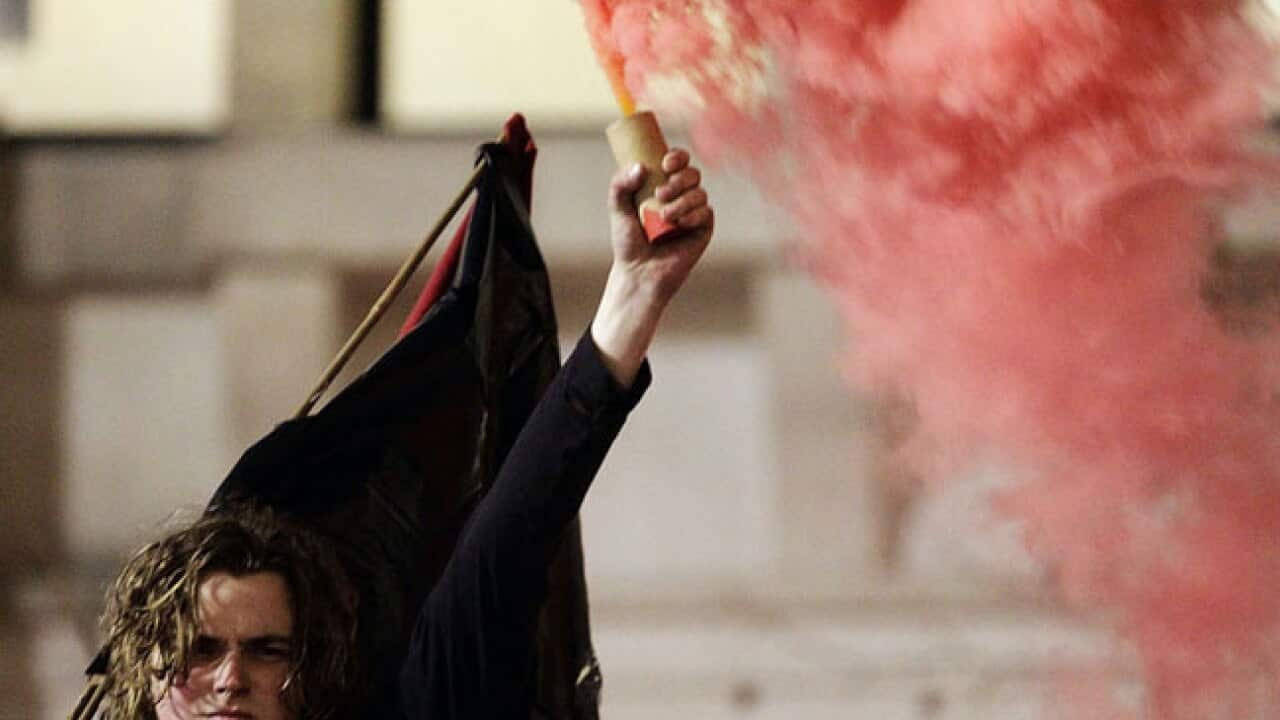
AMÉRICA ECONOMÍA's Rodrigo Lara Serrano compares recent global protest movements like Occupy with the lead-up to the revolutions of the 1840s.
I have a friend who composes elegant and catchy techno pop songs. His band plays in small venues here in Buenos Aires, where he has some fans – but not too many.
He has a day job in telemarketing, for which he proudly speaks English with a “mid-Atlantic” accent. His salary allows him a modest pizza-and-Chinese-food lifestyle.
To save money he commutes on a used bicycle – he had a new one, but it was stolen. He's affable, polite, an avid reader and, generally speaking, quite content with his life.
News that makes sense
Your trusted source for staying up-to-date with the world around you. Get free daily news updates and analysis, straight to your inbox.
But about a year ago I noted a change in our conversations. New words began popping up, like Bilderberg, zeitgeist, indigenous lands, and occupy.
He began talking about how the governments of the United States and Europe – and maybe even China too – are part of a secret global brotherhood that, lacking any real sense of democracy, abscond with the savings of other countries and force average citizens to pay for the luxuries of a tiny class of mega-millionaires.
These same governments use their military might to seize the world's mineral resources, and poison the middle classes with industrial foods designed to cause harm, all the while ruining the seas and forests.
There's something very 21st century about all this talk. At least it seems that way. In reality, however, we've seen this kind of thing before – during the tumultuous years between 1846 and 1848.
We have a habit of looking at the past for reflections of the present.
Many people look at the upheaval, protests and revolutions of 2011-2012 and are reminded of the fall of the Soviet bloc two decades ago, or of the 1968 student movements in Western Europe and the United States.
Some even see similarities with 1914, when world war was eminent due to shifts in the balance of Europe's colonial powers.
But there's another parallel that may actually be more useful for understanding the present: the years just before the revolutionary wave of 1848.
From South America to Eastern Europe...
With the notable exception of France, all of those popular uprisings – from Pernambuco, Brazil to Transylvania – failed, often in a matter of weeks or even days.
But the context in which they occurred was not unlike the paradoxical times in which we are living today.
In terms of urban technology, industrial power and communications, the world had never seen such formidable advances.
For the first time, capitalism was showing off the muscularity of its true power.
But like today, there had also never been so many educated people who felt bereft of their due rights and tricked by the false promises of kings and emperors.
Thanks to the rise of a brand-new mass media, the scandalous breach in wealth between the poorest and richest was suddenly more public than it had ever been. And like in our own times, old certainties and loyalties were dissolving.
New ideas were emerging in place of those certainties, and the people that espoused them – the “radicals” – were feared and demonized, regardless of how utopian or reasonable their proposals were.
The rabble-rousers thought the kings and emperors were using free-market industrialism to subdue the people.
That wasn't the case, although there was no shortage of chains in those days: in the United States alone, there were 3.2 million slaves in 1850.
We too will be judged in retrospect for some of our absurd ideas: the ridiculous quantities of money the United States and China spend on armaments, the huge financial bailouts being offered for nothing in exchange and the fact that basic food stuffs are treated as commodities for market speculation.
People will question too why we didn't invest heavily in clean energy technology, or why we wouldn't come up with a rational, worldwide plan to eradicate hunger.
Conspiracy theorists can be forgiven for trying to make sense of it all. But what they fail to grasp is that there may just not be a real rhyme or reason to how this crazy world operates.








