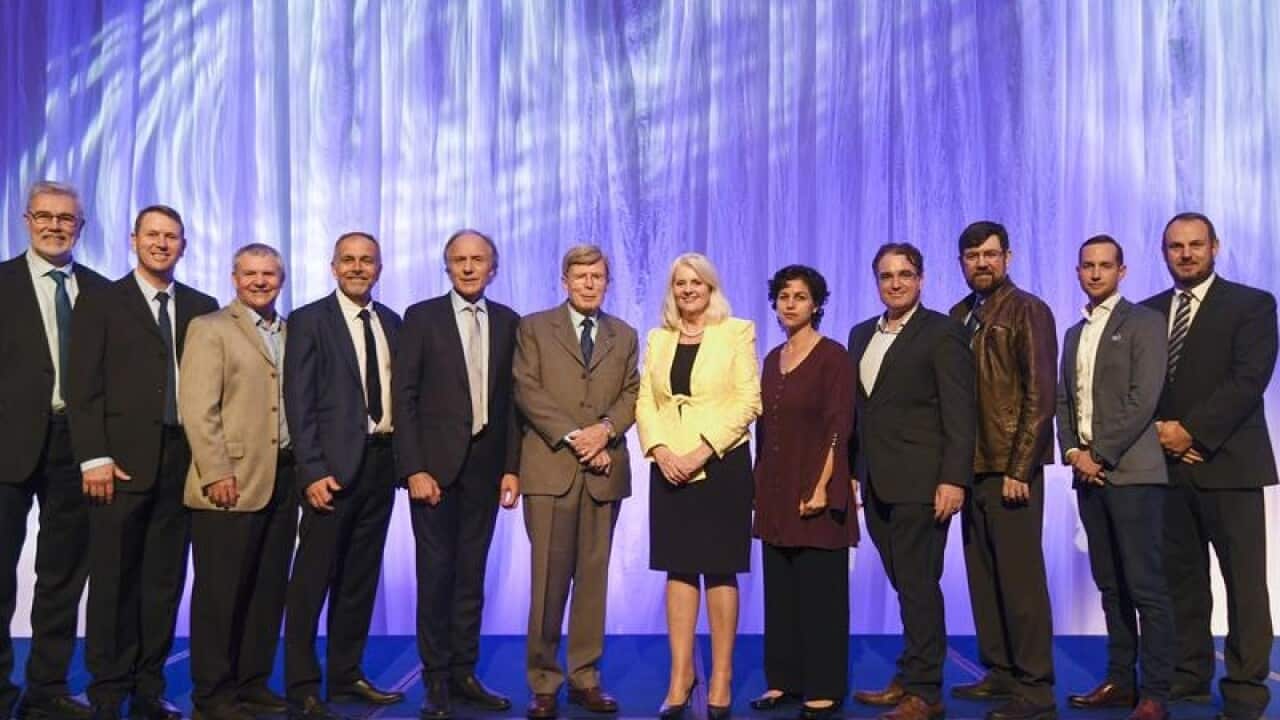
THE PRIME MINISTER'S PRIZES FOR SCIENCE
WINNER OF THE TOP GONG
With a career spanning six decades, emeritus ANU professor Kurt Lambeck has helped uncover how changing sea levels and shifting continents alter the planet. His early surveying work in the 1960s helped build today's GPS-based systems and smartphone navigation tools. He's now studying historic changes in sea levels alongside archaeologists in Europe.
FOR INNOVATION
The Finisar team - Dr Simon Poole, Andrew Bartos, Dr Glenn Baxter and Dr Steven Frisken - developed technology to make internet connections faster and more efficient. Half of the world's internet traffic now goes through their devices, which use light-bending switches. Each switch can handle one million high-definition videos being streamed simultaneously.
News that makes sense
Your trusted source for staying up-to-date with the world around you. Get free daily news updates and analysis, straight to your inbox.
FRANK FENNER PRIZE FOR LIFE SCIENTIST OF THE YEAR
Dr Lee Berger discovered that a fungus growing on the skin of sick frogs had caused mass extinctions of frog species globally. Her work ensures quarantine protocols recognise the threat of disease to biodiversity.
MALCOLM MCINTOSH PRIZE FOR PHYSICAL SCIENTIST OF THE YEAR
Associate professor Jack Clegg has designed flexible crystals which can be tied in knots, with the aim of solving smashed smartphone screens, which currently use brittle crystal semiconductors.
PRIZE FOR NEW INNOVATORS
For his undergraduate engineering project and PhD, Dr Geoff Rogers created a robotic guidewire - two human hairs in diameter - for cardiologists to use during heart surgery. It's controlled by a joystick, allowing it to pass through the twists and turns of human arteries.
FOR EXCELLENCE IN SCIENCE TEACHING IN PRIMARY SCHOOLS
Brisbane-based teacher Brett Crawford mentored his colleagues to help them overcome anxieties about teaching science. Now all the schools' teachers - more than 50 - actively teach science in their classes and the school's results in the field are well above the national average.
FOR EXCELLENCE IN SCIENCE TEACHING IN SECONDARY SCHOOLS
Dr Scott Sleap created the Cessnock Academy of STEM Excellence, partnering local industry with Cessnock High School and primary schools to connect workers with students. For instance, Boeing engineers are mentoring a team of Aboriginal girls to make and race model F1 cars.







