in brief
- The NYFL argues the resources industry generates billions in a region where many Aboriginal people are disadvantaged.
- Woodside says the partnership has delivered "significant benefits" and is seeking to build on them.
Woodside is at a stalemate with a Traditional Owners organisation that is seeking hundreds of millions of dollars more in compensation from the Australian energy giant.
It's understood negotiations between the nation's largest gas producer and the Ngarluma Yinjibrandi Foundation Limited (NYFL) over an agreement that compensates the Indigenous organisation for use of its land in Western Australia's resource-rich Pilbara region have stalled.
Sources close to the negotiations have told SBS News that Woodside offered the NYFL $87 million over 12 years in May, $303 million short of the $390 million package the organisation sought last November. Neither party commented on the figures when approached by SBS News.
The negotiations aim to update an agreement drawn up in 1998 between the two parties, in which NYFL receives funding for community programs, but no royalties from resources.
The NYFL wants the agreement to be "fit for purpose", arguing the resources industry has made billions of dollars from the region while many Aboriginal people who live there are "worse off than before the expansion of the mining, oil and gas industries".
News that makes sense
Your trusted source for staying up-to-date with the world around you. Get free daily news updates and analysis, straight to your inbox.
Woodside says it is "proud of the positive relationship" it has built with the NYFL and has delivered "significant benefits" to it.
Neither Woodside nor the NYFL commented on the status of the negotiations. The energy giant said it "looking forward to continuing" its "positive relationship" with the Traditional Owners organisation, which said it remained "committed to engaging in good faith".
Woodside administers the North West Shelf gas facility on behalf of a joint venture of energy companies. The project encompasses the onshore Karratha Gas Plant, which was built on the Burrup Peninsula in the late 1970s and early 1980s.
It is now one of Australia's major energy projects.
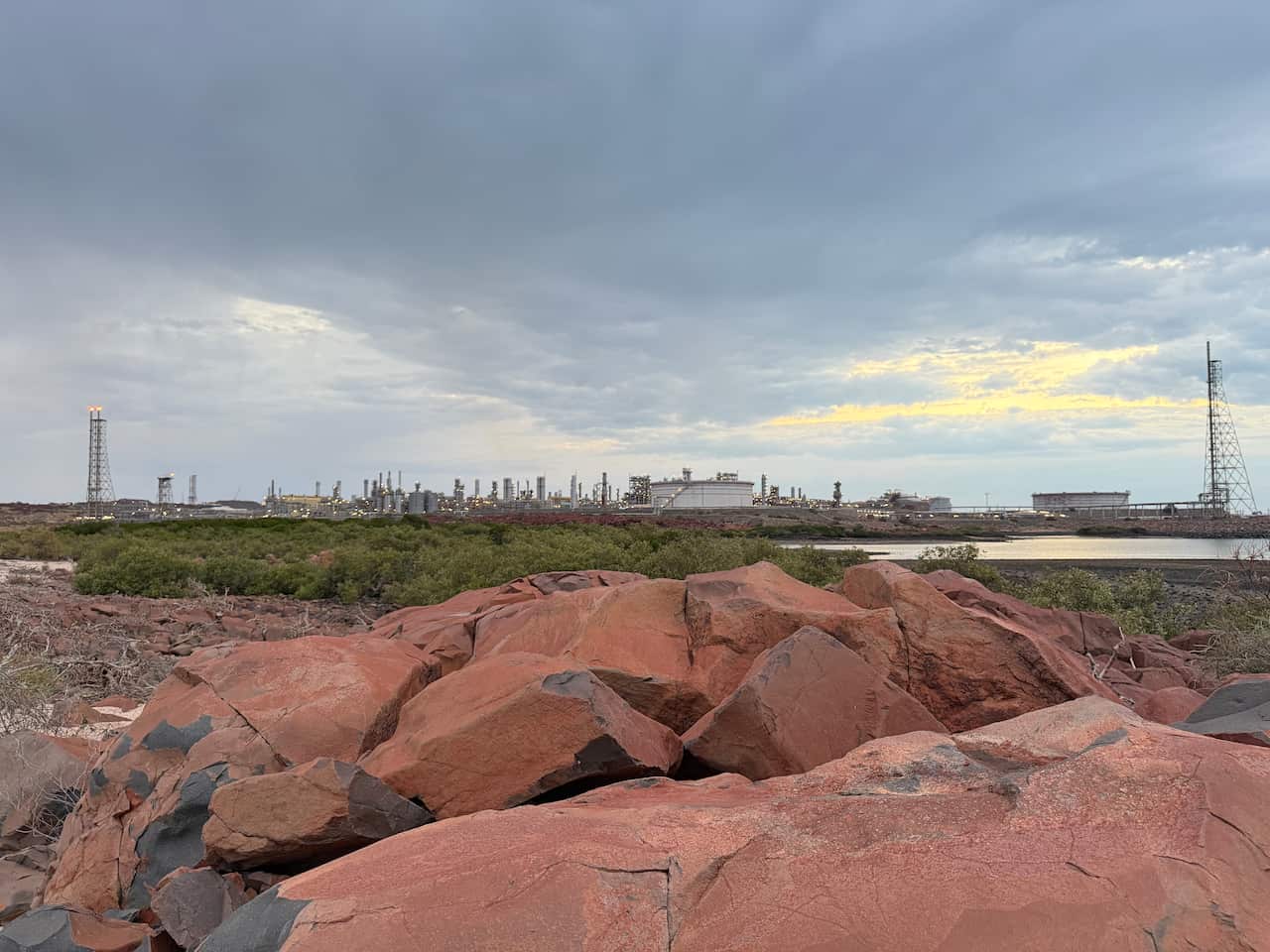
The peninsula is culturally and spiritually significant to First Nations peoples and is part of Murujuga, which holds the densest known concentration of petroglyphs, or rock carvings, in the world. The Murujuga Cultural Landscape was World Heritage-listed in 2025.
The NYFL represents the Ngarluma and Yindjibarndi peoples, who are among the recognised Traditional Owners of the area where the expansive onshore gas plant operates.
Native title, which recognises Indigenous connections to land, does not exist over the Burrup Peninsula. In 2003, the WA Government reached the Burrup Agreement with three Aboriginal claimant groups, including the Ngarluma and Yindjibarndi, providing for land, conservation, cultural, employment and other benefits.
The 1998 agreement
Ngarluma and Yindjibarndi representatives and elders signed a Land Access Agreement in 1998 with the North West Shelf joint venture, operated by Woodside, covering the project's use of their traditional lands, including the site of the Karratha Gas Plant.
The agreement, seen by SBS News, was signed 14 years after the project began operating, by which time sacred sites had been cleared to build its onshore gas plant. It provides for "payments relating to native title and grants of interests in land" and "donations relating to goodwill".
The Ngarluma and Yindjibarndi groups received one-off establishment payments of $500,000, in part used to set up the NYFL and $2.5 million for the Roebourne Cultural Centre.
The deal also included annual goodwill payments of $1.25 million partially indexed to inflation, and other economic and cultural commitments.
It's understood the payments have increased, but the extent remains unclear. Both the NYFL and Woodside did not comment on this, with the NYFL citing contractual confidentiality.
Woodside reported operating revenue of about $10.4 billion for the first half of 2026. The Pilbara more widely generates more than $125 billion in economic output a year, according to economic analysis platform REMPLAN, and supports close to 60,000 jobs.
The exchange between the NYFL and Woodside, along with estimates of revenue and expenditures seen by SBS News, may not be a full account of interactions between the parties nor indicative of the final offer.
Negotiations to update the agreement
In November 2025, the NYFL sought to modernise its 1998 agreement with Woodside.
The NYFL requested a one-off payment of $30 million and annual compensation of $30 million.
Over 12 years, this request to Woodside would amount to $390 million.
In May this year, Woodside responded. The gas giant offered the NYFL an additional $39 million to the original agreement (including $15 million in housing assets), totalling $87 million to NYFL over 12 years.
That leaves a $300 million gap between the NYFL's initial request in November and Woodside's counteroffer six months later.
A NYFL spokesperson did not comment on the figures, saying the negotiations were confidential. But, they said, "agreements must be fair, equitable and outcomes focussed".
"Ngurrara-ngarli (Traditional Owners) across the Pilbara are increasingly seeking to modernise longstanding Land Access and compensation agreements to ensure that they are fit for purpose, are built around self-determination and reflect contemporary First Nations principles," the spokesperson said in a statement.
Unlike some other Traditional Owner groups in the Pilbara, the NYFL does not receive royalties from the project it deals with — the 1998 agreement contained no provision for them.
In addition to one-off payments for housing and infrastructure refurbishments, the NYFL sought $30 million annually to support its membership and the remote town of Roebourne, including operating its not-for-profit community supermarket, job creation and self-sufficiency.
Roebourne, 39km east of Karratha, is one of Australia's most disadvantaged areas, according to cumulative data from the Ieramugadu Data Unit, government statistics and the Census.
An estimated 87 per cent of Indigenous people in the town reported a weekly income below the national median of $805.
According to the 2021 Census, almost one in five Aboriginal households in Roebourne were living in overcrowded homes (those needing at least one more bedroom), nearly double the rate across Western Australia.
"For decades, the resources industry has generated billions of dollars from the Pilbara," the NYFL spokesperson said. "At the same time, independent research shows persistent economic disadvantage across the region, including findings that around two-thirds of Aboriginal people in the Pilbara are economically worse off than before the expansion of the mining, oil and gas industries."
A Woodside spokesperson said a modernised agreement between the two parties would "build on the significant benefits already delivered".
"It intends to further promote sustainable outcomes for the Roebourne community in areas such as economic participation, capacity building, safer and healthier communities and cultural heritage," the spokesperson said,
"We look forward to continuing our positive relationship with NYFL to support the continued delivery of positive outcomes for NYFL members and the Roebourne community."
Compensation claims on the rise
Native title is not applicable in the case of Woodside and the NYFL, but their negotiations come against the backdrop of court rulings in favour of Traditional Owners organisations over loss of native title cultural heritage.
The Federal Court ordered the NT Government to pay over $54.7 million to the Gudanji, Yanyuwa, and Yanyuwa-Marra peoples in February for cultural and spiritual loss regarding the McArthur River Mine.
Separately, the Federal Court awarded Yindjibarndi people $150.3 million against Fortescue in July for unauthorised mining at its Solomon Hub operation, about 240km south-east of Karratha.
While Fortescue paid the funds, the decision is being appealed by Yindjibarndi Traditional Owners, who had initially sought $1.8 billion from the court.
"There are several active compensation claims still waiting in the system that'll take a while to come through, but I would suspect there'd be a great deal more after that," said Ed Wensing, a lecturer at the University of NSW and an expert in native title rights and Indigenous human rights.
He said the recent decisions could influence how future native title compensation claims are negotiated and litigated.
"The compensation era arising from the Native Title system, it's only just begun."
For the latest from SBS News, download our app and subscribe to our newsletter.







